
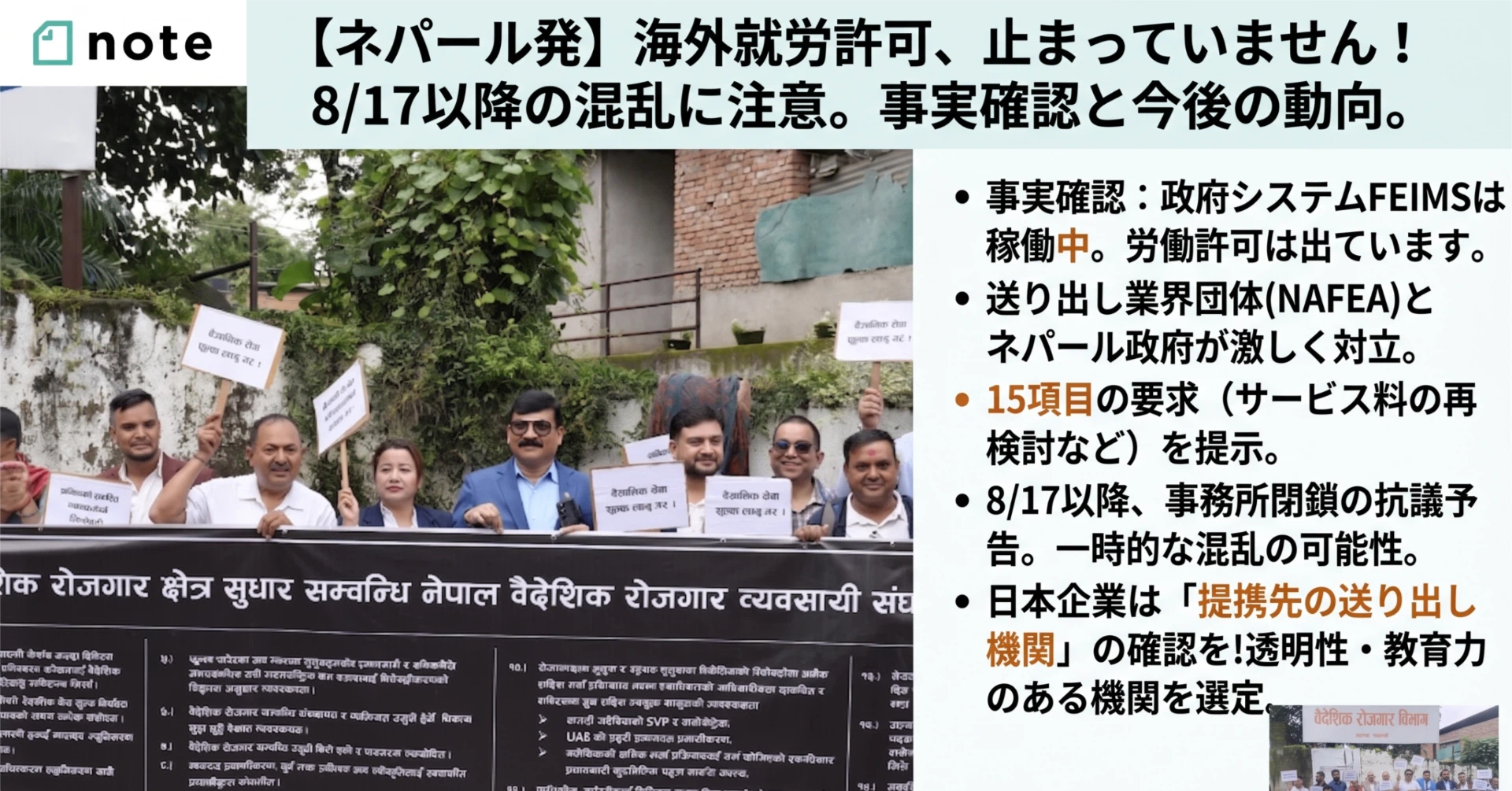
"It seems that overseas work permits for Nepal have been suspended."
Since yesterday, we have been receiving a steady stream of confirmation messages from the Japanese receiving companies and supervising organizations.
To get straight to the point, as of August 11, 2026, overseas work permits are not being issued. On August 10 alone, 104 pre-approvals were issued, and final work permits for 430 people were issued through sending organizations.
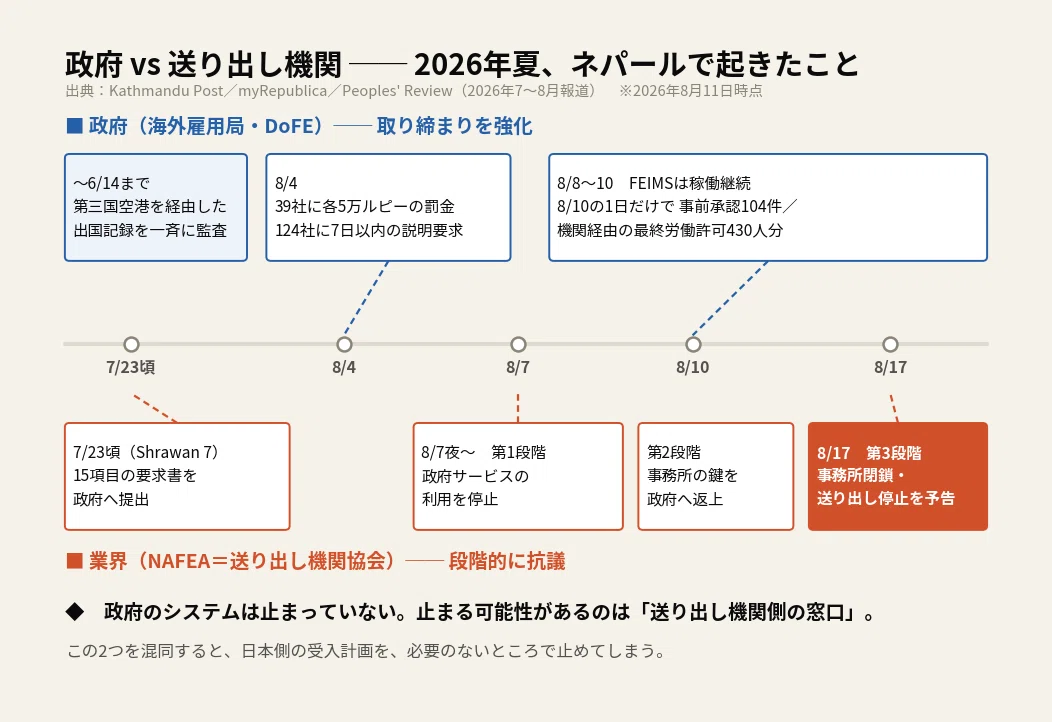
It's not the government that might cause a halt; it's the contact point on the sending organization's side .
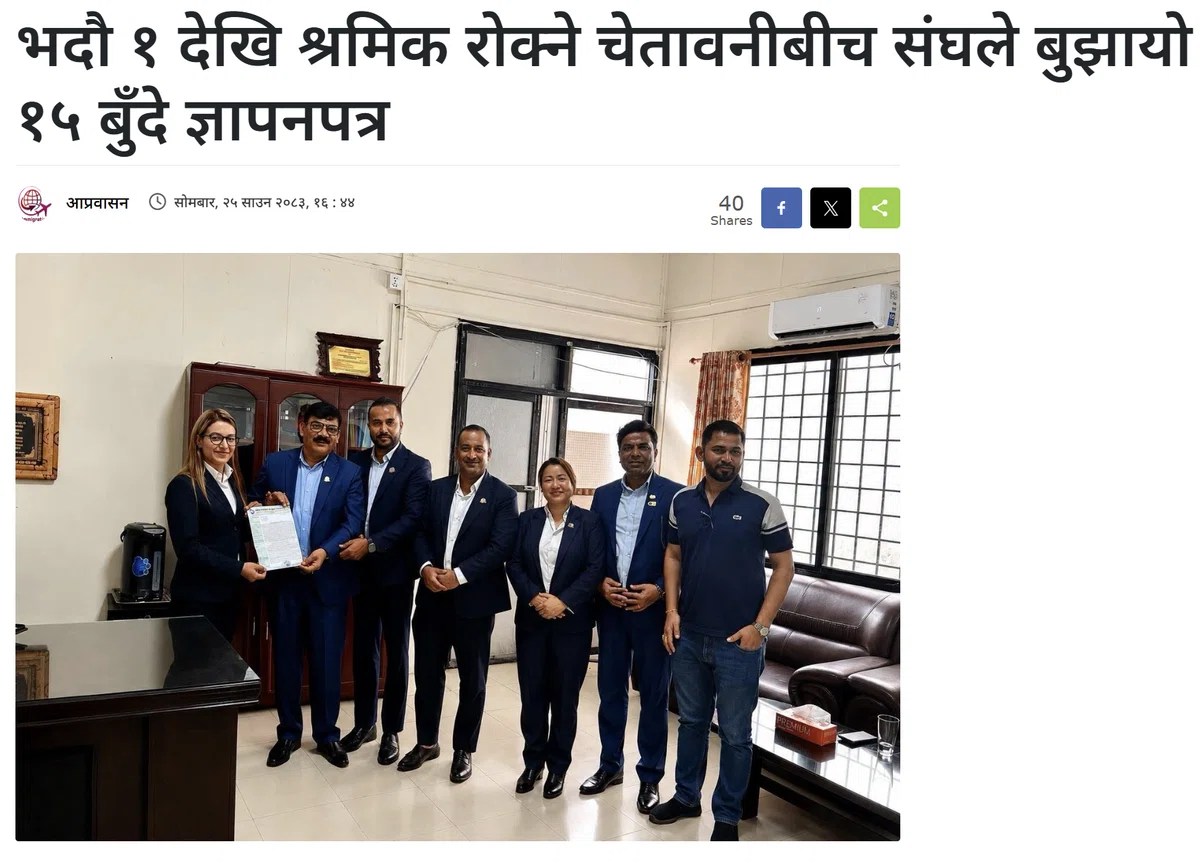
Let's start with verifying the facts. The government's system is functioning.
When Nepalese people go abroad for work, they obtain a work permit from the Department of Foreign Employment [ वैदेशिक रोजगार विभाग ]. Locally, this is called Shram Suikriti .
If you go through a sending organization, information about the job posting, employment contract, organization, and worker will be registered in the government system FEIMS, and final approval will be issued after prior approval.
FEIMS is still active. Online applications and pre-approvals are being issued.
In other words, the situation is not one in which "the Nepalese government has completely stopped overseas employment, including for those going to Japan." If this is misunderstood, Japan will halt its recruitment plans unnecessarily.
So why is this causing such a huge uproar?
What's happening? — The events of the past three weeks
One of the triggers for this was the administrative sanctions imposed on sending organizations that used airports outside of Nepal to send workers out of the country .
Article 22 of the Foreign Employment Act requires that, in principle, passengers depart from airports within Nepal. Government permission is required for alternative routes. However, in practice, due to factors such as difficulty securing seats or high fares, there have been cases where passengers have transited through airports in India or other countries.
The government has been thoroughly investigating this practice since the beginning of this year. They have been reviewing the exit records of permits issued between March and June, and on August 4 , they issued fines of 50,000 Nepalese rupees each to 39 companies and demanded that 124 companies provide explanations within seven days .
There's something I'd like you to pay attention to here.
The number of organizations subject to penalties and investigations varies widely depending on the media report, ranging from 598 to 771 companies. Furthermore, not all companies had their licenses revoked. The penalties varied, ranging from warnings and requests for explanations to fines. I have seen information conveyed to the Japanese side several times stating that "598 companies were shut down." That is inaccurate.
On the other hand, the sending industry has strongly protested, saying, "It's unfair to uniformly punish everyone for handling situations that occurred under special circumstances," and "They're making the agencies out to be the bad guys without even checking what's happening on the ground."
15 demands and a notice for August 17th
The NAFEA, an industry association of sending organizations, submitted a 15-point list of demands to the government around July 23rd (Shrawan 7 in the Nepalese calendar). Here's what it said:
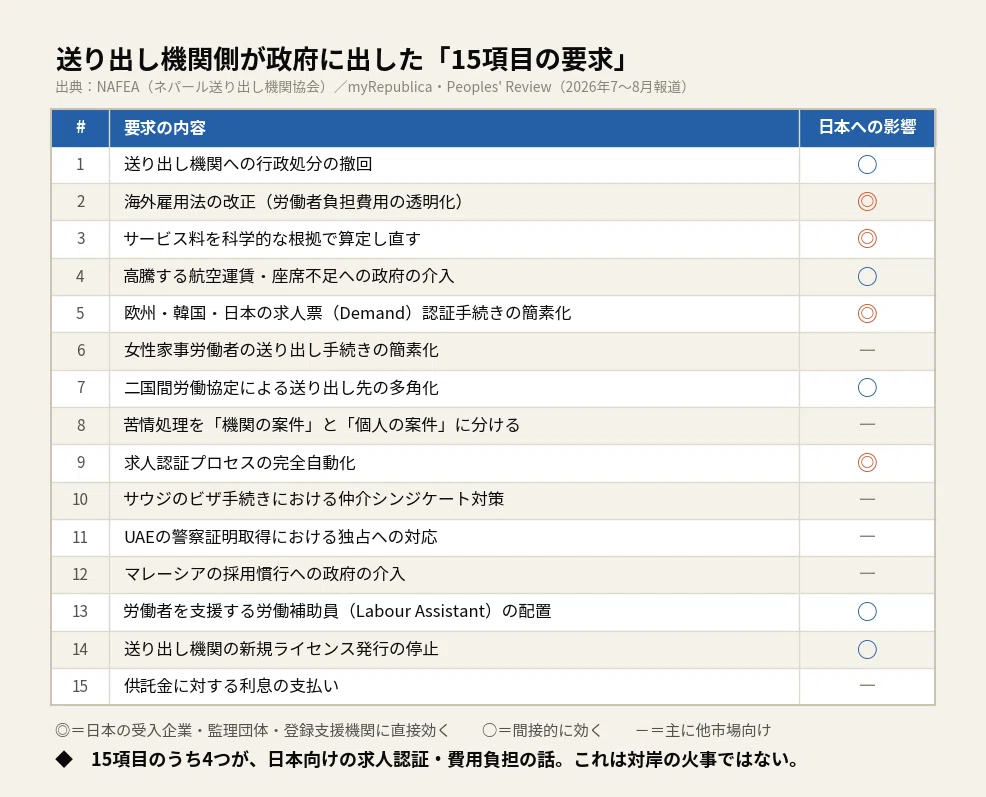
What I consider particularly important is "the service charge."
For many years, Nepal has followed a policy based on the idea of "Free Visa, Free Ticket," which has kept the service fees that organizations can receive from workers extremely low for travel to the Gulf countries and Malaysia.
In response, the organization has consistently argued that "it is impossible to operate at the current rates if you include recruitment, office space, personnel costs, advertising, hiring, document preparation, training, and management." The government is also aware of the problem and has established a committee to review the rates.
In other words, this conflict didn't start out of nowhere. It's simply that the gap between the system and the reality on the ground, which has been building up for over 10 years, has suddenly come to the surface.
Industry groups then began a phased protest campaign on the evening of August 7th.
Phase 1: Do not use government services.
Phase 2: Return the office keys to the government.
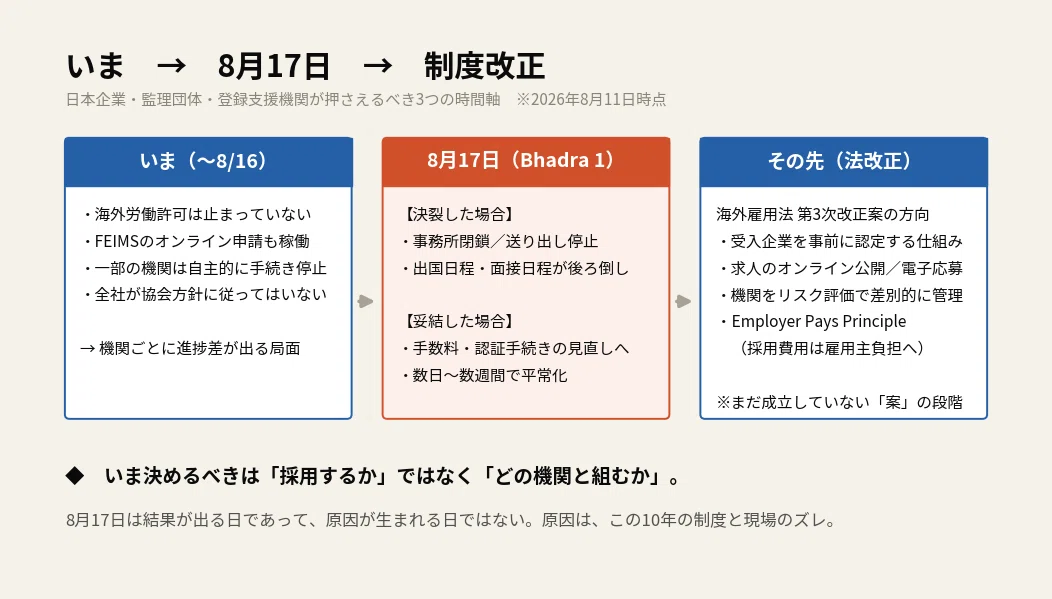
Phase 3: Starting August 17th (Bhadra 1, 2083 in the Nepalese calendar), the office will be closed and sending out workers will cease.
Reading only this, it might seem like "Nepalese people will no longer be able to travel abroad from August 17th." But the situation is a bit more complicated.
Work permits are being issued even amidst the protests. Moreover, not all sending organizations are following the industry association's decisions. The industry association has even indicated that it may revoke the status of member companies that use government services contrary to its policy.
Therefore, the most accurate expression at this point is this:
💡 It's not that "shipments have stopped." "There's a fierce conflict between the industry and the government, and there's a possibility they might stop in the future."
Phase 1: Do not use government services.
Phase 2: Return the office keys to the government.
Phase 3: Starting August 17th (Bhadra 1, 2083 in the Nepalese calendar), the office will be closed and sending out workers will cease.
Reading only this, it might seem like "Nepalese people will no longer be able to travel abroad from August 17th." But the situation is a bit more complicated.
Work permits are being issued even amidst the protests. Moreover, not all sending organizations are following the industry association's decisions. The industry association has even indicated that it may revoke the status of member companies that use government services contrary to its policy.
Therefore, the most accurate expression at this point is this:
💡 It's not that "shipments have stopped." "There's a fierce conflict between the industry and the government, and there's a possibility they might stop in the future."
The biggest impact on Japanese companies is actually that they will no longer be able to recruit on a first-come, first-served basis.
Amidst all the protest news, there's another change that I'm paying more attention to.
In August, the Overseas Employment Bureau reiterated its request to sending organizations to strictly enforce worker selection rules.
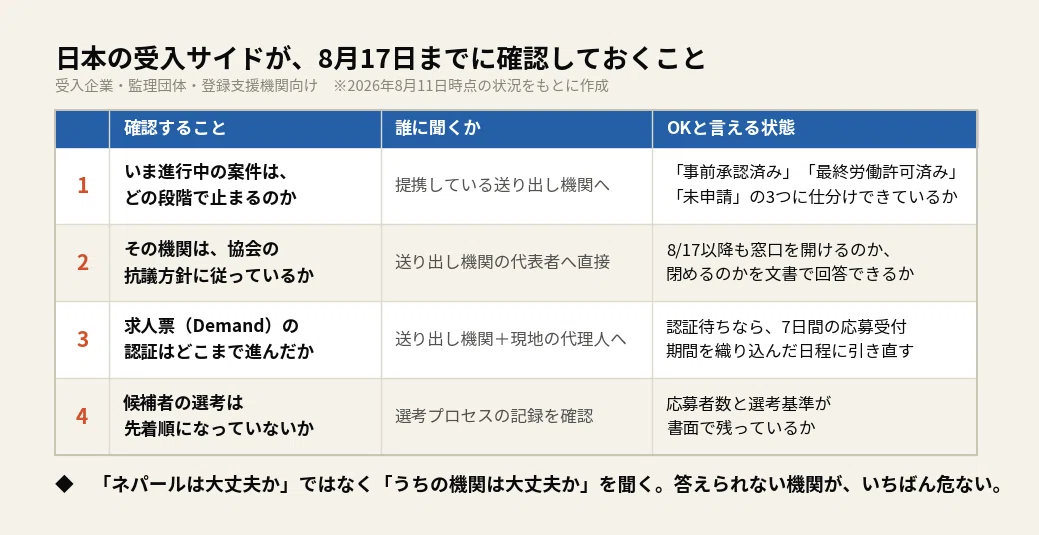
Once you post a job advertisement, you must accept applications for at least seven days. You cannot turn away applications during that period by saying, "We've already filled the positions."
All applicants who apply within the specified period will be initially accepted, then a selection process will be conducted, and the names of those selected will be posted on the organization's website. That's the gist of it.
This is quite effective in practical situations.
Previously, if we received enough candidates early on for a "30-person job opening," we would close the recruitment process at that point. Going forward, the entire process—recruitment → application acceptance → comparison → selection—must be transparent.
I don't think this direction itself is bad.
For Japanese companies, selecting 30 suitable candidates from 100 applicants is far more effective than sending 30 people who applied early, as it will undoubtedly improve the quality of the workforce.
However, the schedule will be pushed back. For projects where the interview date is already fixed, it will be necessary to reschedule at this point.
Amidst all the protest news, there's another change that I'm paying more attention to.
In August, the Overseas Employment Bureau reiterated its request to sending organizations to strictly enforce worker selection rules.
Once you post a job advertisement, you must accept applications for at least seven days. You cannot turn away applications during that period by saying, "We've already filled the positions."
All applicants who apply within the specified period will be initially accepted, then a selection process will be conducted, and the names of those selected will be posted on the organization's website. That's the gist of it.
This is quite effective in practical situations.
Previously, if we received enough candidates early on for a "30-person job opening," we would close the recruitment process at that point. Going forward, the entire process—recruitment → application acceptance → comparison → selection—must be transparent.
I don't think this direction itself is bad.
For Japanese companies, selecting 30 suitable candidates from 100 applicants is far more effective than sending 30 people who applied early, as it will undoubtedly improve the quality of the workforce.
However, the schedule will be pushed back. For projects where the interview date is already fixed, it will be necessary to reschedule at this point.







 EN
EN
 JA
JA