
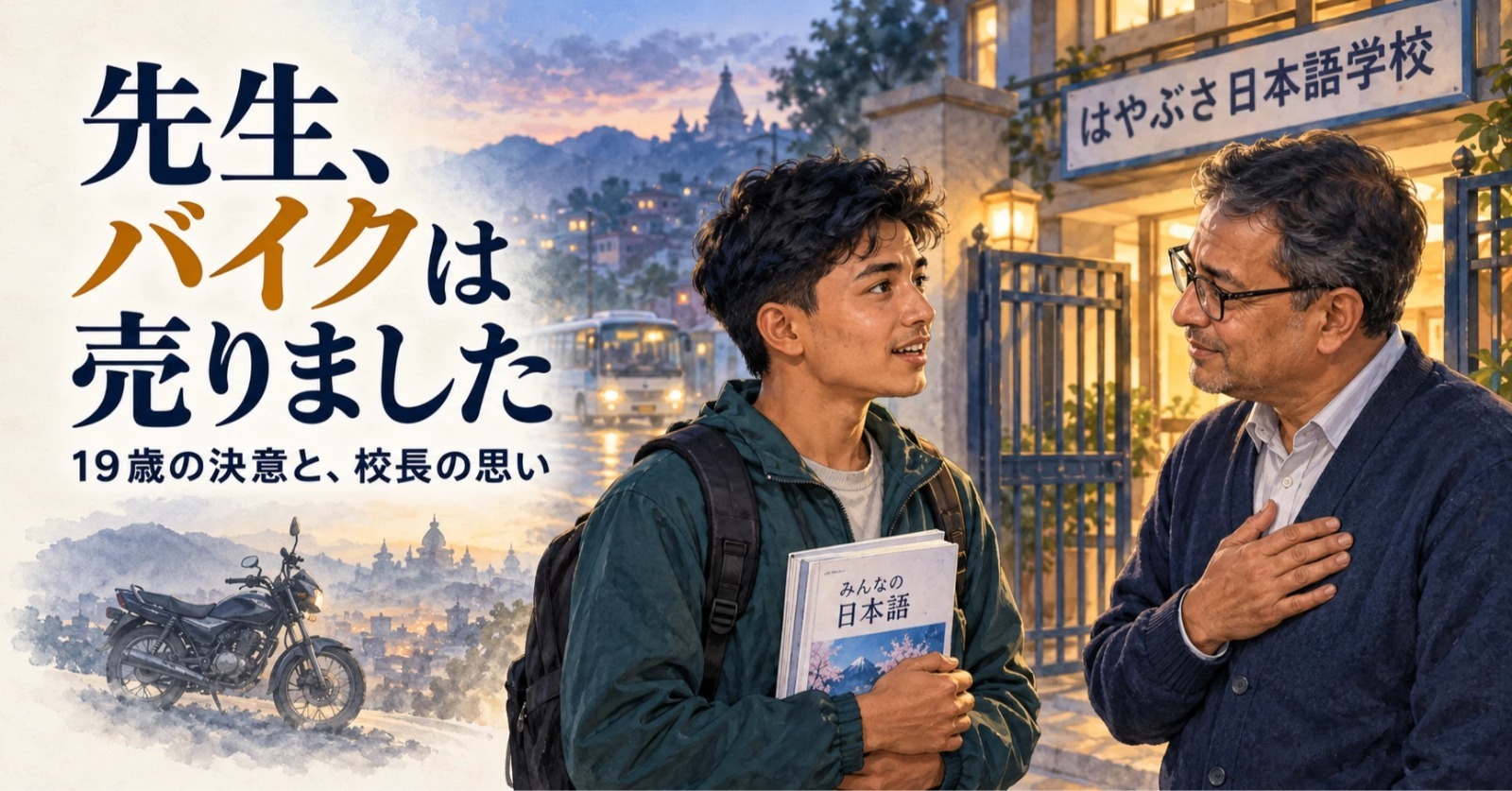
What was the most important thing to you when you were 19 years old? Spending time with friends. Going to see someone you like. Something you love that you managed to acquire by stretching your budget a little. If letting go of it would allow you to continue studying for a little longer , what choice would you make? Today, I'd like to share a story about a 19-year-old student studying at Hayabusa Japanese Language School in Nepal. It's about an incident that happened one morning when I, a teacher of Japanese, learned something important from my student. Hayabusa's mornings start early. Every morning at 5:50 a.m., we do radio calisthenics, and then Japanese class begins. I wake up at 4 a.m. to get ready and usually arrive at school before 5 a.m.
I'm pretty confident in my ability to wake up early. Although, since I'm the principal of a Japanese language school, I really should be working hard to be confident in other things besides waking up early (laughs). The students usually start gathering around 5:30. However, that day was different. When I arrived at the school, there was another student waiting in front of the gate. "Good morning. What brings you here today? You're up quite early." "The bus arrived early." bus? "But you always come here by motorcycle, right?" He replied: "I sold my motorcycle." I was surprised and asked for an explanation.
Having a motorcycle is expensive. The cost of living is high in Kathmandu, so I plan to use the money from selling it for living expenses and tuition here.
I sold my beloved motorcycle and used the money to continue my studies. That's what he decided at the age of 19. For me, it was just the usual early morning at the school gate. But the man standing in front of that gate had come here having made the decision to let go of something precious.
For a 19-year-old, a motorcycle is probably more than just a means of getting to school. You can go see your friends. You can go to your favorite places. It's perfectly natural to want to look a little more stylish. Especially if you have someone you like. If I were the same age and faced the same choice, would I have been able to make a decision so quickly? "No, teacher, I can study more effectively when I have a motorcycle!" I might have become strangely good at that kind of explanation. But he thought for himself and changed his life. He decided to take the bus instead of the motorcycle he used to take.
Hearing that story filled my heart with emotion. If he can continue learning without letting go, that's better. I hope he cherishes the joy of going out with friends and the freedom that comes with being 19 years old. That's why I couldn't simply accept that decision with a simple "That's admirable."
He secured this time for learning at the cost of something precious. How will we use each and every one of those days? I felt like I was being asked that question. There are many students on the Hayabusa spacecraft who are learning Japanese, each with their own circumstances and aspirations. I want to work in Japan and build my own life. I want to support my family. I want to be a good daughter to my parents. Once I gain experience, I want to return to Nepal someday and start my own business.
Each person has a different lifestyle they aspire to, and the path they need to take to achieve it is also different. Nevertheless, their desire to connect their current studies to their future is evident in the classroom every day. Of course, even with strong motivation, studying doesn't always go smoothly every day. There will be times when you can't recall words you thought you'd memorized, or when you feel anxious about the future. Even then, they come back to the classroom and sit down at their desks.
Seeing that dedication, I can't help but think, "I want to make my lessons even better," and "I want to understand each student more." I think I'm encouraging the students, but in reality, I'm the one who's being encouraged the most. These are young people who have studied diligently in their own countries until high school. The learning and effort they have accumulated there will form the foundation of their lives going forward. On top of that foundation, we'll add a new element: the Japanese language.
By doing so, I hope to expand opportunities for people to utilize what they've learned and to connect with others. A year spent learning with Hayabusa might be the catalyst for that change. Of course, you can't master all of Japanese in one year. However, if you build a foundation here and continue to learn by using the language afterward, Japanese will become a source of support for you for a long time to come. Being able to ask, "I don't understand. Could you please explain that again?"
Being able to communicate your physical condition or any problems you're having. Being able to learn about work, express your gratitude, and then be able to teach someone else in return. The thought that a short sentence practiced in the classroom might one day help that student in Japan makes me feel the weight of the words we teach. And along with the time spent learning languages, I also value the time I spend thinking about my future. What do I value most? What am I good at, and what am I interested in? What kind of work do I want to do, and what kind of life do I want to create? When thinking about your career, you should put into words, one by one, what you value, what you are capable of, and what you want to do. It's okay if you don't come up with a perfect answer right away. I just want you to gradually become able to talk about what you've thought about yourself. Then, you learn about the different jobs and industries available in Japan and consider how they relate to your own interests.
For example, if a student wants to open a restaurant in Nepal in the future, what can they learn about customer service, hygiene management, and restaurant operations while working in Japan? What kind of Japanese language skills and knowledge would they need to do so?
Start by thinking about your goals, then identify the skills you need. Consider experiences that will cultivate those skills. Finally, decide "when, where, and what to do." When discussions about the future connect to today's studies and actions, I think the way you view textbooks will change. Learning about Japanese culture, rules, and manners is one way to prepare for it.
Why is punctuality linked to trust? Why is it important to report or consult early when you're in trouble? How do actions you take with good intentions come across to others? Understand the reasons behind their actions, listen to their perspective, and express your own. If there's anything you don't understand, ask for clarification. That's how I want to cultivate the ability to work with others in a safe and secure environment.
When I look into the eyes of my students, I sincerely want to connect each of them with the right company or school that suits them. I want to see them learn, work, and gain confidence. To achieve this, we ourselves, who are sending students abroad, must also learn more. We need to carefully listen to the students' wishes, talk with those who will accept them, and thoroughly confirm what kind of life and growth opportunities await them there. I want students who cherish their families to also cherish their own health and happiness. I want to tell them that it's okay to ask for help when things don't go well. And I hope that one day they will be able to think for themselves and choose their own path. I believe that fostering such abilities is also part of the job of a Japanese language school. The money students pay for tuition reflects the lives and choices of each individual. His story that day reminded me of that fact once again. Are we delivering learning that is worth the money and time invested? Are we creating a classroom environment where students feel comfortable asking questions? What can we do today to help this student take their next step? As principal, I want to ask myself this question again and again. I hope that someday, he will be able to build his own life and ride his beloved motorcycle again. "Teacher, this time I bought it with my own money."
I would be very happy to hear such a report. And, overwhelmed with joy, I might even add an unnecessary comment. "Congratulations... but make sure you wear your helmet properly." Even after graduation, a teacher may still be a teacher. I will never forget the words I heard at the school gate that day: "I sold my motorcycle."
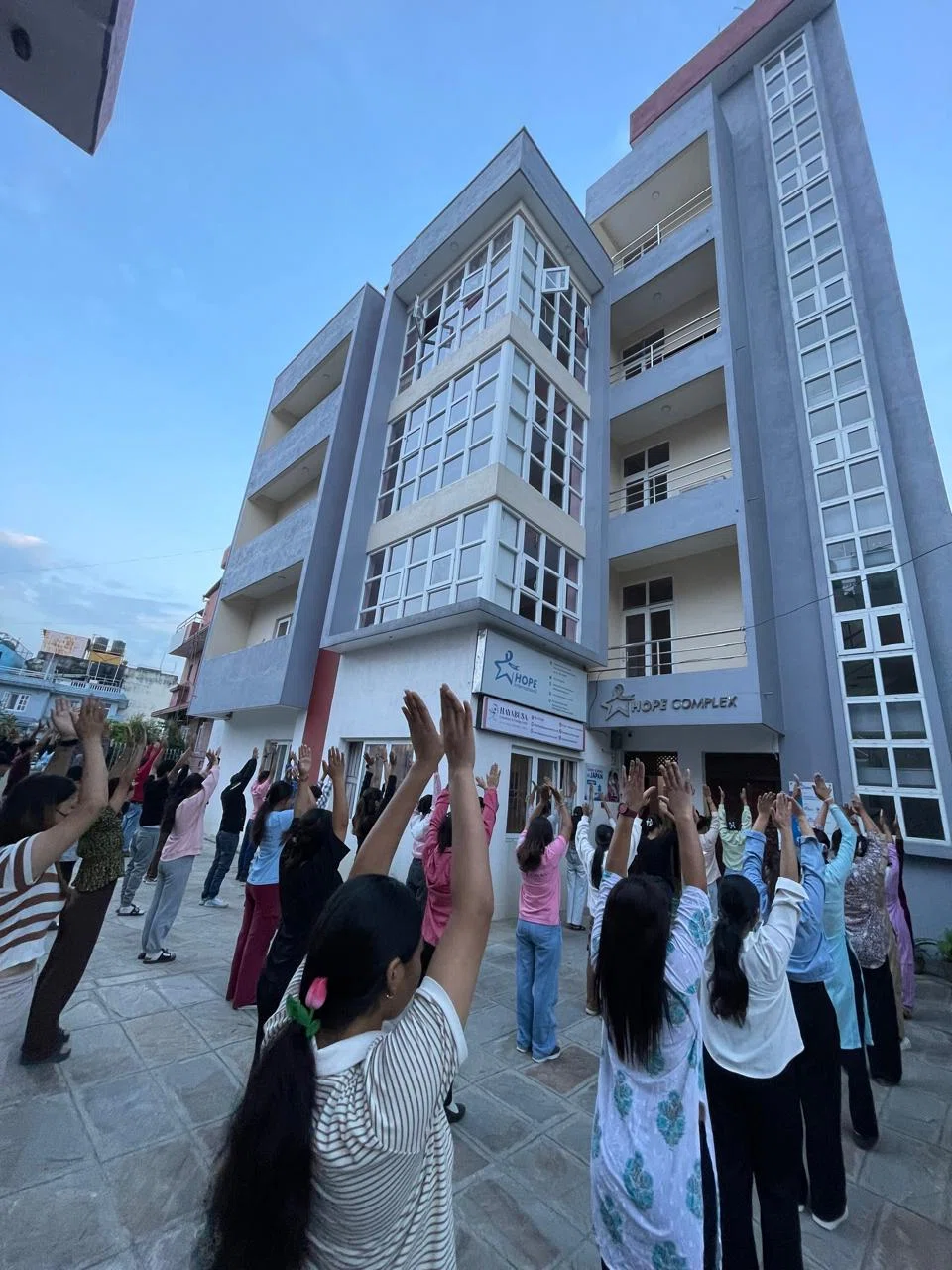
I'll get up at 4 AM again tomorrow and head to school. At 5:50 AM, I'll do morning exercises with the students and then start my Japanese class. To be able to talk about one more thing than yesterday. To be able to think about my future a little more concretely. Students come to our school believing in their own future. We want to be a school that can live up to those expectations. With those thoughts in mind, I will open the gates of Hayabusa again tomorrow.
Darrell Umesh, Principal of Hayabusa Japanese Language School







 EN
EN
 JA
JA