
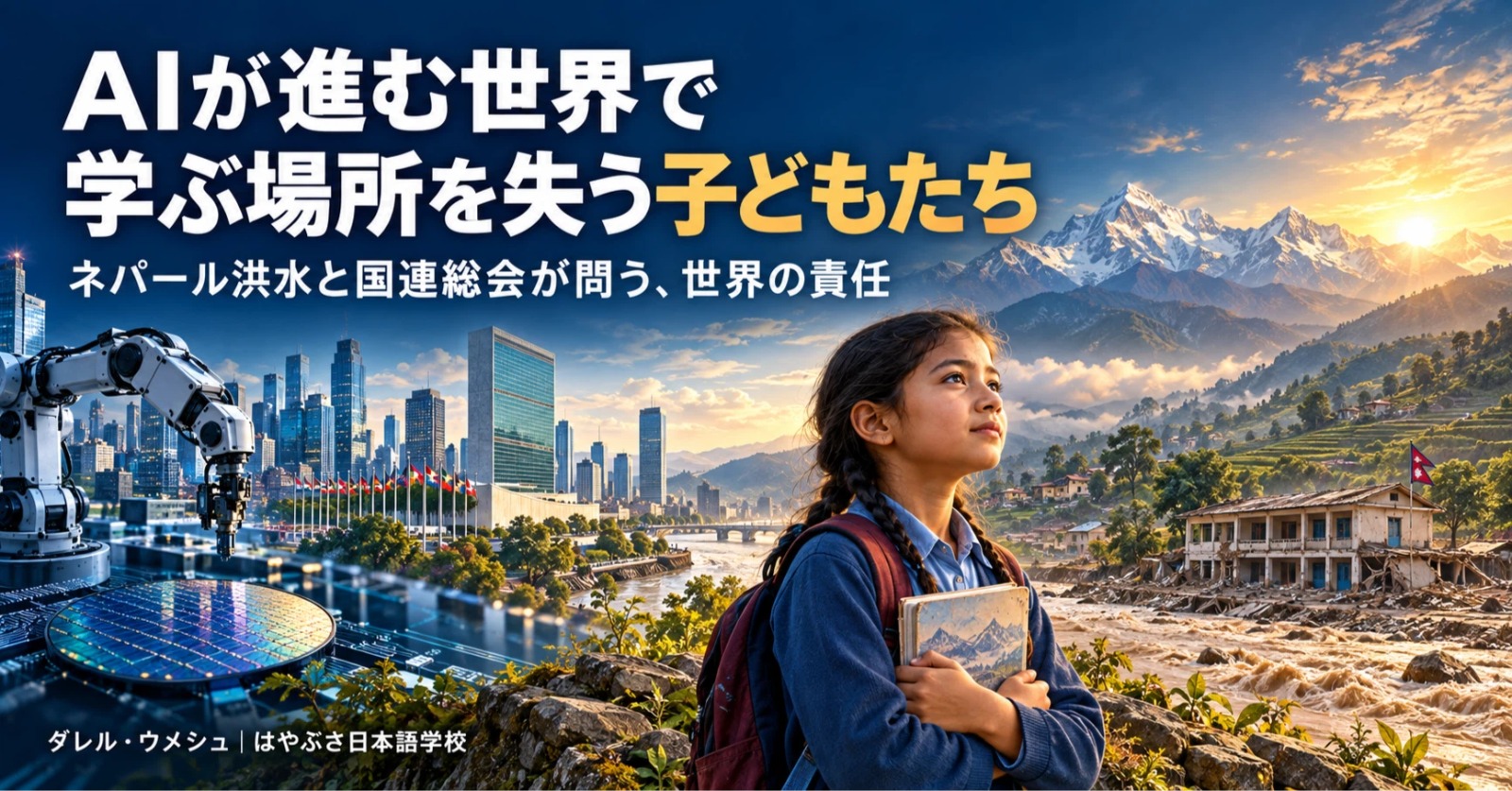
Reflections on the 81st UN General Assembly and the Nepal Floods: The Responsibilities and Forms of Development in the International Community
When the world talks about the potential of AI, robots, and semiconductors, I think of the children living in the mountains of Nepal. What kind of future can we create with new technology? Some children share that hope. On the other hand, there are children who live in daily anxiety about whether they will be able to eat enough or continue attending school.
Even if we are born in the same era and on the same planet, the conditions for choosing our future can be vastly different. On August 26, 2026, massive floods struck Nepal, causing serious damage not only to people's lives but also to places where children learn. I would like to reflect on this disaster and the speech given by Prime Minister Barendra Shah, also known as Baren, at the United Nations on September 24, with the people of Japan. While providing life-saving aid, how can we create the conditions for the Nepalese people to build their own future?
I run a Japanese language school and a sending agency in Nepal. From my position in education, which connects Japan and Nepal, I would like to consider this issue in relation to children's learning and employment opportunities. Currently, the general debate of the 81st United Nations General Assembly is taking place in New York. The General Assembly opened on September 8, and the general debate by representatives from various countries is being held from September 22-26 and on the 28th local time. Representatives from the 193 UN member states and other countries are expressing their positions on global issues. This year's themes are restoring trust in the UN and responding to a changing world. Issues such as war, climate change, inequality, AI, and UN reform are being discussed, and related meetings on climate change measures and health are also being held.
Therefore, in order to understand what Nepal is trying to say, let's first look at the extent of the flood damage. The UN Nepal Office's Situation Report No. 9 includes figures from Nepal's National Disaster Management Authority as of 7 PM on September 23rd: 1,453 dead and 5,644 missing . These figures do not include the missing. Search and confirmation efforts are ongoing, and the numbers may change.
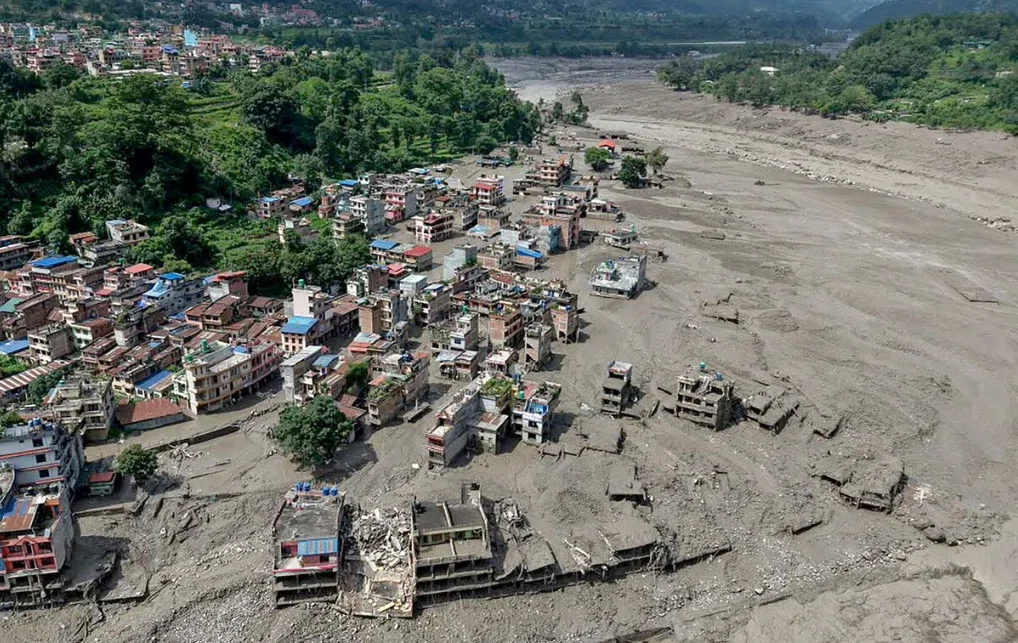
According to a UNICEF report dated September 22, an estimated 84,270 people were affected, including 32,021 children. 64 water supply facilities, 7 medical facilities, and 23 schools were damaged. Surveys in the education sector reported impacts on 9,430 students and 216 teachers. Simply listing numbers doesn't reveal the individual lives of those people.
When schools are destroyed, there is a need for a place to resume classes. When bridges and roads are lost, it becomes difficult to transport food and medicine. Families who have lost their fields and shops need to rebuild their income. To support children's learning, along with textbooks, we must restore housing, food, safe commutes to school, and family life. Was this flood caused by climate change? This is a situation where we shouldn't make a definitive judgment based solely on the strength of our feelings. ICIMOD, the International Centre for Integrated Mountain Development, explained that on August 26, a collapse occurred on the north-facing slope of Mount Langtang Lirung, triggering a rockfall that caused an ice and rock avalanche. This led to a destructive flow down the Botekoshi Trishli River basin.
An analysis published on September 17 by World Weather Attribution suggests that long-term warming may have destabilized the slopes through glacial shrinkage and the melting of permafrost in rock crevices. However, it is a complex disaster involving geological conditions and other factors, and the analysis does not assess whether the landslide would not have occurred without human-induced climate change. It is necessary to understand the landslide, which was the direct trigger, and global warming, which is changing the mountain in the background, as separate factors. Therefore, we cannot definitively say that this disaster was caused solely by climate change. However, just because there are uncertainties does not mean that we should postpone taking action against global warming.
Newcastle University, which participated in the study, explains that the scale of this event exceeded the limits of existing adaptation measures, and that glaciers and high-altitude permafrost respond to past warming over long periods. Simply increasing the number of warnings will not prevent all damage. Emission reductions and disaster preparedness efforts must be pursued simultaneously. Given this situation, what did Prime Minister Barren appeal to the UN General Assembly on September 24th? The speech, released by the Nepalese Ministry of Foreign Affairs, can be summarized as follows, focusing on its main points: - Securing sufficient grant funds to support recovery and reconstruction from flood damage. - Himalayan climate and disaster prevention cooperation centered on Nepal, India, and China. This includes sharing satellite information, monitoring glacial lakes, early warning, and cross-border assistance. - A more equitable international economic order that allows access to essential goods for daily life and production, such as fertilizers and fuel. - A system that allows small countries and vulnerable people to participate in how burdens are shared and in decision-making.
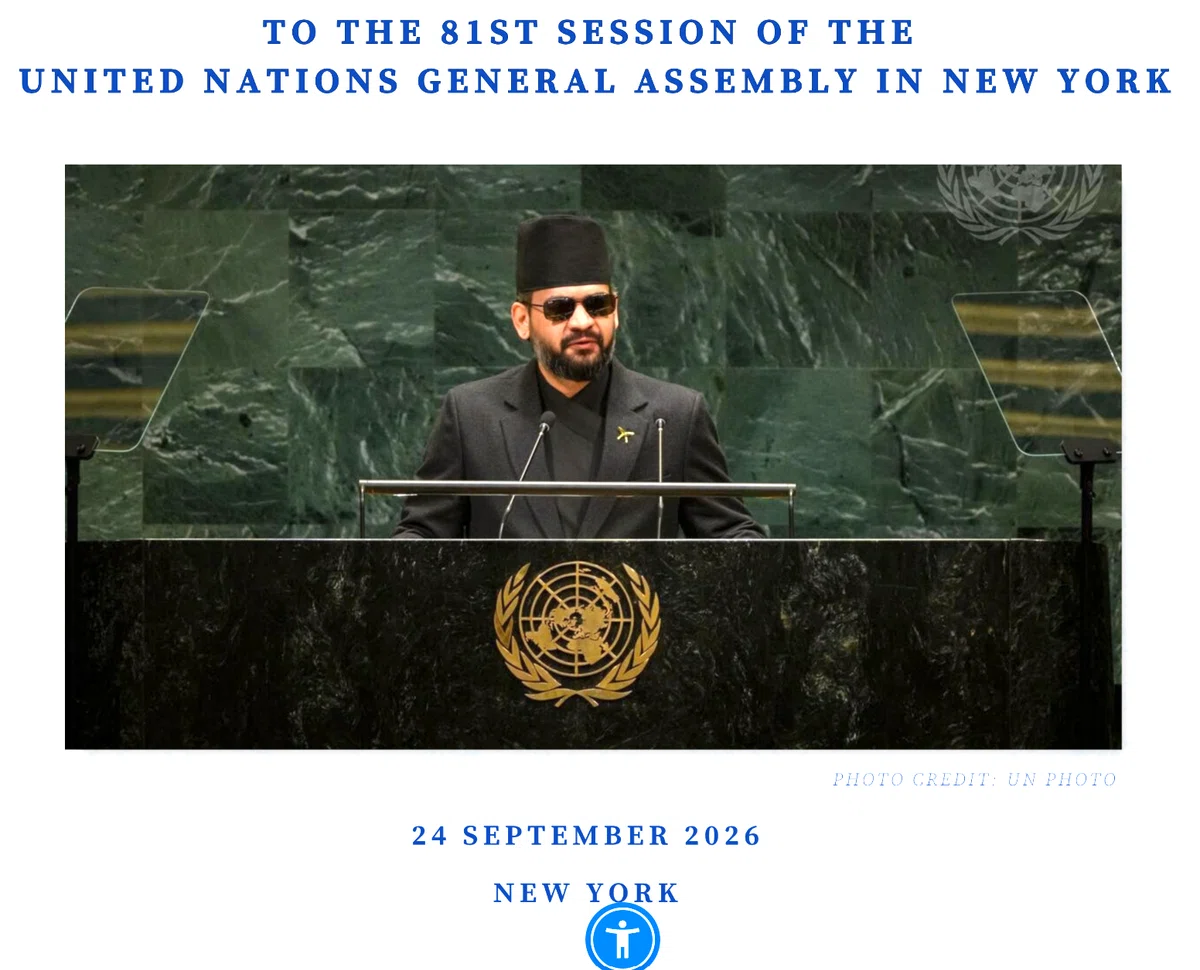
The Prime Minister also highlighted the contrast between the transportation of military supplies and the difficulty farmers face in obtaining necessary supplies. He argued that climate justice, along with funding, involves questions of who bears the burden and whose voices are heard. These were proposals and assertions made in the speech, and not decisions made at this general assembly. I interpreted this speech as a call for both support to return to normal life after the disaster and opportunities to move forward. From here on, these are my own thoughts as someone involved in education and human resource development.
Relief funds and support for the "losses and damages" caused by climate change cannot be treated as trivial matters. For affected families, it is their food for the day, their medicine, and their roof over their heads to shelter from the rain. While acknowledging the urgency of the situation, we also want to consider what comes after providing support. If the burden accumulates with each reconstruction, and we lose the capacity to invest in schools and industries, the options available to the next generation for their future will also narrow. What's needed, I believe, is a way to seamlessly connect relief, recovery, and long-term development without interruption. How do people in Japan feel about the reality that children of farming families born in mountain valleys often lack access to sufficient food and educational opportunities?
Of course, this doesn't mean that there are no schools throughout Nepal. Nor does it mean that the Nepalese people have made no progress. According to a WFP report, the school feeding program has grown to reach approximately 3 million people in 77 districts nationwide, and will be fully funded by the Nepalese government by 2025. On the other hand, providing nutritional support to areas with chronic food insecurity remains a crucial challenge. What we want to protect is the accumulation of these efforts. Learning opportunities that have gradually expanded are interrupted by disasters and poverty. How can we reduce this cycle? We hope that advancements in AI and robotics will bring their benefits even to people living in mountainous areas. Satellites and sensors can be used to survey dangerous slopes, communications can be used to send out warnings, and educational materials tailored to children's language can support their learning. These are just some of the applications of this technology.
However, it's not as simple as just delivering the machines. Power, communications, maintenance parts, people to teach how to use them, and people who can communicate in the local language are all needed. AI predictions also have their limitations and errors, so decisions must be made in conjunction with residents' experience and on-site observations. When expanding access to technology, we also need to cultivate people who can use, fix, and improve it. We want you to consider the costs involved in that process as well when you decide to cooperate. What role should developed countries play? First, we must translate our responsibility to reduce greenhouse gas emissions into actual policies and investments. Both efforts to support after a disaster and efforts to prevent future risks are necessary. We want developed countries to act in accordance with their historical responsibility and capacity to respond. At the same time, every country, including current major emitters and emerging economies, needs to fulfill its own responsibilities.
Next, the challenge is to ensure that the promised assistance reaches where it is needed. The Paris Agreement already includes a framework for developed countries to provide financial support to developing countries for emission reduction and adaptation, as well as for technology development and transfer, and capacity building. The challenge now is to implement this framework and improve it into a system that can be used at the local level. Furthermore, I would like to incorporate the following mechanisms into future international cooperation. - Funding should be designed to ensure that education and healthcare are not cut during reconstruction. Grant aid should be prioritized for emergency relief and basic livelihood reconstruction, and existing debt should be subject to negotiations regarding repayment deferrals during disasters. Industrial investments should be individually assessed for profitability and repayment capacity. - This contract ensures that knowledge and jobs remain in the local area. It includes cooperation on disaster prevention equipment and energy projects, training of local engineers, maintenance budgets, parts procurement, and participation of Nepalese companies. The terms of use of the technology will be agreed upon with the rights holders to ensure its continued usability. - The conditions for selling what is produced and buying what is needed. Stabilizing border logistics, supporting quality inspection and certification, and promoting fair trade contracts will broaden opportunities for Nepalese agricultural products, manufactured goods, and services to reach the market. - A system that allows disaster victims to participate in decision-making. Local governments, residents, women, farmers, and young people in mountainous regions will participate from the stage of determining the priorities of disaster prevention projects and support. Results will be measured not only by the amount of contributions, but also by the resumption of education, the recovery of incomes, and the continued operation of facilities.
These are not introductions to systems decided at this year's UN General Assembly, but rather proposals from me. I believe it is important that those receiving aid take responsibility for its purpose and operation. So, what should Nepal itself do? While we must demand accountability from the international community, we must also take action domestically. We must make contracts for aid funds and public works projects transparent so that residents can see who received what. We must also establish a consultation service for those who were left out of the aid. I believe that international trust is built through these kinds of everyday administrative actions.
When building roads or hydroelectric power plants, we must consider not only the benefits at the time of construction, but also the future risks to the climate, slopes, and the entire watershed. If it is necessary to relocate from dangerous areas, we must ensure that residents agree and that they have access to land, jobs, and schools in order to rebuild their lives. Education and vocational training are also part of building a disaster-resilient nation. We need to cultivate people who can repair local infrastructure, enhance the value of agricultural products, teach in schools, and develop plans for government. We want to consider both opportunities to work abroad and to increase jobs domestically that utilize these skills. I myself am involved in work that sends young people to Japan. That's why I don't want to measure the success of education solely by the number of people who make it to Japan. I want to consider whether they were able to learn, work with peace of mind, and expand their future options. Can they connect the experience they gained in Japan to work or business in Nepal, according to their wishes? I want to take all of that into account. Developing independently doesn't mean not relying on other countries. It means having the ability to prioritize, manage, and improve things ourselves, even while receiving cooperation. I believe there are things that Japanese companies, schools, and research institutions can do together.
For example, we could combine support for disaster prevention equipment with training local engineers. We could connect young people studying in Japan with researchers and companies working on regional issues in Nepal. We could support school lunches while fostering a system for continuously purchasing ingredients from local farmers. Even if we start small, there is meaning in working together to create the conditions necessary for it to be sustainable locally. I'm sure many people in Japan have anxieties about their own lives and their future. It's not easy to think about problems in distant countries amidst all that. Even so, I hope you won't view Nepalese children solely as beings waiting for aid. I want you to see them as individuals with the potential to become partners in solving local problems by gaining opportunities to learn and using their skills.
This isn't about the planet Earth itself disappearing tomorrow. What we need to protect is the environment on which we can live, eat, learn, and work with peace of mind. If that is destroyed, technological progress and economic growth will no longer be able to support people's happiness. A child born in the mountain valleys of Nepal can have enough to eat, attend school in peace, and eventually choose their own future. The skills and jobs they develop will, in turn, support the lives of others. I want to work with the people of Japan to create their future.







 EN
EN
 JA
JA