
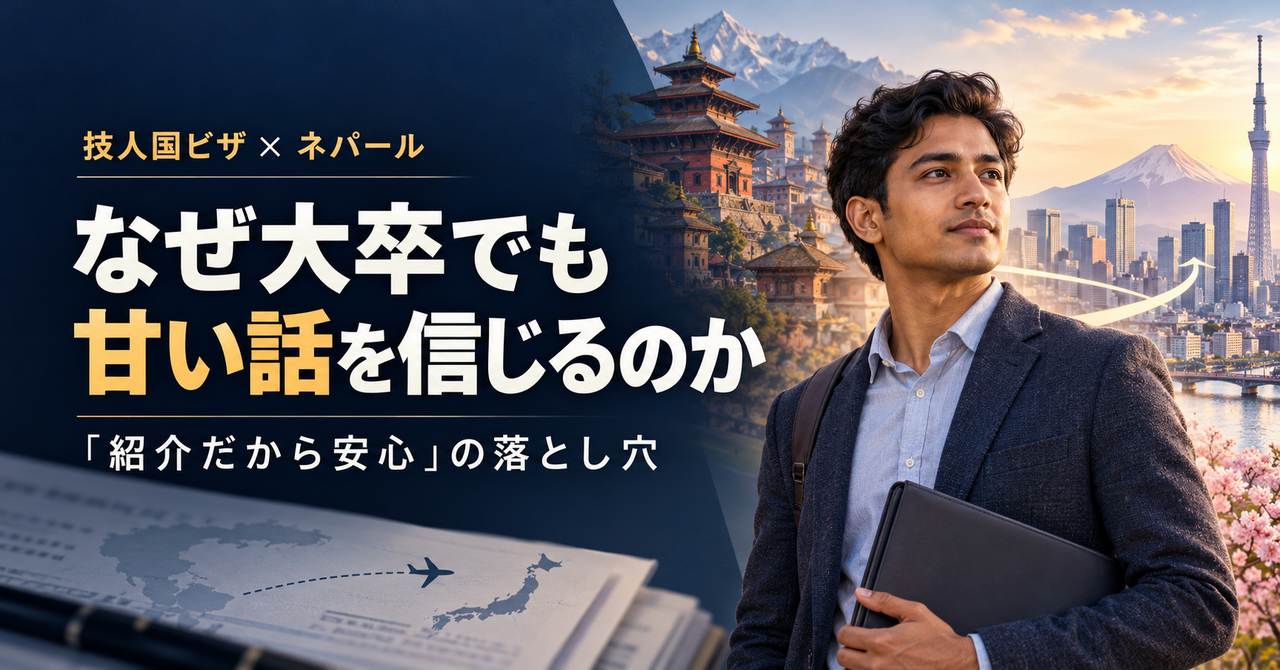
The Pitfalls of Referrals and Trust I Have Seen on the Ground in Nepal
Someone I know held a position of responsibility at an educational institution in Nepal. This person had social standing and a stable income. They were not someone who needed to go to Japan to make a living.
Yet this person went to Japan without sufficiently learning Japanese, under the “Engineer/Specialist in Humanities/International Services” status of residence, commonly known in Japanese as “Gijinkoku” (技術・人文知識・国際業務).
At the time, I advised them that going to Japan without studying Japanese was risky. But my words did not get through. In the end, this person returned to Nepal within 1 year.
The circumstances of their return cannot be attributed to Japanese-language ability alone. Still, the experience made me think again about the importance of checking the details and preparing before departure.
They have graduated from university and have experience in society. Why, then, do they still believe promises that sound so appealing?
I have worked in both Japan and Nepal, and I now run a Japanese-language school and a sending organization in Nepal. This year is our 4th year since starting the school.
What I have seen on the ground are pitfalls that academic qualifications alone cannot prevent. One particularly significant issue, I feel, is the gap between the reassurance people take from “someone referred me” and the responsibility the person making the referral believes they have.
The experiences discussed here are not an argument about the character of Nepali people as a whole, or about their superiority or inferiority to Japanese people. With full recognition that many Nepali people work, study, and live diligently in Japan, I want to share the problems I have witnessed.
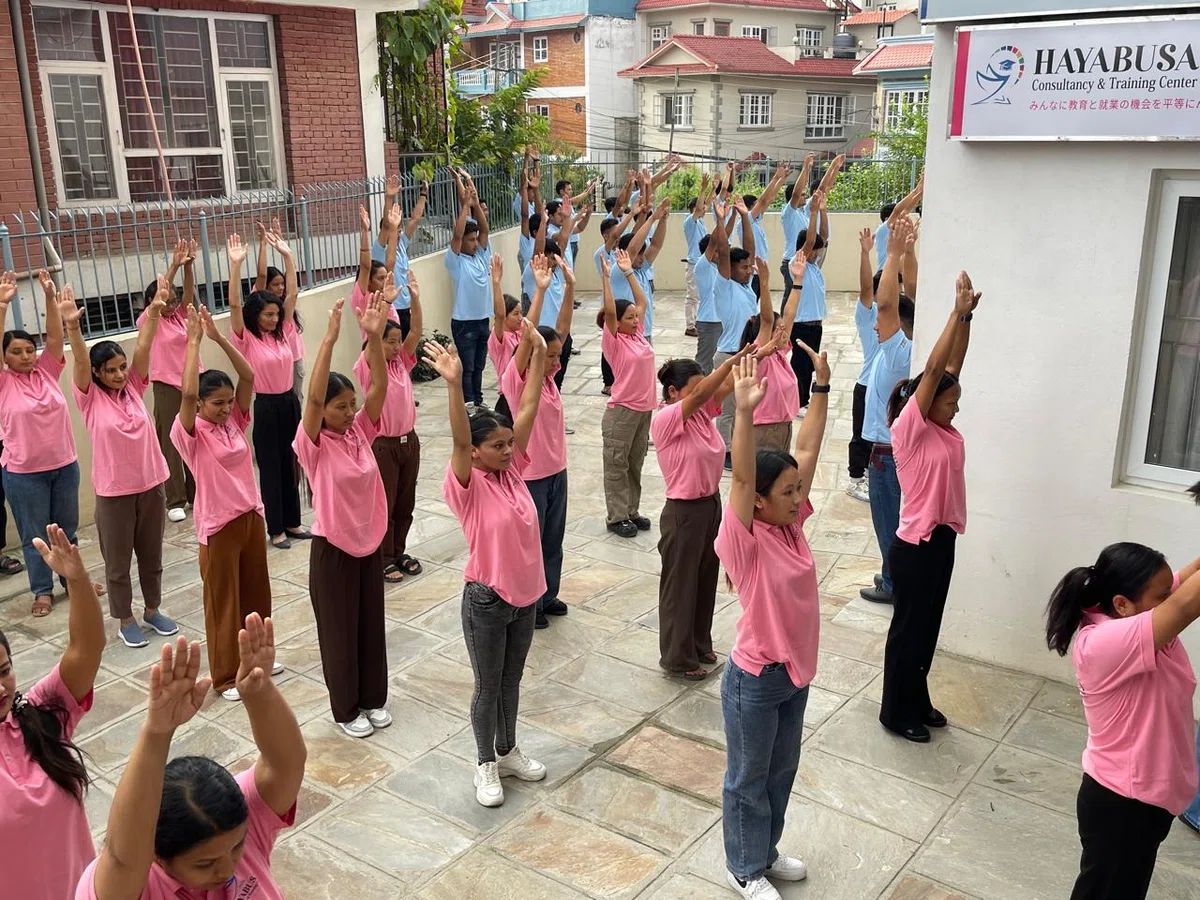
The Number of Nepali Residents in Japan Has Exceeded 330,000
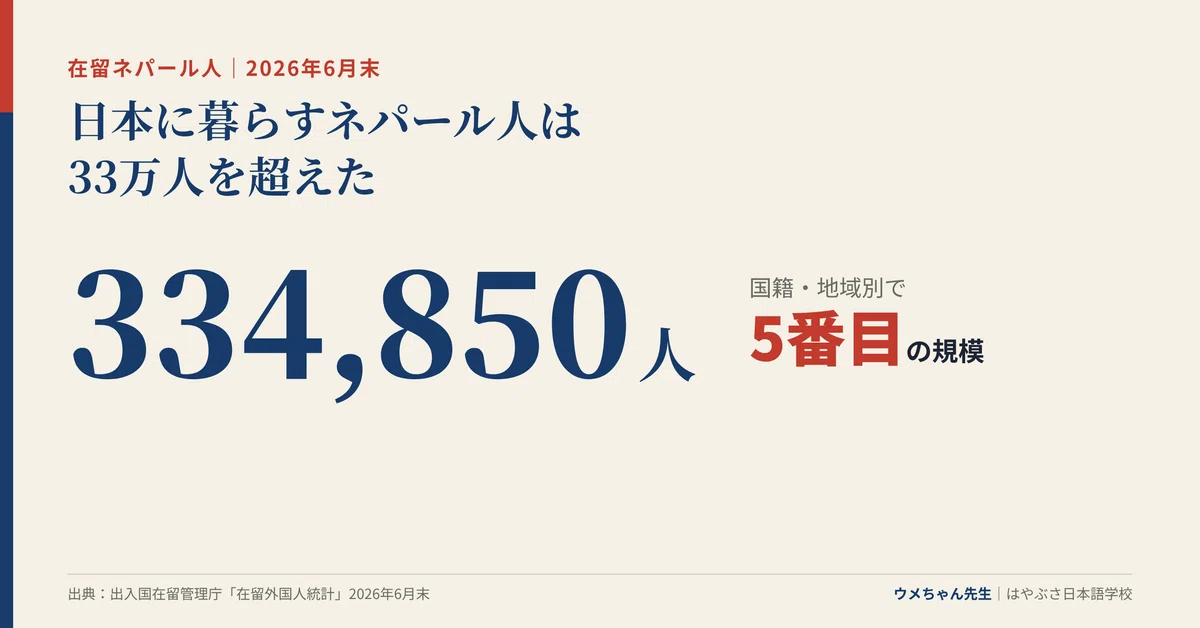
First, let us look at the scale of the situation.
According to figures published by the Immigration Services Agency of Japan, there were 334,850 Nepali residents in Japan at the end of June 2026. They were the 5th-largest group by nationality or region.
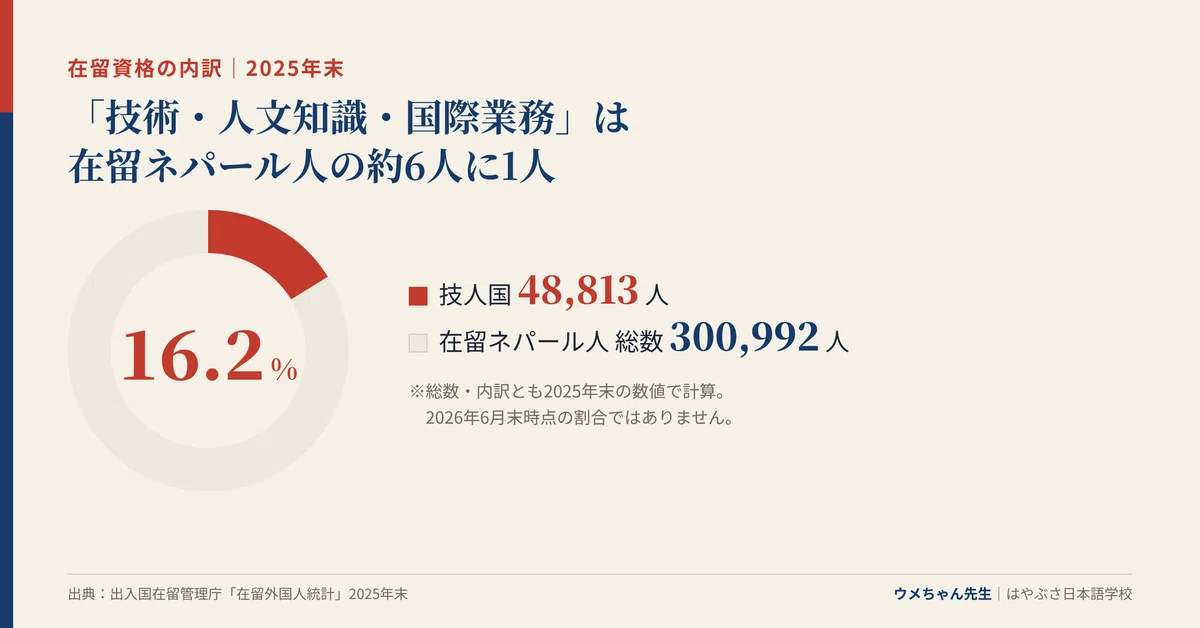
For the Gijinkoku breakdown, the end-of-2025 statistics, for which I was able to confirm both the breakdown and the total, show 48,813 out of 300,992 Nepali residents, or approximately 16.2%. This percentage was calculated using end-of-2025 figures for both numbers; it is not the percentage for the end of June 2026.
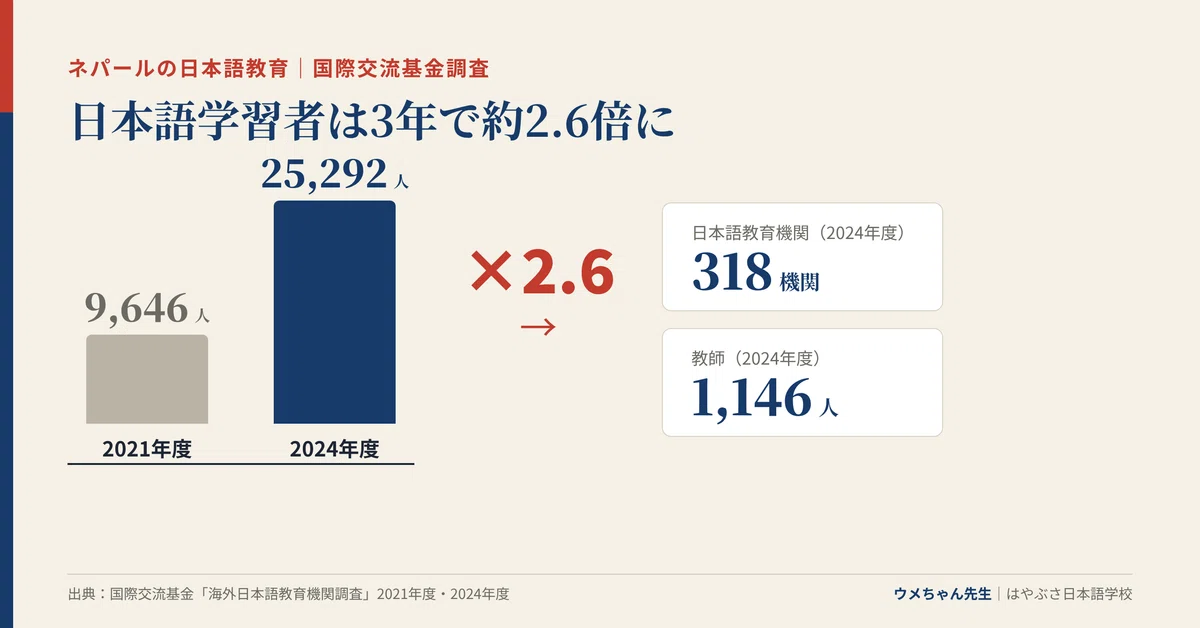
Japanese-language learning has also expanded in Nepal. The Japan Foundation’s fiscal 2024 survey identified 318 Japanese-language education institutions, 1,146 teachers, and 25,292 learners. Compared with 9,646 learners in fiscal 2021, the number grew to approximately 2.6 times its previous size in 3 years.
However, this does not mean that “Nepal has a total of 318 Japanese-language schools.” It is the number of Japanese-language education institutions, including universities and other institutions, that responded to the survey. Nor does it represent the entire learning population, including people studying independently, or the number of schools as of 2026.
Of the learners in fiscal 2024, 24,846, or approximately 98.2%, were studying “outside the formal school education system.” This shows the substantial role that private language schools and similar institutions play as a gateway to Japan.
These figures do not show the rate of fraud victimization. They show how many people’s futures can be shaped by the explanations, education, and referrals provided by schools and intermediaries.
The First Factor: Confusing Delegation with Verification
In Nepal, even within the scope of what I have personally seen, it is not unusual for people to pay service providers to fill out relatively simple applications submitted to government offices.
Of course, there is nothing wrong with seeking professional help. There are situations in which it is better to entrust complicated procedures to someone with experience. The same is true in Japan.
The problem arises when entrusting someone with the procedures leads directly to the conclusion that “I do not need to check the details.”
Under what status of residence am I going? Which company will I work for, and what work will I do? What exactly am I paying for? Does the explanation match the contract?
Even though these decisions can shape a person’s life, the step of checking for oneself gets left out. I believe studying a specialized subject at university and being able to interpret an overseas employment contract or a system of residence statuses are different abilities.
The Second Factor: Trust in a Community Where People Know One Another
When interviewing students who hope to work in Japan, I often hear this answer:
“My weakness is that I am too quick to trust people.”
This answer alone does not establish that the person is actually easy to deceive. It may simply be a standard answer used in interviews. Still, when I think about life in the Nepali village where I grew up and with which I remain connected, there are aspects I can understand.
In a village, many of the people around you are familiar faces. You know which family someone belongs to, what their parents do, and what relationships they have. Trusting other people is an important strength that supports everyday life.
Sometimes, however, people carry that same sense of trust over to urban service providers whose actual circumstances are harder to see, or to transactions across national borders.
Trusting someone you know and establishing that the explanations given by a provider connected to that person are correct are separate matters that must be checked separately.
The Third Factor: Different Understandings of What a Referral Means
This is a difference I especially want people in Japan to understand.
Someone chooses a provider introduced by a relative, friend, or acquaintance. Because they trust the person who made the referral, they do not investigate sufficiently themselves. I see people making choices this way in my work.
In such a situation, the person seeking advice understands the referral as “They have chosen a trustworthy provider for me.” But the person making the referral may be thinking, “I only shared the contact details and put them in touch. I want the two sides to discuss things themselves from there.”
With the same referral, one person believes they have received an assurance of trustworthiness, while the other has merely created a point of contact. This mismatch makes problems worse.
My impression of how people work in Japan is that those making referrals have a strong awareness that their own credibility is also at stake. If something goes wrong, they too would feel unable to face the person they introduced. That is why they do not readily introduce someone they do not know well. That is the approach to work I have observed.
Meanwhile, among the people around me in Nepal, some actively connect people as an act of kindness but do not consider the subsequent transaction to fall within their own responsibility.
This is not a difference that applies to every person in either country. There are irresponsible referrals in Japan, and there are people in Nepal who look after those they introduce through to the end. Also, the responsibility I mean here is not legal liability as a guarantor. It concerns how people remain involved after making a referral and how they think about their own credibility.
That is precisely why I would like people receiving a referral to go a step further and ask:
“Have you actually done business with that company?”
“Have you checked what happens after people go to Japan?”
“Is this an introduction because you know their contact details, or a recommendation based on checking the actual work involved?”
I am not saying that you should distrust the person making the referral. I want you to establish what they have checked before making it.
Even Among the People I Know, at Least 10 Have Returned Home
Since I started the school, I personally know of at least 10 people who came to Japan under Gijinkoku but returned home because they could not extend their period of stay.
These are cases from my own circle, not a survey from which trends among Nepali people as a whole can be estimated. The inability to obtain an extension alone does not establish that fraud took place.
Of course, if false explanations or deceptive acts did occur, responsibility lies with those who engaged in them. A person’s failure to check sufficiently does not make that responsibility disappear.
Many of these people had proceeded with the arrangements through providers on the Nepali side. In some cases, multiple parties were involved, including intermediaries on the Japanese side.
The more parties are involved, the harder it becomes for the individual to see who explains the employment conditions, who checks the job duties, and who responds to requests for advice after arrival in Japan. Rather than assuming that “someone must have checked,” it is necessary to keep a record of who checked what.
Whenever I recall the educational professional described at the beginning, I feel that, regardless of academic qualifications or job titles, everyone is a beginner when faced with an unfamiliar system.
Not everyone who obtains Gijinkoku is a university graduate. In some cases, people qualify on grounds other than academic background. The issue I am discussing here is that having academic qualifications does not necessarily enable someone to distinguish a truthful explanation from a false one.
Promises of a Quick Departure and Education That Takes Time
At Hayabusa, we value the path of learning Japanese and developing the ability to work before going to Japan. In our own practice, one option is to spend 2 years or more studying toward passing N3 or N2.
Meanwhile, some people hear that, by paying through a provider, a COE (Certificate of Eligibility) can be issued in around 3–6 months, and choose that route instead.
One of these is the time spent on education; the other is an estimate presented for the application process. They are not comparisons of the same thing. Nor is a COE being issued in a short time, in itself, evidence of wrongdoing.
Even so, to the individual, it looks like the difference between “a route that takes time to study” and “a route that gets me to Japan quickly.”
They want to start working as soon as possible. They think they can learn after arriving in Japan. I understand those feelings. But without sufficient Japanese, it becomes difficult to ask for explanations when problems arise or to seek advice about one’s situation.
I place importance on Japanese-language education not simply because I want people to pass exams. I want them to have the ability to ask questions about their own work and lives, rather than leaving everything to someone else.
I Want to Put the Same Questions to Japanese-Language Teachers and Sending Organizations
I have also seen cases in which people who had difficult experiences in Japan went on to run Japanese-language schools or take teaching jobs after returning home.
I do not intend to criticize returning home or experiencing failure in itself. On the contrary, there is great value in reflecting on those experiences, studying again, and using what was learned to educate and protect the next group of students.
What matters is not simply whether someone has lived in Japan, but what they have learned and what they can teach. Japanese-language ability, teaching skills, an understanding of the system, and a willingness to admit what they do not know. As someone who runs a school, I too must answer these questions.
I ask Japanese companies and others involved in receiving workers not to judge schools or sending organizations solely by the title of the person making the referral or the number of people they have sent abroad.
• Observe actual classes and speak directly with students.
• Check whether the individual has also been given explanations of the employer, job duties, and itemized costs.
• Confirm each party’s role and whom to contact for advice if problems arise.
• Ask not only how many people have arrived in Japan, but also how they have been working and living since then.
I would like you to apply these same checks to Hayabusa as well.
Pair Trust with Verification
Nepal, too, has a proverb that means, “Chanting God’s name with the mouth, while keeping a dagger tucked inside one’s clothing.”
मुखमा राम राम, बगलीमा छुरा。
It is a warning about people whose outward words differ from their inner intentions. It is not that Nepal lacks the wisdom to be wary of sweet words.
Even so, people feel reassured when someone close to them makes an introduction. When they hear what they have been hoping to hear, they want to believe it. Surely this is not a problem unique to Nepal.
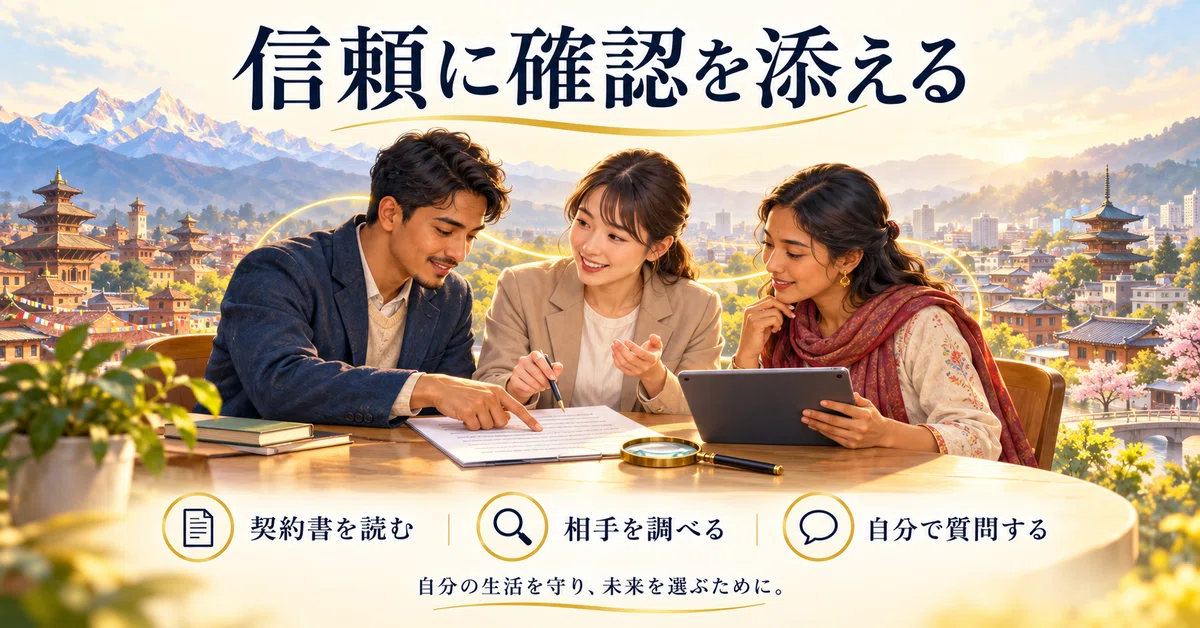
I do not want us to lose the warmth of a society in which people can trust one another. But when working across national borders, I want people to pair that trust with reading contracts, researching the other party, and asking questions themselves.
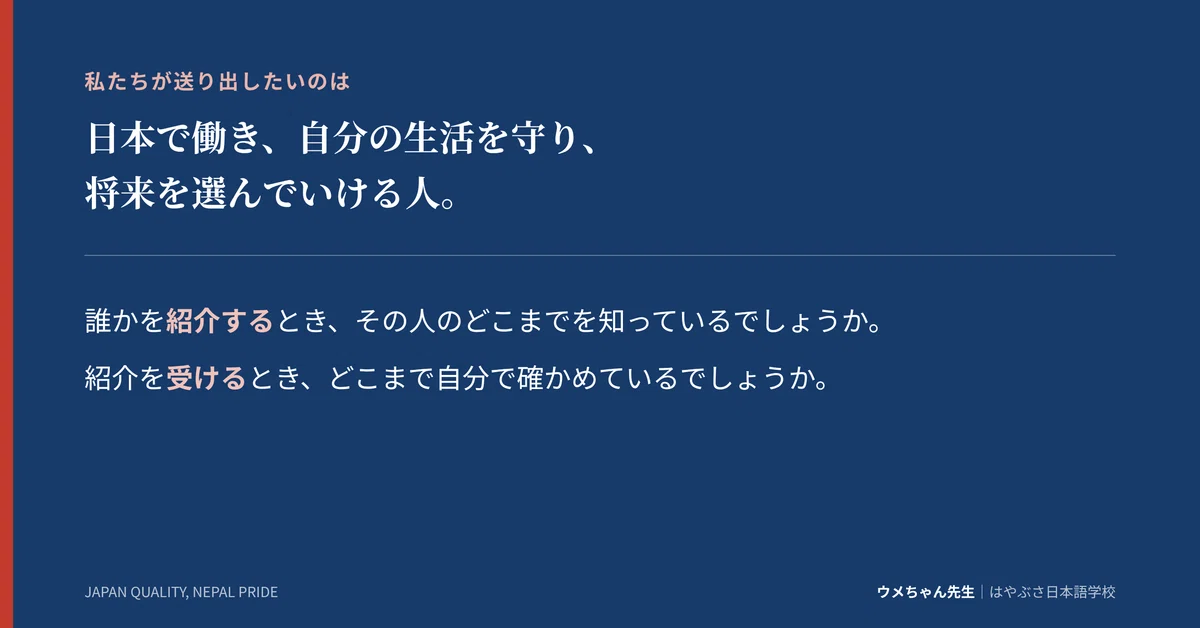
The people we want to send abroad are not merely people who can get to Japan. They are people who can work in Japan, protect their own livelihoods, and make choices about their futures.
When we introduce someone, how much do we really know about that person?
And when we receive an introduction, how much do we check for ourselves?
Umesh Dharel
Representative, Hayabusa Group
Hayabusa Nepal Human Resources Pvt. Ltd. / Hayabusa Japanese Language School
About the Sources and Data
The reference dates for the statistics differ by source. The total number of Nepali residents is from the end of June 2026, the number and proportion under Gijinkoku are from the end of 2025, and the Japanese-language education figures are from the fiscal 2024 survey. The personal accounts and reflections on referrals are the author’s observations, not a statistical survey comparing national character. Some details, such as job titles in the examples, have been generalized to prevent individuals from being identified.
Immigration Services Agency of Japan: Number of Foreign Residents as of the End of June 2026
https://www.moj.go.jp/isa/publications/press/13_00070.html
Immigration Services Agency of Japan: Statistics on Foreign Residents, December 2025, Table 1 — Foreign Residents by Nationality/Region and Status of Residence
https://www.e-stat.go.jp/stat-search/files?layout=dataset&stat_infid=000040472260
The Gijinkoku proportion of 16.2% was calculated as 48,813 ÷ 300,992.
The Japan Foundation: Fiscal 2024 Survey on Japanese-Language Education Abroad, South Asia, Table 2-3-1
https://www.jpf.go.jp/j/project/japanese/survey/result/dl/2024/south_asia.pdf
The Japan Foundation: Japanese-Language Education, Country/Region Information — Nepal, Fiscal 2025
https://www.jpf.go.jp/j/project/japanese/survey/area/country/2025/nepal_2.pdf
The proportion studying outside the formal school education system, 98.2%, was calculated as 24,846 ÷ 25,292.
Immigration Services Agency of Japan: Status of Residence — Engineer/Specialist in Humanities/International Services
https://www.moj.go.jp/isa/applications/status/gijinkoku
नेपालीपोष्ट (Nepali Post): Explanation of the Nepali Proverb
https://nepalipost.com/beta/5435
Related Article
Why Is the Japanese of Nepali Learners Not Improving? The Real Issue Revealed by Data on 25,292 Learners
https://note.com/umechyansensei/n/n239b189d7714
Hashtags for Posting
#Nepal #InternationalTalent #JapaneseLanguageEducation #Gijinkoku #WorkingAbroad #MulticulturalCoexistence
Original Article (note): https://note.com/umechyansensei/n/n3b260b540615







 EN
 JA