
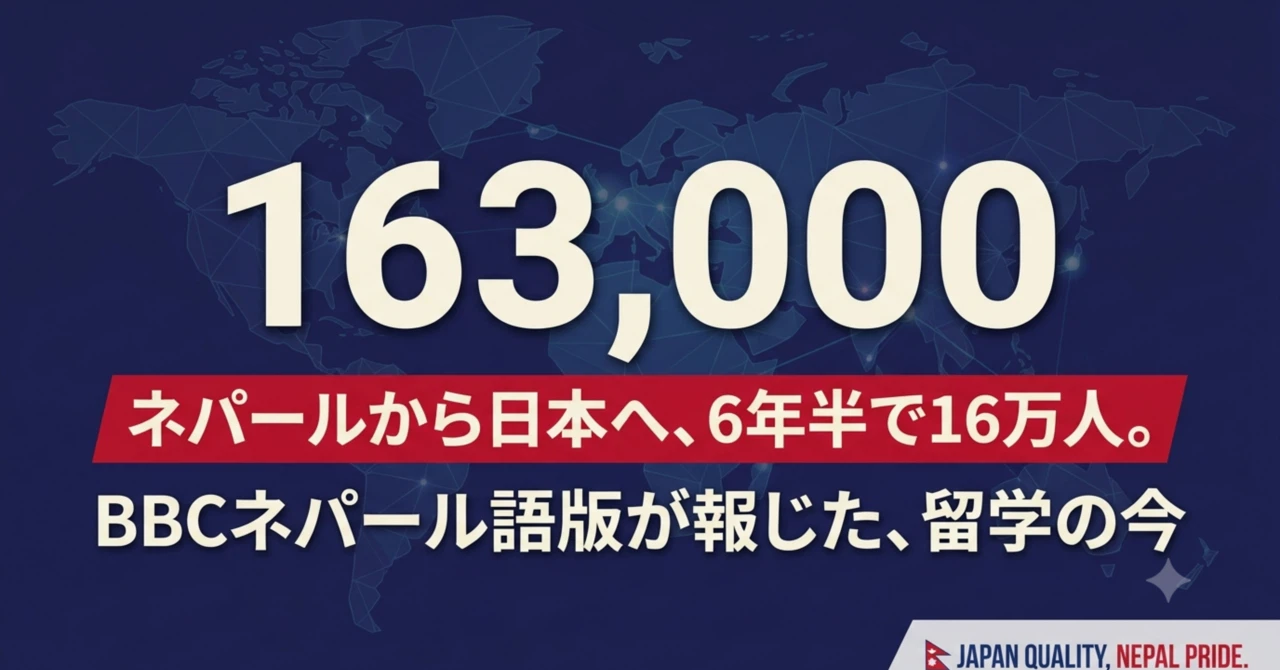
163,000 people in six and a half years. This is the number of Nepalese who came to Japan on student visas
Nepal Immigration Bureau, as of the first week of August 2026.
The BBC Nepali edition reported the figures yesterday (August 19, 2026). For me, who runs a Japanese language school in Kathmandu, this article was like a compilation of answers. Today, I will be sharing with the Japanese host side the contents of this article and the "behind the numbers" that can be seen from the local area.
Let's summarize the figures reported by the BBC.
All sources are data from the Nepal Immigration Bureau and the Central Bank of Nepal cited by the BBC Nepali edition (August 19, 2026, reporter Hunindra Dahar).
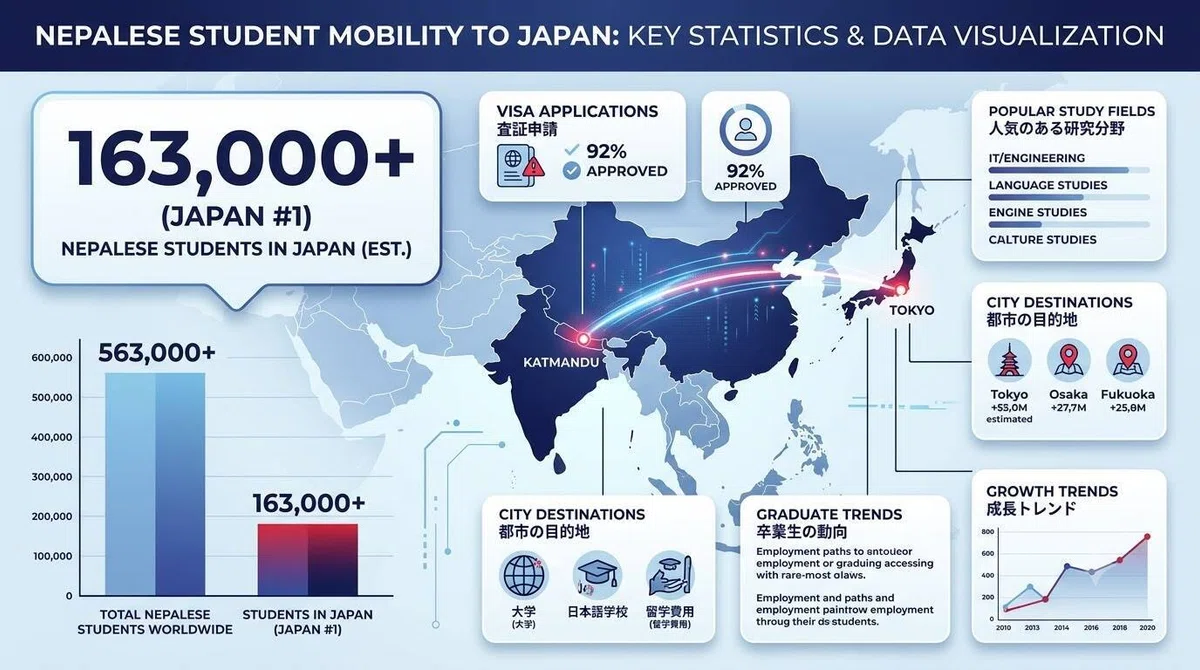
2020 〜Approximately 563,000 Nepalese people (137 countries) left the country to study in the first week of August 2026, of which 163,000 went to Japan (student visas) Over 163,000 people left the country
to study in 2025 (record high) Over 133,000,
of which Japan Over 40,800 in
2026 (until the first week of August) 31,000 people bound for Japan.
Japan has been the largest destination for Nepalese international students for the past six and a half years. It's not Australia or the United States, it's Japan.
And one more thing. According to the Central Bank of Nepal, the amount of money flowing out of the country for higher education is 132.23 billion rupees this fiscal year (compared to 138.48 billion rupees last year). Considering the size of Nepal as a country, this is a huge number.
In a BBC article that goes beyond "no English exams" to explain why Japan is the
country, Tirta Bhandari, former executive director of ECAN, an industry association for study abroad consultants, explains:
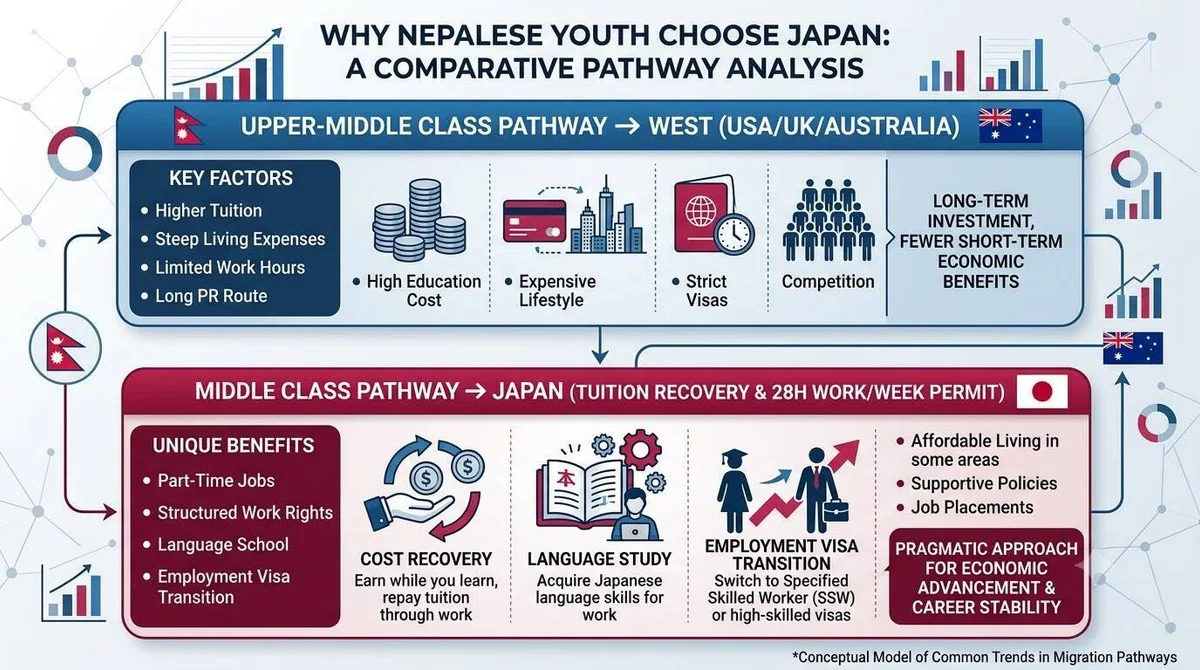
The wealthy and upper middle class → Canada, Australia, the US, the UK, and Northern Europe;
the middle class and lower middle class → Japan
The reason is clear.
Because the costs can be recovered. One year of language study abroad costs 1.5 million rupees 〜1.8 million rupees, up to 3 million rupees for a two-year course (converted to Japanese yen [check: exchange rate at time of conversion]). The initial costs are lower than in Western countries, and you can recoup the costs by working a legal part-time job for 28 hours a week. Furthermore, if you have completed your bachelor's degree in Nepal, you can switch to a work visa relatively quickly.
Instead of English exams (such as IELTS), Japanese exams are required, and recently some schools have come up with GPA2.8 as a mandatory requirement. This is also mentioned in the article.
💡 In other words, Japan has been chosen as the "recoverable and return-on-investment country" for Nepal's middle class If you think that "longing for Japanese culture" is the main factor at the entrance, you will misjudge the situation.
The core of the article is a statement from Professor Peshal Kan
al of Tribhuvan University, pointed out by experts, that the host side should face
Many students study at the undergraduate level, but they lack an ultimate goal. They use education as a means to learn language, work and culture, and earn a living,"
and it is said that "about 5〜10%" of them will acquire university-level expertise and land higher-level jobs.
That's a harsh point. But having been in this industry for 20 years, I don't want you to read this as, "That's why Nepalese talent is no good."
It's the other way around Tens of thousands of "18-year-olds with no set purpose" arrive in Japan every year. If this is true, then how far they can build their sense of purpose and Japanese language skills before moving on to Japan will determine their retention after joining the company. The seeds of disappearance and early departure were born in Kathmandu before arriving in Japan.
The numbers also indicate a "slowdown."
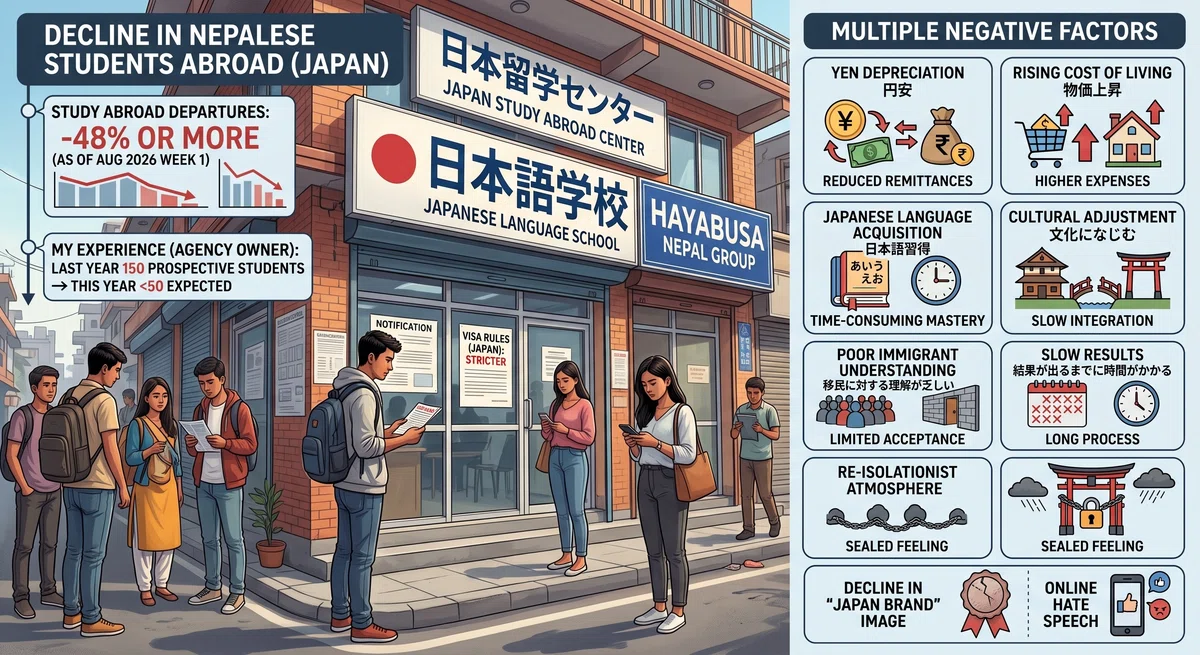
What cannot be overlooked is that the number of people leaving the country to study this year has decreased by more than 48% compared to the previous year (as of the first week of August 2026, according to the same article). It is believed that the effects of stricter visa requirements in various countries are beginning to become apparent.
I have experienced that myself. Last year, there were 150 people who wanted to study abroad, but this year there are expected to be fewer than 50. There are various factors at play, but I simply see a decline in the image of Japan, the so-called "Japanese brand."
Hate speech is rampant on social media in Japan, and from the perspective of foreign migrant workers, the benefits of going to Japan are already diminishing.
In addition,
-The amount of money sent down has decreased due to the weak yen
-Rising prices make the cost of living high
-I have to learn Japanese
-It takes time to become familiar with Japanese culture
-Despite being a developed country, it has little understanding of immigration
-It takes time to get results
-There is a real "national isolation" atmosphere
These factors are intertwined.
The article also reports that Nepal's Ministry of Education has launched a policy to "keep the country in the country," including partnering with foreign universities and enacting legislation for joint degrees.
💡 The premise that "infinitely many people will come from Nepal" is no longer safe. The policies and household finances of the sending country will change. The shift from hiring based on quantity to hiring based on quality is a long wait for the host company.
Summary: The numbers teach us one thing: 160,0
00 people going to Japan is a testament to our trust in Japan. At the same time, many of them are crossing "with no clear purpose."
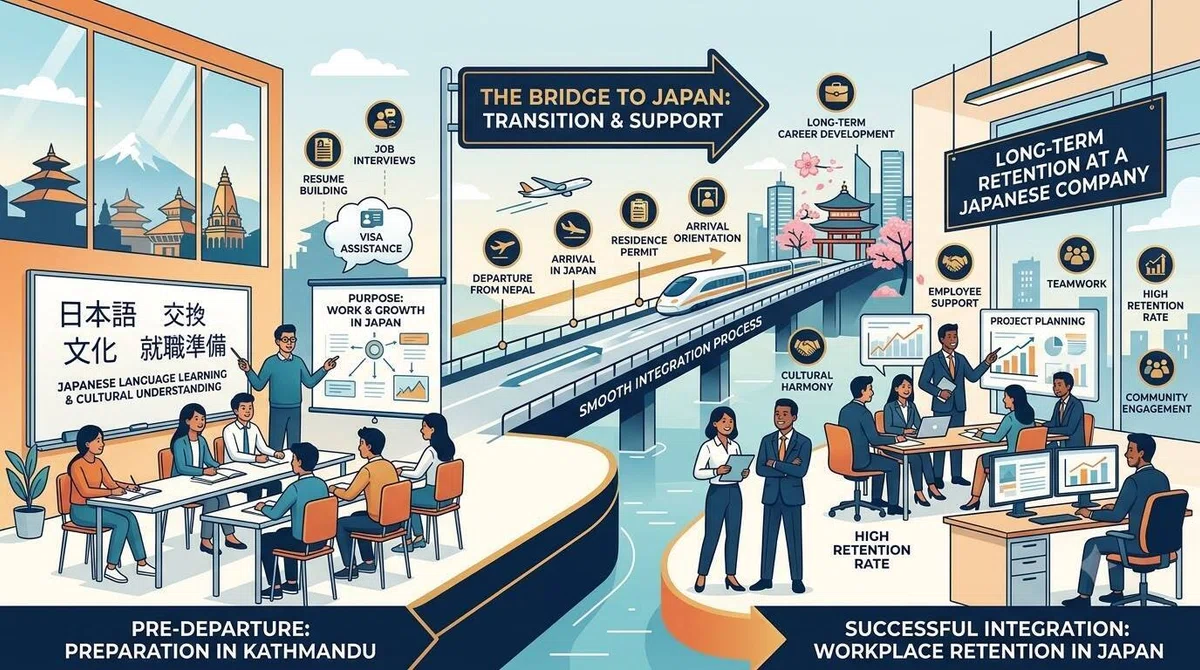
The key to bridging this gap is education before the day of travel. It is from the resume that the host company should see in the interview how well the sender has trained their Japanese language skills and sense of purpose.
We are the Yabusa Nepal Group, which runs a Japanese language school in Kathmandu and creates "preparation for Japan" for students.
I myself have lived in Japan for about 20 years, and of those, I worked in the human resources industry for about 10 years.
I was originally an international student.
I didn't have enough Japanese, and I didn't understand how job hunting works in Japan, so I had a lot of trouble with my job search.
After that, he became involved in recruiting foreign talent at a major talent company, and this time he looked at foreign talent from the perspective of the companies that were hiring.
What struck me most was the significant gap between "the level of foreign talent that companies are looking for" and "the actual readiness of foreign talent to come to Japan."
This isn't just about Japanese language skills.
There was a much larger difference than we could have imagined between communication skills, understanding of Japanese culture and customs, work ethic, reporting, contacting and consulting, punctuality, attitudes towards future careers, and what companies thought "that's how much they understand" and what foreign talent actually understood.
As an international student, I have struggled with this gap, and since then I have sided with companies and seen many situations where they have struggled to recruit foreigners because of this gap.
Having experienced both positions, I have come to a conclusion.
It's too late to try to fill this gap after entering Japan.
What's really important is to start your education before coming to Nepal, that is, from the stage where you're still in Nepal.
Learning Japanese.
To learn about Japanese culture.
Understanding the Japanese way of thinking.
Why keep to time.
Why reporting, contacting, and consulting are necessary.
What to learn by going to Japan, and what to aim for beyond that.
Setting career goals and planning a career path to achieve them.
The foundation will be laid in Nepal before being sent off to Japan.
I have come to believe that this is the best way to bridge the gap between foreign talent and Japanese companies.
To put that idea into my own hands, about four years ago I left a large publicly traded company where I had worked for many years and jumped into Nepal.
That's why we started the current Hayabusa Japanese Language School.
What we want to create is not simply "students who can go to Japan."
Even after going to Japan, I am a student who can continue to learn, grow, and seize opportunities on my own.
So we value not only the work we send to Japan, but also the "pre-port education" that comes before it.







 EN
EN
 JA
JA