Why aren't Nepalese people improving their Japanese? What's the "real problem" revealed by data from 25,292 learners...?
The figure of 25,292 is based solely on date compiled by JFT, in reality, many more Nepalese people are learning Japanese.
The number of Japanese language learners has increased 2.6 times in just three years .
However, surprisingly few people progress beyond the N4 level.
I've been searching for the answer to this contradiction for a long time.
I sometimes hear stories like this from people involved in recruiting and training foreign talent in Japan.
"Nepalese people don't seem to improve their Japanese very quickly."
We also hear more specific feedback from the hiring managers.
"I said I was N4 level in the interview, but in reality I can barely hold a conversation."
"Even though I've been in Japan for many years, I still can't fully understand work instructions."
"Compared to Indonesians and Myanmar people, I feel their Japanese is weaker."
Especially in the field of recruitment,
"Myanmar candidates come for interviews after passing the N3 level, while Nepalese candidates come with just enough to barely pass the N4 level."
It is sometimes said that...
So, are Nepalese people really bad at Japanese?
I don't think so.
I currently run a Japanese language school and a business that sends personnel to Japan in Nepal.
I see students studying Japanese every day.
We recruit teachers, educate them, and sometimes deal with teachers who leave the company.
We also hear about post-hiring evaluations from Japanese companies.
That's why I've had one big question for a while now.
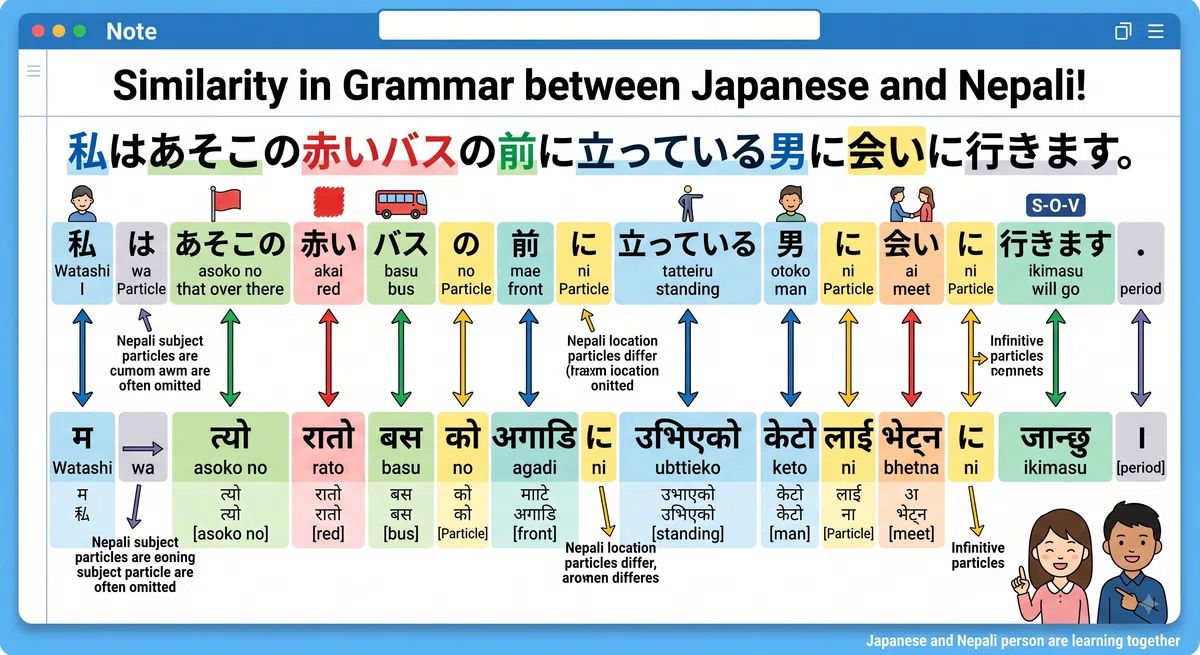
Nepali and Japanese have relatively similar word order.
Nepali and Japanese grammar are quite similar.
Nepalese students are by no means lacking in learning ability.
So why do so many students get stuck around the N4 level and not progress to N3 or N2?
This time, I decided to stop writing based solely on my own feelings.
I consulted materials from the Japan Foundation, JLPT, JFT-Basic, the Japanese government, the Japanese Embassy in Nepal, academic research, JALTAN, JALSAN, and others.
I then incorporated my own experiences working in the education system in Nepal.
Then, a large structure became visible.
The conclusion I've reached so far is this:
It's not that "Nepalese people's Japanese isn't improving."
The growth rate of the system for sending talent to Japan is outpacing the long-term development of the system for cultivating Japanese language skills.
I believe this is a major challenge currently facing Japanese language education in Nepal.
I personally didn't have much trouble learning Japanese.
Let me tell you a little about myself.
I went to Japan as an international student about 20 years ago.
And about three years after moving to Japan, I passed the JLPT N1 exam.
Of course, since I was a student, I did quite a lot of part-time jobs.
I didn't spend hours studying at my desk every day after getting home.
Rather, the day before the exam,
"It would be embarrassing if I fell asleep during the exam."
I thought about taking time off from my part-time job, sleeping for about 10 hours, and then going to the exam.
Looking back now, I don't recall feeling that learning Japanese itself was "extremely difficult."
Of course, this is based solely on my personal experience.
However, it is precisely because of this experience that I,
I'm not convinced by the explanation that "they can't speak Japanese because they're Nepalese."
That's right.
So why are so many students currently stuck around the N4 level?
First, look at these numbers.
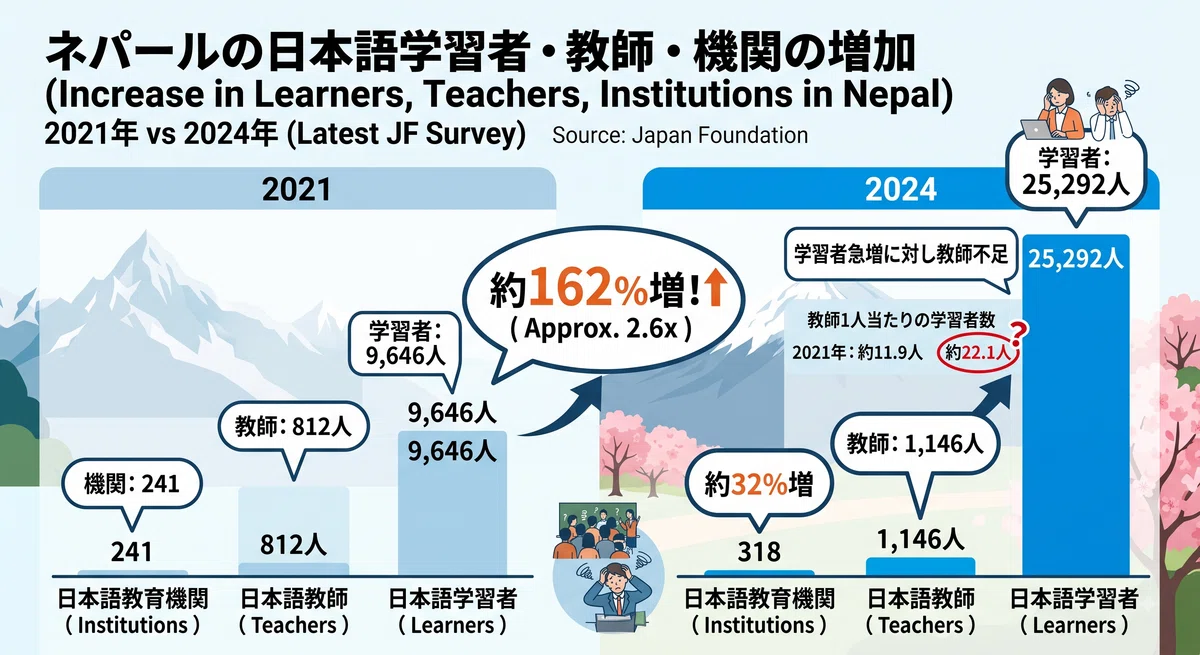
According to the "2024 Survey of Overseas Japanese Language Education Institutions" published by the Japan Foundation, Japanese language education in Nepal has expanded rapidly in recent years.
Japanese language education in Nepal
Item Increase in 2021 vs. 2024 Japanese Language Education Institutions 241 318 (approx. 32% increase) Japanese Language Teachers 812 1,146 (approx. 41% increase) Japanese Language Learners 9,646 25,292 (approx. 162% increase)
The number of learners has increased approximately 2.6 times in just three years.
This is wonderful.
So many Nepalese people are interested in Japan and are learning Japanese.
I think this presents great potential for Japan as well.
However, looking at the numbers from a different perspective reveals a different picture.
The number of learners increased by approximately 162%.
However, the number of teachers has only increased by about 41%.
A simple calculation shows that the number of learners per teacher is:2021: Approximately 11.9 people ↓
2024: Approximately 22.1 people
It has almost doubled.
Of course, this doesn't mean "22 students per class."
However, at least,
The rate at which people want to learn Japanese is increasing may not be keeping pace with the adequate training of personnel to teach Japanese.
I think this is an important point that emerges from the data.
And the reality of the "teacher shortage" that cannot be seen from data alone.
From here on, I'll be sharing stories based on my own experiences at the Japanese language school I run.
This year marks the fourth year since we started Hayabusa Japanese Language School.
Currently, the group has six schools in total, with over 900 students studying Japanese.
There are approximately 36 classes.
Naturally, Japanese language teachers are always needed.
When you advertise for teachers on Facebook or similar platforms, you receive inquiries from a variety of people.
What I feel there is,
"Being able to speak a little Japanese" and "being able to educate students as a teacher" are two completely different things.
That's the reality.
Among the applicants,
"I'm currently studying for the N3 level. I can teach up to the N4 level."
Some people say that.
Of course, I'm not saying that everyone who studies for the N3 level isn't suited to be a teacher.
but,
I'm still learning at an intermediate level myself, yet I'm on the teaching side, instructing beginners.
This indicates that there is a significant shortage of Japanese language teachers in many areas.
Furthermore, some applicants only check employment conditions such as salary, work location, working hours, and whether or not overtime is required, and show little interest in the educational philosophy or "what kind of students you want to cultivate."
Of course, checking the conditions is necessary.
The problem is,
There are cases where applicants appear to be applying for a job not because they are interested in "the job of teaching," but simply because it's "a job they can do."
is.
And after actually hiring them, there were further incidents that made me think even more.
A Japanese language teacher who borrowed money from students
About a year and a half ago, we hired a Japanese language teacher.
About a month and a half after I started working there, I discovered something surprising.
That teacher had borrowed money from several students and staff members.
The reason is,
"I have no money."
"I have to repay the money I borrowed from my friend."
There were various examples like these.
Upon further investigation, it became clear that the days on which the money was borrowed were strangely concentrated around Thursdays every week.
I was even more surprised when I learned the reason.
It was money intended for going out for drinks the following Friday night.
In other words,
He was using money borrowed from students for drinking.
Naturally, we asked that teacher to resign.
The amount borrowed from students was confirmed by the school and handled as part of the payroll settlement.
Of course, this does not represent all Japanese language teachers in Nepal.
There are many excellent and responsible teachers.
but,
"Teachers should be role models for their students."
Even basic professional ethics like this are sometimes not sufficiently shared.
This is a problem that goes beyond Japanese language ability.
Teachers who teach Japanese need to know more than just the language,
Manners.
A sense of responsibility.
time.
promise.
Attitude towards work.
A way of thinking that is necessary in Japanese society.
These are also things that should be conveyed to students.
That's precisely why it's necessary to cultivate the teachers themselves.
The day I was told, "I won't be coming in tomorrow."
There's another experience I'll never forget.
One evening, I suddenly received a message from a teacher who was in charge of about three classes.
"I won't be going to school starting tomorrow."
Upon checking the reason, it turned out that the teacher himself had applied to go to Japan through another company.
"If you teach Japanese at that school, you'll get a discount on service fees for traveling to Japan."
They said that these were the conditions they were presented with.
Therefore, they said they would be moving there the following day.
From the perspective of our competitors, we were able to acquire teachers.
From the individual's perspective, the cost of travel became cheaper.
However, I thought this:
The ones who deserve the most pity are the students who trusted that teacher and studied hard every day.
For students, teachers are not easily replaceable.
We meet face-to-face every day, ask questions, consult with each other, and build a relationship of trust.
They just end it with, "I won't be coming in tomorrow."
Of course, this is also a problem specific to this individual.
However, I myself,
"The fact that I hired someone like this as a teacher shows that there was a problem with my own hiring process."
I deeply regretted it.
Why does this happen?
When you hire people on-site, a certain pattern emerges.
I returned to Japan prematurely due to some unforeseen circumstances.
I can speak Japanese to some extent.
However, there aren't many jobs in Nepal where you can make use of your Japanese language skills.
Therefore,
"I can speak Japanese, so I'll become a Japanese language teacher."
This is the result.
However,
Being able to speak Japanese.
Understanding Japanese culture.
Accepting the rules of the workplace.
Teaching others.
Nurturing students.
These are all different abilities.
Nevertheless, we have to hire teachers because there is a shortage.
There are also few adequate teacher training programs.
He himself wants to go to Japan in the future.
Then,
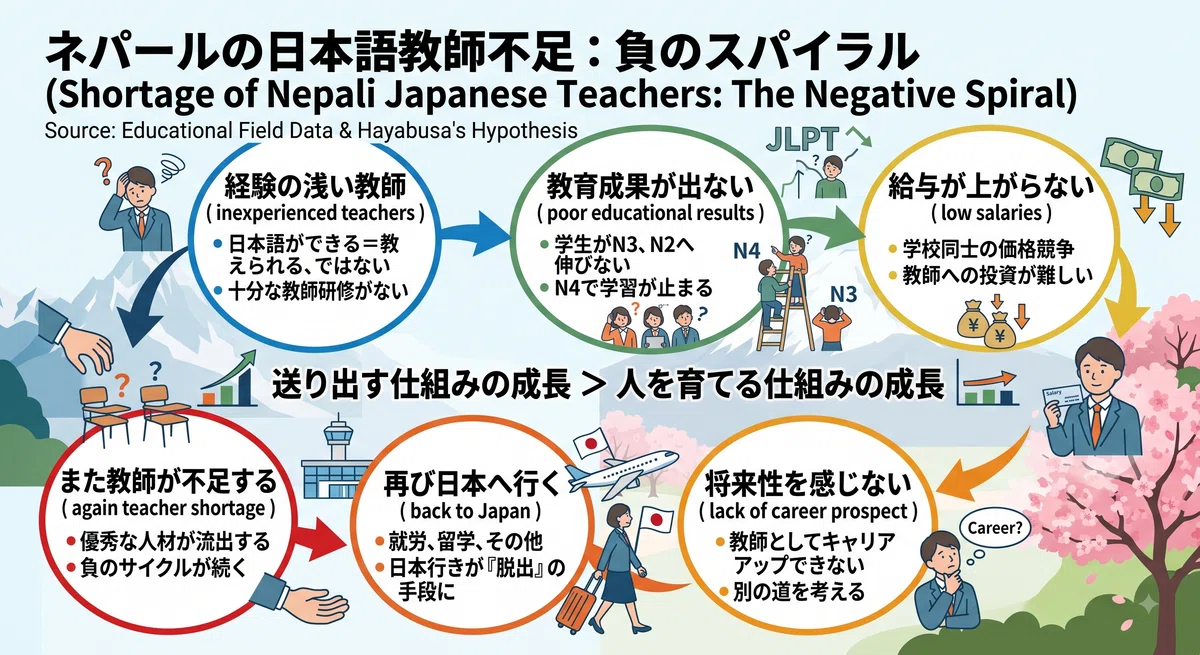
Inexperienced teachers ↓ Poor educational results ↓ Low salaries ↓ No future prospects in teaching ↓ Return to Japan ↓ Another teacher shortage
This creates a vicious cycle .
I believe this is a very significant problem in Japanese language education in Nepal.
I see the same problem with staff recruitment.
This isn't just about teachers.
At Hayabusa Japanese Language School, students are also asked to help clean classrooms, hallways, toilets, and other areas.
Why?
If you go to Japan, you will have opportunities to clean, both at school and at work.
However, in Nepal,
"I've never cleaned my house."
It's not uncommon to find students like that.
That's why cleaning has been part of the education even before we went to Japan.
And of course, the staff will also help with the cleaning alongside the students.
However, when I mention this during staff interviews,
"I want to work in an office, so I don't want to do cleaning."
It is sometimes said that...
Even highly capable individuals sometimes decline the offer for this reason.
"Office work involves using computers."
"Cleaning is not my job."
That's my opinion.
Of course, there are differences in culture and work ethics.
However, what Japanese companies are looking for in foreign talent is
We're looking for someone who can look at the bigger picture and act accordingly, not just someone who does their assigned tasks.
This is often the case.
Herein lies another example of the gap between Nepalese and Japanese work ethics.
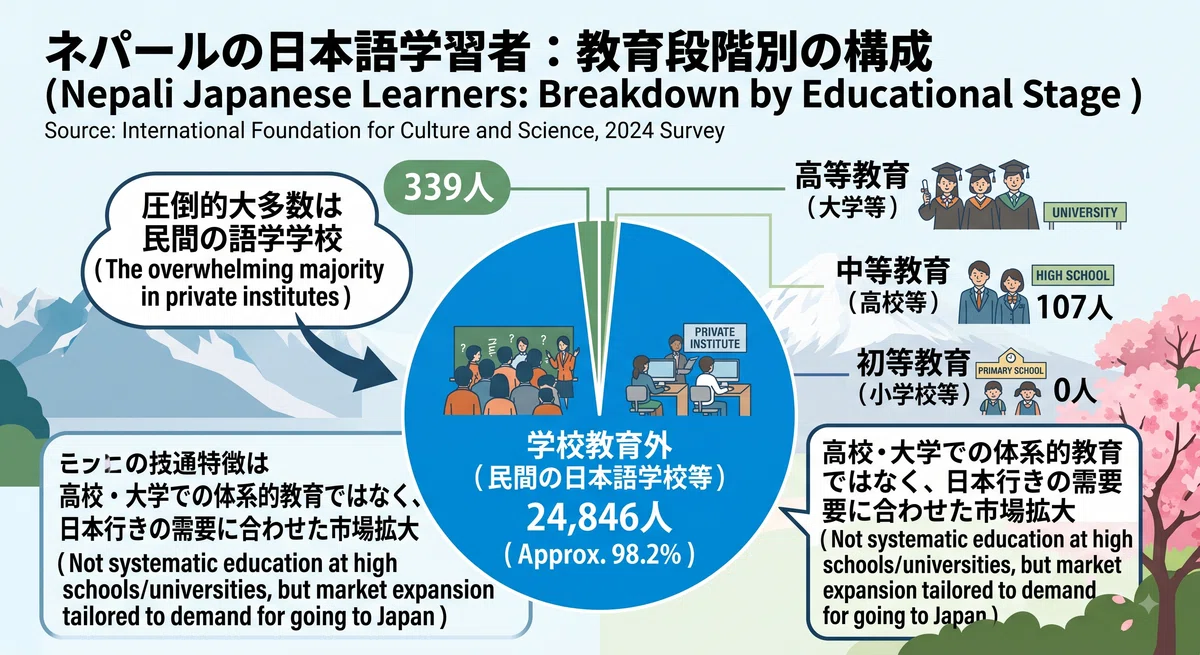
Even more surprising is the figure: 98% are "outside of formal schooling."
Here's a breakdown of the 25,292 Japanese language learners in 2024 by educational level.
Number of learners by educational stage: Primary education: 0, Secondary education: 107, Higher education: 339, Outside of schooling: 24,846
Approximately 98.2% of learning takes place outside of formal schooling.
This is a figure that I would like Japanese people involved in human resources and Japanese language education to be aware of.
Currently, the group has six schools in total, with over 900 students studying Japanese.
There are approximately 36 classes.
Naturally, Japanese language teachers are always needed.
When you advertise for teachers on Facebook or similar platforms, you receive inquiries from a variety of people.
What I feel there is,
"Being able to speak a little Japanese" and "being able to educate students as a teacher" are two completely different things.
That's the reality.
Among the applicants,
"I'm currently studying for the N3 level. I can teach up to the N4 level."
Some people say that.
Of course, I'm not saying that everyone who studies for the N3 level isn't suited to be a teacher.
but,
I'm still learning at an intermediate level myself, yet I'm on the teaching side, instructing beginners.
This indicates that there is a significant shortage of Japanese language teachers in many areas.
Furthermore, some applicants only check employment conditions such as salary, work location, working hours, and whether or not overtime is required, and show little interest in the educational philosophy or "what kind of students you want to cultivate."
Of course, checking the conditions is necessary.
The problem is,
There are cases where applicants appear to be applying for a job not because they are interested in "the job of teaching," but simply because it's "a job they can do."
is.
And after actually hiring them, there were further incidents that made me think even more.
A Japanese language teacher who borrowed money from students
About a year and a half ago, we hired a Japanese language teacher.
About a month and a half after I started working there, I discovered something surprising.
That teacher had borrowed money from several students and staff members.
The reason is,
"I have no money."
"I have to repay the money I borrowed from my friend."
There were various examples like these.
Upon further investigation, it became clear that the days on which the money was borrowed were strangely concentrated around Thursdays every week.
I was even more surprised when I learned the reason.
It was money intended for going out for drinks the following Friday night.
In other words,
He was using money borrowed from students for drinking.
Naturally, we asked that teacher to resign.
The amount borrowed from students was confirmed by the school and handled as part of the payroll settlement.
Of course, this does not represent all Japanese language teachers in Nepal.
There are many excellent and responsible teachers.
but,
"Teachers should be role models for their students."
Even basic professional ethics like this are sometimes not sufficiently shared.
This is a problem that goes beyond Japanese language ability.
Teachers who teach Japanese need to know more than just the language,
Manners.
A sense of responsibility.
time.
promise.
Attitude towards work.
A way of thinking that is necessary in Japanese society.
These are also things that should be conveyed to students.
That's precisely why it's necessary to cultivate the teachers themselves.
The day I was told, "I won't be coming in tomorrow."
There's another experience I'll never forget.
One evening, I suddenly received a message from a teacher who was in charge of about three classes.
"I won't be going to school starting tomorrow."
Upon checking the reason, it turned out that the teacher himself had applied to go to Japan through another company.
"If you teach Japanese at that school, you'll get a discount on service fees for traveling to Japan."
They said that these were the conditions they were presented with.
Therefore, they said they would be moving there the following day.
From the perspective of our competitors, we were able to acquire teachers.
From the individual's perspective, the cost of travel became cheaper.
However, I thought this:
The ones who deserve the most pity are the students who trusted that teacher and studied hard every day.
For students, teachers are not easily replaceable.
We meet face-to-face every day, ask questions, consult with each other, and build a relationship of trust.
They just end it with, "I won't be coming in tomorrow."
Of course, this is also a problem specific to this individual.
However, I myself,
"The fact that I hired someone like this as a teacher shows that there was a problem with my own hiring process."
I deeply regretted it.
Why does this happen?
When you hire people on-site, a certain pattern emerges.
I returned to Japan prematurely due to some unforeseen circumstances.
I can speak Japanese to some extent.
However, there aren't many jobs in Nepal where you can make use of your Japanese language skills.
Therefore,
"I can speak Japanese, so I'll become a Japanese language teacher."
This is the result.
However,
Being able to speak Japanese.
Understanding Japanese culture.
Accepting the rules of the workplace.
Teaching others.
Nurturing students.
These are all different abilities.
Nevertheless, we have to hire teachers because there is a shortage.
There are also few adequate teacher training programs.
He himself wants to go to Japan in the future.
Then,
Inexperienced teachers
↓
Poor educational results
↓
Low salaries
↓
No future prospects in teaching
↓
Return to Japan
↓
Another teacher shortage
This creates a vicious cycle .
I believe this is a very significant problem in Japanese language education in Nepal.
I see the same problem with staff recruitment.
This isn't just about teachers.
At Hayabusa Japanese Language School, students are also asked to help clean classrooms, hallways, toilets, and other areas.
Why?
If you go to Japan, you will have opportunities to clean, both at school and at work.
However, in Nepal,
"I've never cleaned my house."
It's not uncommon to find students like that.
That's why cleaning has been part of the education even before we went to Japan.
And of course, the staff will also help with the cleaning alongside the students.
However, when I mention this during staff interviews,
"I want to work in an office, so I don't want to do cleaning."
It is sometimes said that...
Even highly capable individuals sometimes decline the offer for this reason.
"Office work involves using computers."
"Cleaning is not my job."
That's my opinion.
Of course, there are differences in culture and work ethics.
However, what Japanese companies are looking for in foreign talent is
We're looking for someone who can look at the bigger picture and act accordingly, not just someone who does their assigned tasks.
This is often the case.
Herein lies another example of the gap between Nepalese and Japanese work ethics.
Even more surprising is the figure: 98% are "outside of formal schooling."
Here's a breakdown of the 25,292 Japanese language learners in 2024 by educational level.
Number of learners by educational stage: Primary education: 0, Secondary education: 107, Higher education: 339, Outside of schooling: 24,846
Approximately 98.2% of learning takes place outside of formal schooling.
This is a figure that I would like Japanese people involved in human resources and Japanese language education to be aware of.
Currently, the group has six schools in total, with over 900 students studying Japanese.
There are approximately 36 classes.
Naturally, Japanese language teachers are always needed.
When you advertise for teachers on Facebook or similar platforms, you receive inquiries from a variety of people.
What I feel there is,
"Being able to speak a little Japanese" and "being able to educate students as a teacher" are two completely different things.
That's the reality.
Among the applicants,
"I'm currently studying for the N3 level. I can teach up to the N4 level."
Some people say that.
Of course, I'm not saying that everyone who studies for the N3 level isn't suited to be a teacher.
but,
I'm still learning at an intermediate level myself, yet I'm on the teaching side, instructing beginners.
This indicates that there is a significant shortage of Japanese language teachers in many areas.
Furthermore, some applicants only check employment conditions such as salary, work location, working hours, and whether or not overtime is required, and show little interest in the educational philosophy or "what kind of students you want to cultivate."
Of course, checking the conditions is necessary.
The problem is,
There are cases where applicants appear to be applying for a job not because they are interested in "the job of teaching," but simply because it's "a job they can do."
is.
And after actually hiring them, there were further incidents that made me think even more.
A Japanese language teacher who borrowed money from students
About a year and a half ago, we hired a Japanese language teacher.
About a month and a half after I started working there, I discovered something surprising.
That teacher had borrowed money from several students and staff members.
The reason is,
"I have no money."
"I have to repay the money I borrowed from my friend."
There were various examples like these.
Upon further investigation, it became clear that the days on which the money was borrowed were strangely concentrated around Thursdays every week.
I was even more surprised when I learned the reason.
It was money intended for going out for drinks the following Friday night.
In other words,
He was using money borrowed from students for drinking.
Naturally, we asked that teacher to resign.
The amount borrowed from students was confirmed by the school and handled as part of the payroll settlement.
Of course, this does not represent all Japanese language teachers in Nepal.
There are many excellent and responsible teachers.
but,
"Teachers should be role models for their students."
Even basic professional ethics like this are sometimes not sufficiently shared.
This is a problem that goes beyond Japanese language ability.
Teachers who teach Japanese need to know more than just the language,
Manners.
A sense of responsibility.
time.
promise.
Attitude towards work.
A way of thinking that is necessary in Japanese society.
These are also things that should be conveyed to students.
That's precisely why it's necessary to cultivate the teachers themselves.
The day I was told, "I won't be coming in tomorrow."
There's another experience I'll never forget.
One evening, I suddenly received a message from a teacher who was in charge of about three classes.
"I won't be going to school starting tomorrow."
Upon checking the reason, it turned out that the teacher himself had applied to go to Japan through another company.
"If you teach Japanese at that school, you'll get a discount on service fees for traveling to Japan."
They said that these were the conditions they were presented with.
Therefore, they said they would be moving there the following day.
From the perspective of our competitors, we were able to acquire teachers.
From the individual's perspective, the cost of travel became cheaper.
However, I thought this:
The ones who deserve the most pity are the students who trusted that teacher and studied hard every day.
For students, teachers are not easily replaceable.
We meet face-to-face every day, ask questions, consult with each other, and build a relationship of trust.
They just endit with,"I won't be coming in tomorrow."
Of course, this is also a problem specific to this individual.
However, I myself,
"The fact that I hired someone like this as a teacher shows that there was a problem with my own hiring process."
I deeply regretted it.
Why does this happen?
When you hire people on-site, a certain pattern emerges.
I returned to Japan prematurely due to some unforeseen circumstances.
I can speak Japanese to some extent.
However, there aren't many jobs in Nepal where you can make use of your Japanese language skills.
Therefore,
"I can speak Japanese, so I'll become a Japanese language teacher."
This is the result.
However,
Being able to speak Japanese.
Understanding Japanese culture.
Accepting the rules of the workplace.
Teaching others.
Nurturing students.
These are all different abilities.
Nevertheless, we have to hire teachers because there is a shortage.
There are also few adequate teacher training programs.
He himself wants to go to Japan in the future.
Then,
Inexperienced teachers ↓ Poor educational results ↓ Low salaries ↓ No future prospects in teaching ↓ Return to Japan ↓ Another teacher shortage
Thiscreatesa vicious cycle .
I believe this is a very significant problem in Japanese language education in Nepal.
I see the same problem with staff recruitment.
This isn't just about teachers.
At Hayabusa Japanese Language School, students are also asked to help clean classrooms, hallways, toilets, and other areas.
Why?
If you go to Japan, you will have opportunities to clean, both at school and at work.
However, in Nepal,
"I've never cleaned my house."
It's not uncommon to find students like that.
That's why cleaning has been part of the education even before we went to Japan.
And of course, the staff will also help with the cleaning alongside the students.
However, when I mention this during staff interviews,
"I want to work in an office, so I don't want to do cleaning."
It is sometimes said that...
Even highly capable individuals sometimes decline the offer for this reason.
"Office work involves using computers."
"Cleaning is not my job."
That's my opinion.
Of course, there are differences in culture and work ethics.
However, what Japanese companies are looking for in foreign talent is
We're looking for someone who can look at the bigger picture and act accordingly, not just someone who does their assigned tasks.
This is often the case.
Herein lies another example of the gap between Nepalese and Japanese work ethics.
Even more surprising is the figure: 98% are "outside of formal schooling."
Here's a breakdown of the 25,292 Japanese language learners in 2024 by educational level.
Number of learners by educational stage: Primary education: 0, Secondary education: 107, Higher education: 339, Outside of schooling:24,846
Approximately 98.2% of learning takes place outside of formal schooling.
This is a figure that I would like Japanese people involved in human resources and Japanese language education to be aware of.
Japanese language education in Nepal is almost entirely supported by the private market.
Japanese is not widely and systematically taught in high schools and universities, nor does it necessarily lead to opportunities for studying abroad or finding employment.
On the contrary.
"I want to study in Japan."
"I want to go to Japan under the Specified Skills Visa program."
"I want to go to Japan for a training and employment program."
There is a prior demand for this.
In response to this demand, the market for private Japanese language schools and consultancy services is expanding.
The Japan Foundation also cites the increase in Japanese language education institutions, teachers, and learners in Nepal as a result of the growing number of learners aiming to study or work in Japan.
I believe there's a very important point here.
Do you want to "study Japanese" or "go to Japan"?
These two are similar.
However, they are fundamentally different.
To students,
"Do you want to go to Japan?"
If you ask,
"yes!"
I answer immediately.
So,
"Do you want to take the N3 exam?"
"After going to Japan for three years, will you take the N2 exam?"
"Do you want to make Japanese a skill you can use for a lifetime?"
I asked.
Then, some students' moods change slightly.
In fact, within the Hayabusa Nepal group, approximately 900 people are studying Japanese, divided into about 36 classes.
The majority of them are at the N5/N4 level.
Classes that cover N3 are only a small fraction of the total.
Why is that?
It's very simple.
Many students,
"If you have an N4 level certification, you can proceed with the procedures to go to Japan."
That's because I think so.
In other words,
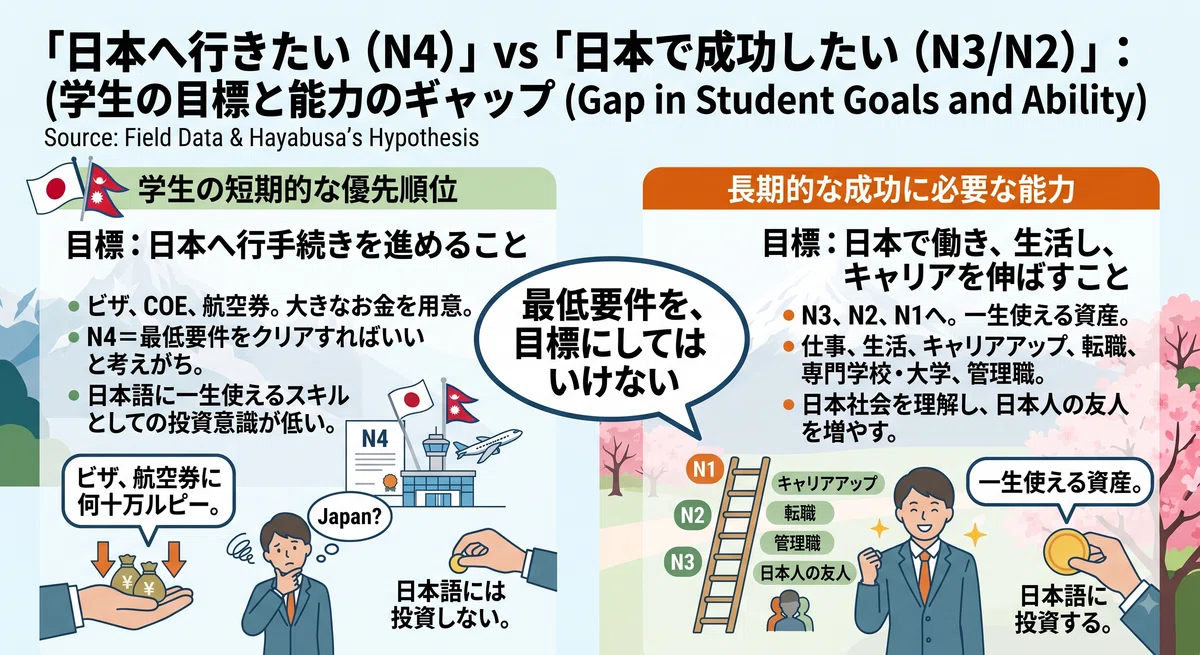
N4 = Japanese language skills necessary to go to Japan.
N3 = Japanese language level necessary for working, living, and advancing your career in Japan.
When comparing these two,
For students, the short-term priority is often N4.
I'll pay for a visa, but I don't want to pay for the Japanese language.
This is something I strongly feel when I'm working in the field.
COE.
visa.
Air ticket.
Consultancy fees.
Many families prepare a large sum of money if they have the opportunity to go to Japan.
However,
Regarding Japanese language education,
"Can't you make it any cheaper?"
"How many months will it take to finish?"
"I only need to pass the N4 level."
This is the result.
I often tell my students this:
You only need one visa.
I only need one airline ticket.
but,
You can use Japanese for your entire life.
Yet, even though they can spend hundreds of thousands or millions of rupees on "travel," they don't invest enough in "Japanese," a skill they can use for a lifetime.
Is this solely the students' responsibility?
I don't think so.
We in the study abroad industry, the recruitment industry, and the schools,
They have been more focused on promoting the "opportunity to go to Japan" than on the "value of learning Japanese."
There should be sides as well.
The same structure has been pointed out in academic research.
This isn't just my personal feeling.
A 2022 study by Dipesh Kharel analyzes how Nepalese educational consultancies, Japanese language schools, students, and the systems of both countries are interconnected and have contributed to student migration from Nepal to Japan.
Furthermore, in 2025, Sanjaya Karki of Chiba University conducted research on Nepalese students attending Japanese language schools.
According to the study, of the 112,593 National Authorization Certificates (NOCs) for overseas study issued by the Nepalese government in the 2023/24 fiscal year, 34,731 were for Japan.
And most of them were studying abroad at Japanese language schools.
In other words,
Japanese language schools function not only as "places to learn Japanese" but also as "gateways to travel to Japan."
That's one aspect of it.
Karki's research is based on interviews with a small number of people, so it cannot be generalized to all Nepalese students.
However, there are some very thought-provoking examples.
This is an example of a student who, despite not receiving sufficient Japanese language instruction in Nepal, proceeded with the application process for studying abroad and subsequently struggled with school life and part-time jobs due to insufficient Japanese language skills after arriving in Japan.
This is not solely a matter of the Nepalese consultancy.
I believe Japan also bears some responsibility.
There is also a problem on the Japanese side, which only sees "Japanese language schools" as a business.
On the Japanese side,
"How many students should we gather?"
"How do we fill the capacity?"
Are there schools that prioritize this too much?
To what extent are students studying Japanese locally?
Are you actually attending classes?
Do you have the motivation to learn Japanese?
Without sufficient verification,
We will accept it once all the necessary documents are in order.
If such a system exists,
Schools that offer stricter education on the Nepalese side may be at a disadvantage.
In fact, at our school as well,
"With other consultancys, you could go to Japan without having to study Japanese this much."
"Why is N4 necessary for Hayabusa?"
Some students are told this and end up switching to other companies.
If you only consider business,
"In that case, let's lower the standards."
That might be the case.
However, if you do that, it ceases to be education.
Therefore, I
"Why is it that schools that teach Japanese seriously sometimes find themselves at a disadvantage when it comes to recruiting students?"
I believe we need to change the very structure of the market.
Is it true that Nepalese people are at a disadvantage when learning Japanese?
There's one more thing I'd like everyone in Japan to know.
Nepali and Japanese are not the same language.
The characters are also different.
Hiragana.
Katakana.
And then there are the kanji characters.
Kanji characters, in particular, pose a significant hurdle for Nepalese people who do not use them.
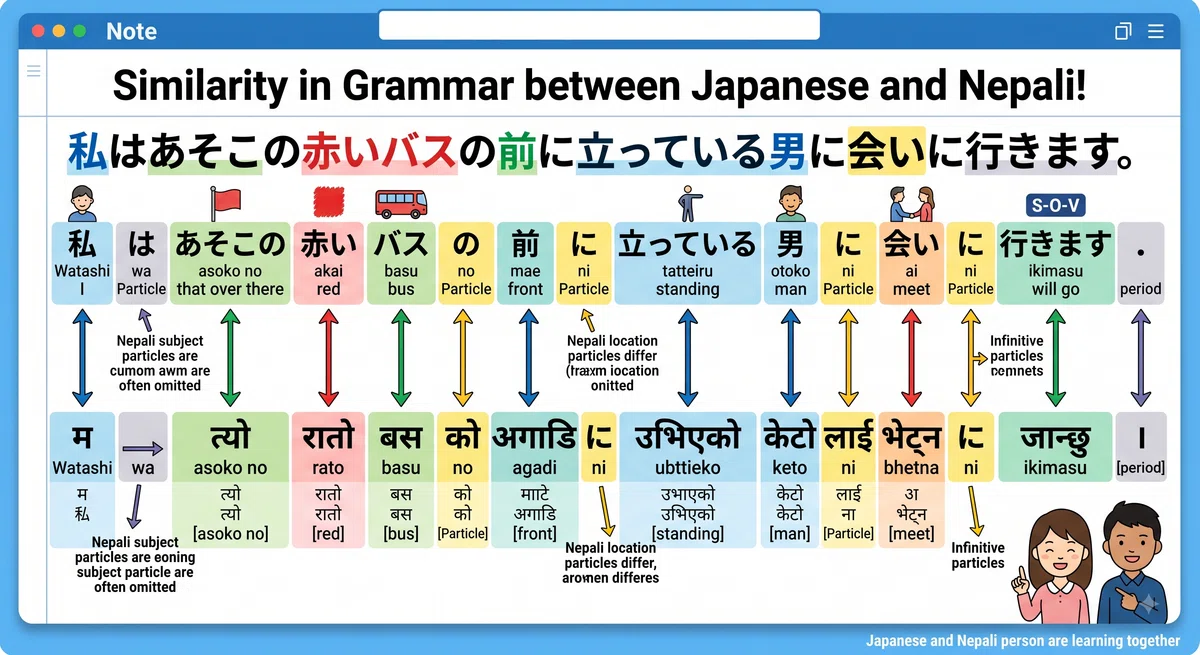
However, grammar has some interesting commonalities.
In an interview with Ambassador Kikuta published by the Japanese Embassy in Nepal, it was mentioned that Nepali has many similarities with Japanese in terms of word order and grammar.
for example,
Japanese
I am going to Japan.
Nepali
म जापान जान्छु। Ma Japan jānchu.
English
I go to Japan.
Japanese and Nepali basically share the sense that "the verb comes at the end."
The same applies to slightly longer sentences.
Japanese
I'm going to meet the man standing in front of that red bus over there.
Nepali
म त्यो रातो बसको अगाडि उभिएको केटोलाई भेट्न जान्छु।
English
I am going to meet the man standing in front of that red bus.
Thus, Japanese and Nepali have quite similar word order sensibilities.
Therefore, I
"Nepalese people are not good at Japanese."
I cannot agree with that explanation.
Rather, the problem is,
An educational environment that progresses from beginner to intermediate level.
I think it might be located there.
The "N4 barrier" as seen in the JLPT scores
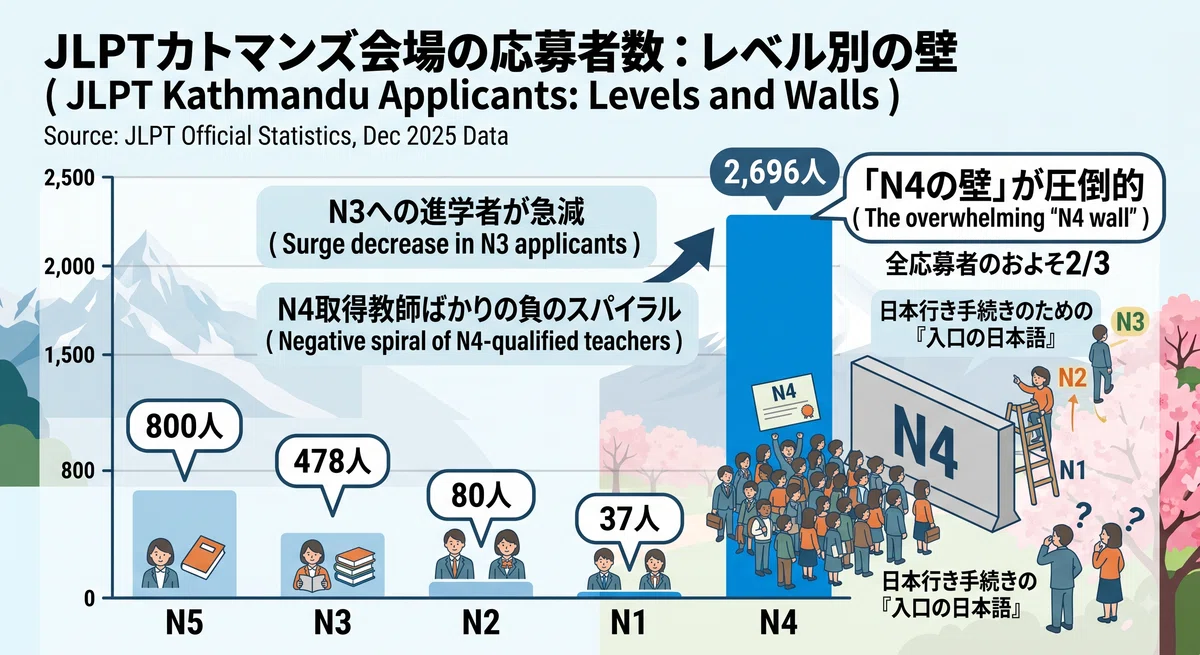
Let's look at the number of JLPT applicants at the Kathmandu venue in December 2025.
Number of applicants by level: N1 37, N2 80, N3 478, N4 2,696, N5 800. Total: 4,091.
N4 alone accounts for approximately two-thirds of all applicants.
Of course, based on these numbers alone,
"Nepalese people stop studying at the N4 level."
We cannot conclude that this is the case.
Some people take exams such as JFT-Basic or NAT-TEST.
but,
N4: 2,696 people
N3: 478 people
N2: 80 people
This difference simply cannot be ignored.
Many people gather at "Japanese as an entry point" for those going to Japan.
The number of people who move forward from there decreases sharply.
This may reveal one of the challenges facing Japanese language education in Nepal.
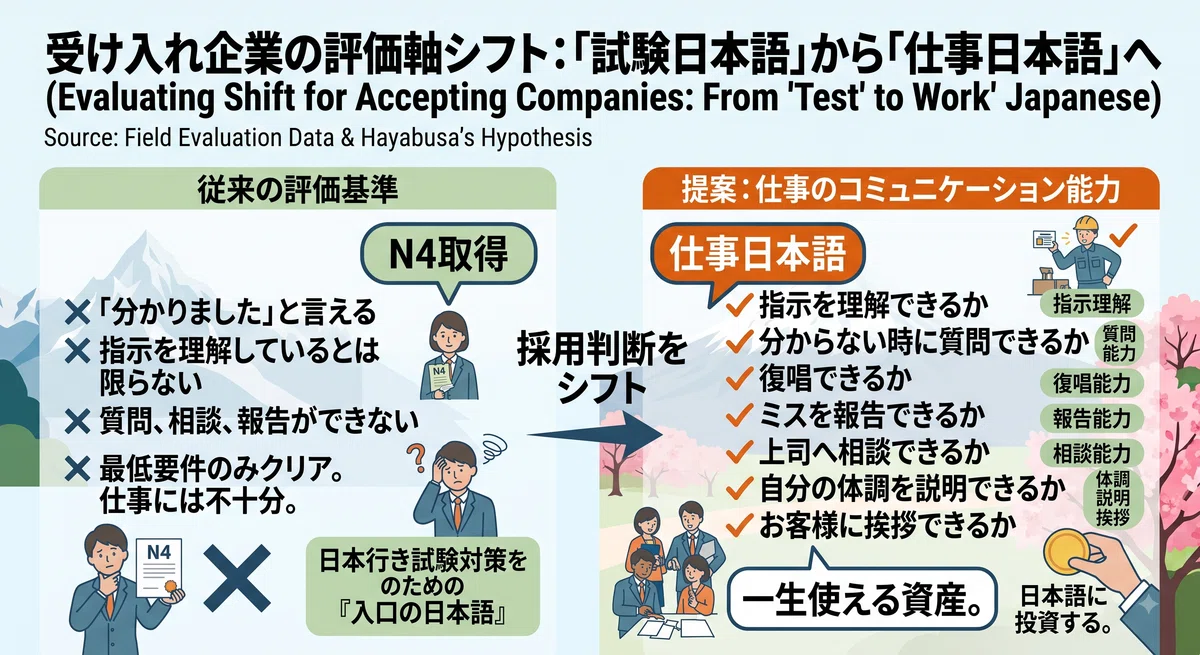
N4 Japanese and "Japanese for working in Japan" are different.
This is something that I would like recruiters at Japanese companies to know as well.
"I have an N4."
That thing,
"I can communicate at work."
They are not the same thing.
for example,
"Understood"
It can be said that...
However, they may not truly understand the instructions.
What is needed in the workplace is,
"I understand up to this point, but I don't understand from here on."
"Say that again, please"
"Does that mean ○○?"
"I was wrong."
"This is the problem we are currently facing."
"What should I do?"
It's an ability that can be described as such.
I will
"Japanese for work"
That's what we call it.
The Japan Foundation's JFT-Basic exam is also designed to measure the Japanese language ability of foreigners living in Japan to communicate in real-life situations.
In future training and employment programs, the initial Japanese language requirement will be incorporated into the system.
Here's one thing I'm worried about.
Once the minimum standards are set,
The market
"As long as you meet the minimum standards, that's all that matters."
Wouldn't it be better to move in that direction?
A minimum standard of service is necessary.
but,
Minimum standards should not be used as educational goals.
If you want to train people to work in Japan for 3, 5, or 10 years,
We need to consider the Japanese language beyond that point.
The Japanese government is also providing support. However, is it reaching the people on the ground?
Through this research, I've come to realize something new about myself.
"The Japanese government has done nothing."
That way of saying it is incorrect.
The Japan Foundation provides grants for Japanese language education for people living and working in Japan, as well as support for teaching materials and teacher training, targeting countries including Nepal.
There are also excellent educational materials for foreigners living in Japan, such as "Irodori."
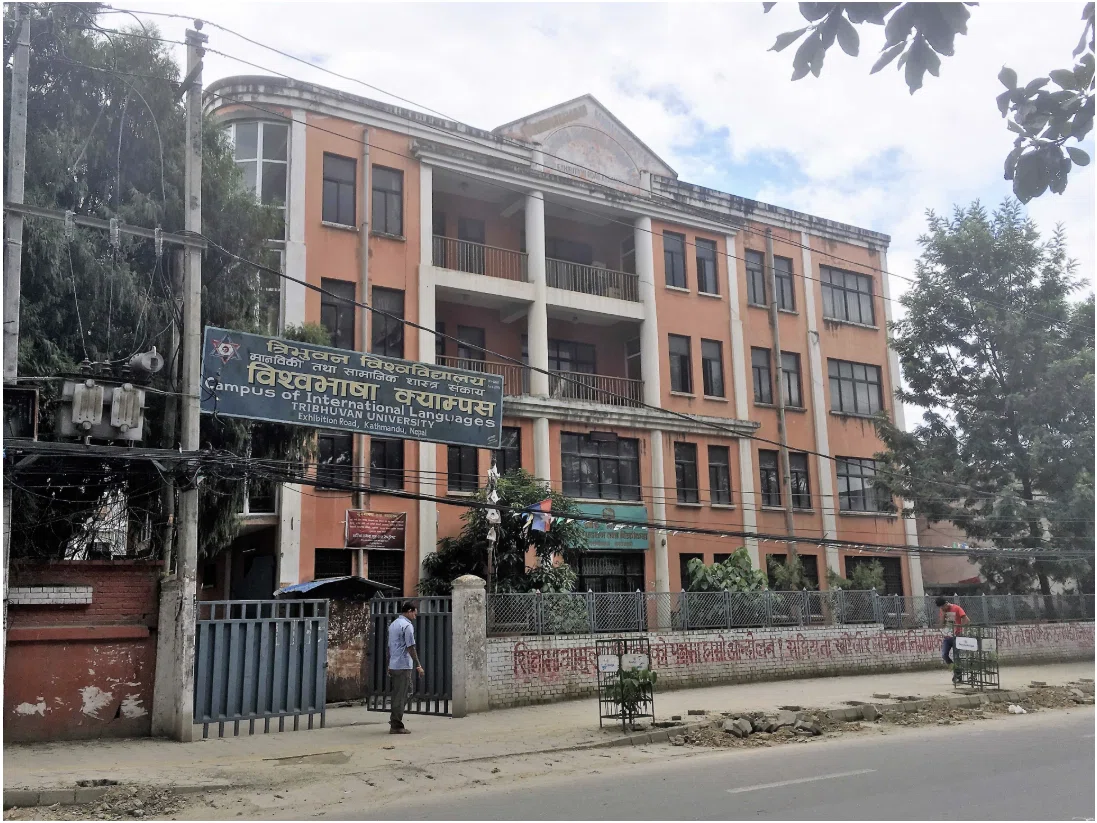
Furthermore, in March 2026, the Japanese government signed an agreement to provide grant assistance worth US$64,885 to improve the Japanese language classroom at the Campus of International Languages at Tribhuvan University.
This initiative supports the digitalization of the Japanese language education environment through measures such as the installation of electronic smartboards and classroom renovations.
I think this is a very good thing.
On the other hand, there are over 25,000 Japanese language learners in Nepal, the majority of whom are in private educational institutions.
Furthermore, the Japan Foundation does not have a permanent overseas office in Nepal; its main base in South Asia is New Delhi.
Therefore, I
"We do not provide support."
Rather than criticizing, I would like to ask this question.
Given that the Japanese language learning market has grown 2.6 times in the last three years, is the current scale of teacher and educational support sufficient?
Equipment is also important.
Teaching materials are also important.
However, in the end,
I'm a teacher.
We shouldn't just end it with "the quality of teachers in Nepal is poor."
So, is the quality of Japanese language teachers the problem?
We shouldn't jump to conclusions here either.
Even after investigating this time,
Average salary of a Japanese language teacher
Number of teachers with N1 certification
Number of teachers with N2 certification
Number of teachers teaching at or below N3 level
Annual teacher training hours
Average length of service
I was unable to find any reliable, publicly available nationwide statistics on these topics.
Therefore,
"It's no good because they're all N3 teachers."
"The quality of teachers is low because their salaries are low."
We cannot make such a definitive statement without data.








 EN
EN
 JA
JA