
![Where have all the prospective students gone? From 130 to 20. Even though the number of Japanese language learners is increasing! [Part 1]](https://hayabusanepal.com/storage/articles/images/tRnlQbhxzKgDUGmgsHRKXLtgNGtjTzxFx7NRagjr.jpg)
Last April, 130 students expressed interest in studying in Japan. This year, the number is around 20.
For me, running the Hayabusa Japanese Language School in Nepal, this is a change I cannot ignore. A simple calculation shows a decrease of approximately 85%. From a school management perspective, this is an extremely difficult situation.However, there is one more number I would like to share with you. Currently, over 900 students are studying Japanese at Hayabusa. The number of Japanese language learners is actually increasing. While the number of people wishing to study in Japan is decreasing, the number of people studying Japanese is increasing. Why is this happening? What we're seeing on the ground is an increase in students who want to work in Japan through programs like the Specified Skills Visa and the upcoming Training and Employment Program. This change cannot be explained simply by assuming that young people have lost their desire to go to Japan. I feel that my purpose and method for traveling to Japan are being re-evaluated. I want to share this change with schools and companies in Japan, from the perspective of education in Nepal. This time, I will consider the background by looking at the history of Japanese language schools, the financial situation of students studying abroad, the Japanese system, and pre-arrival education.
Even if the classroom is full, it doesn't necessarily mean that the next group of international students will show up.
I've heard from teachers in charge of recruitment at Japanese language schools in Japan that recruiting in Nepal is difficult. Tredekim Co., Ltd.'s "Japanese Language Education Industry News" also reports that schools with diverse nationalities and geographical locations are saying that recruiting for April 2027 is proving difficult. However, the original article only reflects the situation at the interview stage. It does not prove a decrease in the total number of final applications nationwide. While I appreciate Tredecim providing us with material to consider changes in the industry, I would like to carefully distinguish between the two. ( Tredecim's original article) In fact, according to a survey by the Japan Student Services Organization (JASSO), there were 408,069 international students as of May 1, 2025. The number of students enrolled in Japanese language institutions was 140,174, an increase from the previous year. (JASSO 2025 Survey) These figures and the sense of urgency felt by the recruiters are not contradictory. The number of enrolled students represents those who have already come to Japan to study. The response to recruitment, on the other hand, reflects the movement of those who are yet to come. Schools hire teachers and prepare classrooms and dormitories even before students enroll. A decrease in recruitment doesn't mean that rent and personnel costs will be halved the following month. They need to anticipate the next changes while their classrooms are still full.
Nepalese students studying in Japan began in 1902 with eight students.
The study of history by young Nepalis in Japan is not a recent phenomenon. According to documents from the Japanese Embassy in Nepal, in 1902, the Nepalese government sent eight young men to Japan. They arrived in Yokohama on June 17th. The government covered their travel expenses, tuition, and living expenses, and the students studied agriculture, mechanical engineering, mining, and chemistry. ( Historical documents from the Japanese Embassy in Nepal)
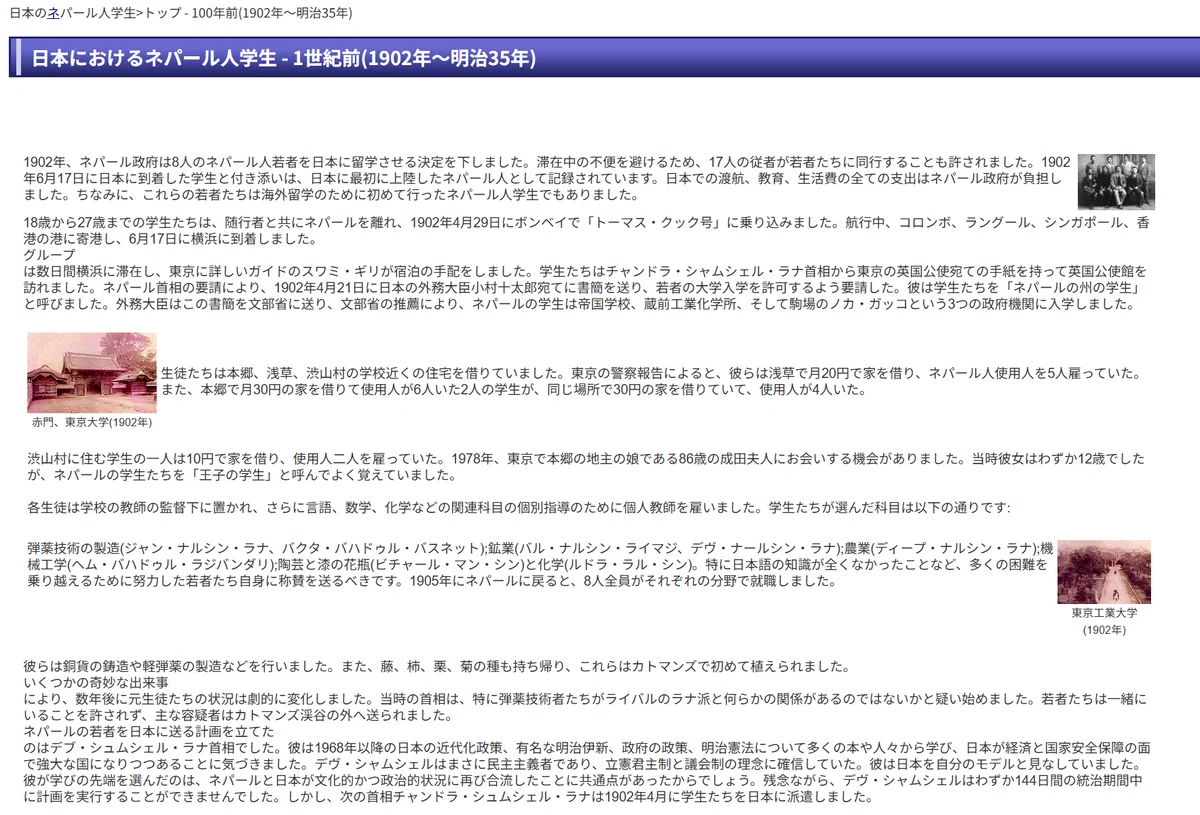
At that time, Japan was an Asian country undergoing modernization. There were young people who sought to learn knowledge and technology from Japan. I see in this history something that connects to our work today. On the other hand, in the modern lineage of Japanese language education for international students, there is the event in 1896 when Jigoro Kano accepted 13 students from China. This was an initiative that combined Japanese language with general education. While it is not the sole origin of Japanese language education as a whole, it shows the relationship of learning a language and then progressing to specialized education. ( Research by Junichiro Sakai) The fields of study students choose today, and their family circumstances, are different from those of the past. Nevertheless, the question of "what to study in Japan and how to use that knowledge" remains just as important.
From an era dominated by China and South Korea to Nepal's rise as a major power!
Japan's acceptance of international students has expanded in line with national policies. In 1983, the "100,000 International Students Plan" was launched, followed by the "300,000 International Students Plan" in 2008. The latter was a plan to support not only entry into Japan but also learning environments and post-graduation employment. ( Ministry of Education, Culture, Sports, Science and Technology - Policy History , 300,000 Students Plan)
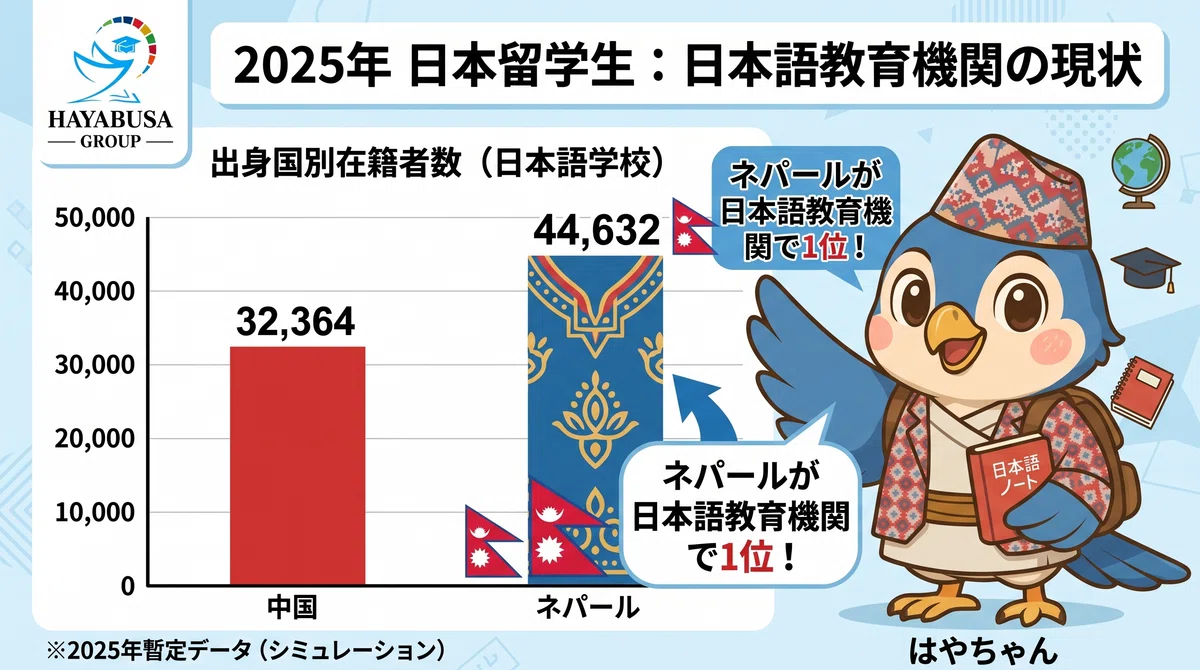
According to 2010 statistics on international students at universities and vocational schools, China, South Korea, and Taiwan were the top countries. Subsequently, in the 2010s, the presence of Vietnamese and Nepalese students increased. However, the 2010 statistics do not directly reflect the current total number of students (which includes all Japanese language schools), so a direct comparison of increases and decreases in numbers is not possible. (JASSO 2010 survey) According to a survey of member schools by the Association for the Promotion of Japanese Language Education, in 2014, China accounted for 37.0%, Vietnam 31.5%, and Nepal 10.9%. While Chinese students remain a major source, the list of sending countries has expanded. ( Survey by the Association for the Promotion of Japanese Language Education) The underlying factors likely include expectations for higher education and employment in Japan, the activities of local schools and recruitment agencies, and information passed down from senior to junior students. Even if the number of students from other countries increased after the earthquake or diplomatic issues, history cannot be explained by a single event. Let's look at the current situation based on the 2025 JASSO survey. Country of Origin: All international students in Japan, including those attending Japanese language schools: China 131,097 (32,364); Nepal 100,239 (44,632); Vietnam 43,366 (19,686); Myanmar 29,413 (16,165); Sri Lanka 17,626 (8,090) Source: JASSO 2025 Detailed Table . All figures represent the number of enrolled members. Looking solely at Japanese language education institutions, Nepal is the largest source country. The changes occurring in Nepal are no longer limited to just a few schools in Japan. Regarding the number of schools, an industry analysis based on the list of schools announced in April 2026 states there are approximately 851 schools. However, the transition to the accreditation system is progressing, and this is not a definitive figure that counts all schools operating nationwide without duplication as of September. It is also necessary to separate this from statistics that include local Japanese language schools, etc. ( Summary and explanation of the number of schools announced) The number of students enrolled in Japanese language education institutions increased from approximately 26,000 in 2011 to approximately 140,000 in 2025, including the impact of the COVID-19 pandemic. Precisely because this is such a rapidly growing industry, it is now necessary to re-examine whether the same rate of growth will continue.
Looking at studying in Japan from a family's financial perspective
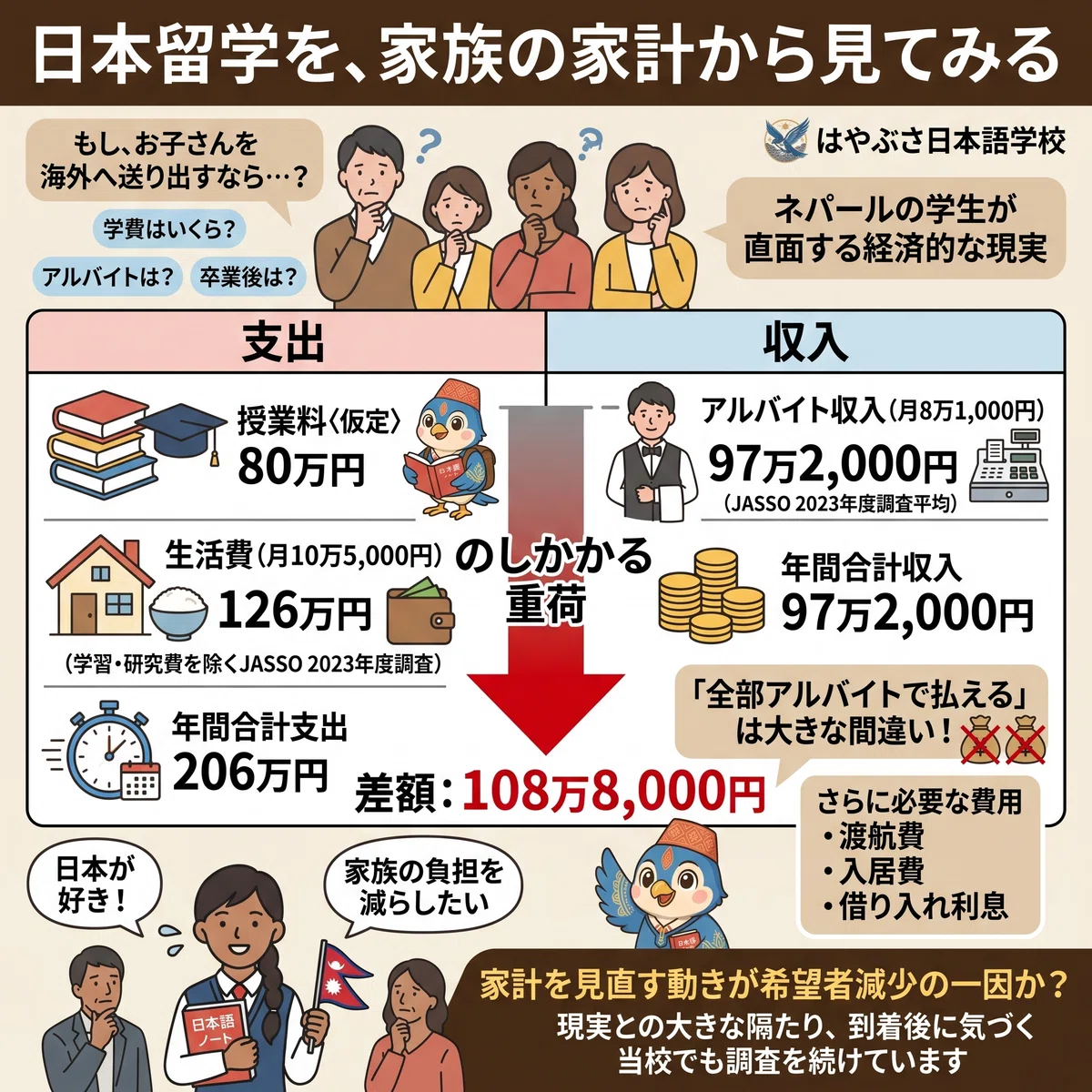
I would like our Japanese readers to imagine themselves in the position of sending their own children abroad. How much will the tuition be? Will I be able to find accommodation? What will I do if I can't find a part-time job? What kind of work will I be able to do after graduation? For families in Nepal, studying abroad is a choice that involves these kinds of questions. Sometimes, a student may simultaneously harbor feelings of love for Japan and a desire to lighten their family's burden. Here, we will calculate the household expenses of students studying abroad in Japanese yen. According to the JASSO survey on the living expenses of privately financed international students, the average monthly income from part-time jobs is approximately 81,000 yen. Living expenses, excluding study and research expenses, average 105,000 yen per month. Both figures are based on the 2023 survey and do not represent the actual income and expenses of each student in 2026. Part-time job income , living expenses If we assume the annual tuition fee is 800,000 yen, it would be as follows: Item Annual Amount Tuition (Assumption for Comparison) 800,000 yen Living Expenses (105,000 yen/month) 1,260,000 yen Total 2,060,000 yen Part-time Job Income (81,000 yen/month) 972,000 yen Difference 1,088,000 yen This is an estimate based on a combination of different average values and assumptions. It will vary depending on the school, region, and individual work situation, and further costs such as travel expenses, accommodation, and interest on any loans will also need to be considered. "If you go to Japan, you can pay for all your tuition and living expenses with part-time jobs." If you decide to study abroad based on such an explanation, a huge gap will arise once you arrive. I believe the decrease in applicants is related to people reviewing their household finances. However, we at the school have not yet been able to determine how many people gave up solely because of the cost.
The 28-hour work week rule wasn't established this year.
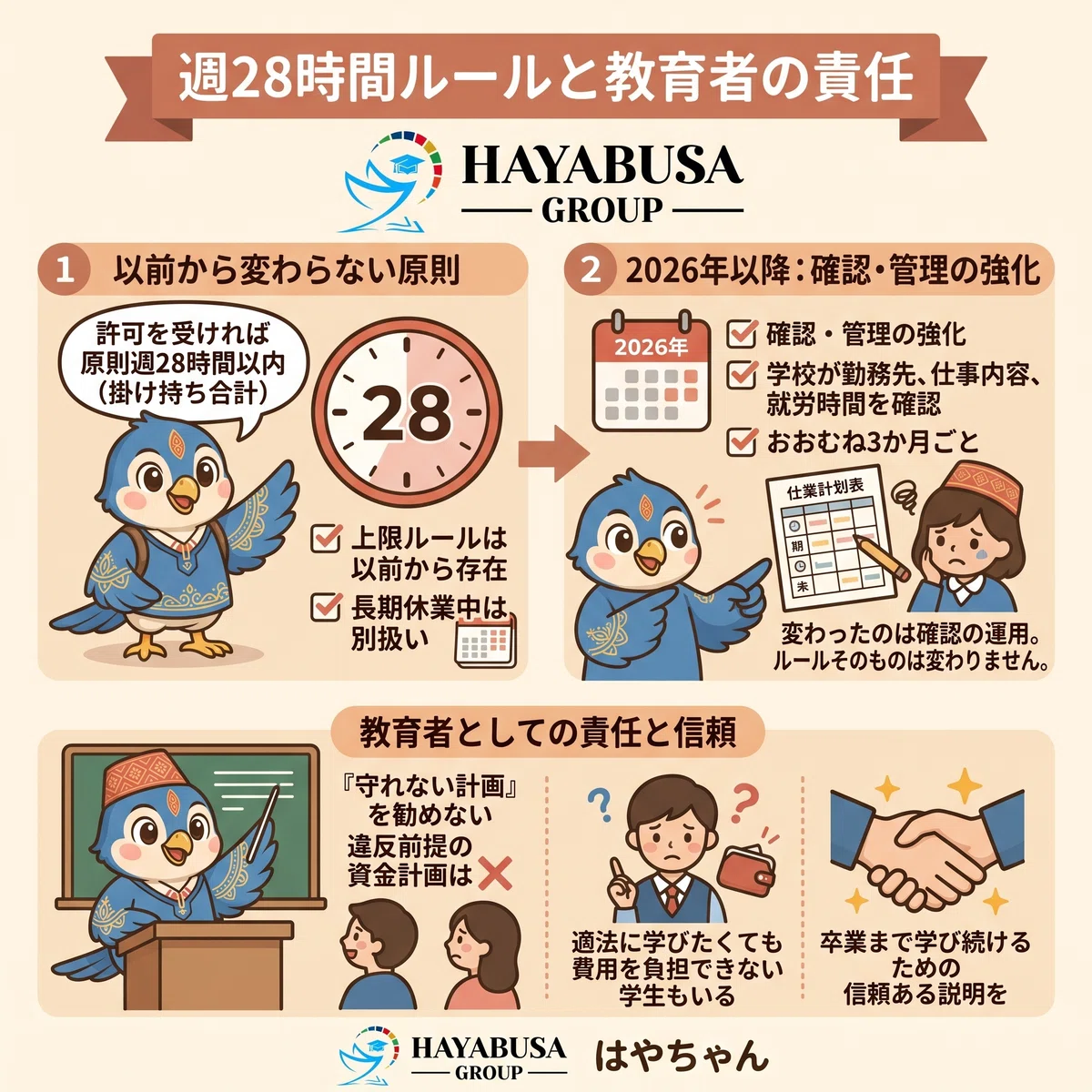
International students in Japan can, in principle, work part-time for up to 28 hours per week if they have permission. This limit applies to multiple jobs, and the total hours are counted. While there are different rules during school holidays, the 28-hour weekly limit has been in place for some time. ( JASSO information) By 2026, a new system was introduced requiring schools to verify employees' workplaces, job descriptions, and working hours approximately every three months. The main change is said to be in the verification and management methods. This is an explanation of the system based on immigration documents . If there was a financial plan that assumed working beyond the legal limit, that plan must be revised. However, it is also wrong to conclude that the reason for the decrease in applicants is that "there were many students who wanted to work illegally." There are people who want to study while working legally but cannot afford the expenses. As educators, the question we adults must ask ourselves is whether we recommended plans that students could not follow. Trust cannot be maintained if the explanations for increasing enrollment numbers and the explanations for ensuring students continue their studies until graduation are inconsistent.
Changes in the system and the anxieties that arise when they are communicated overseas.
There will also be changes to career paths after graduation. For the Specified Skills visa in the "Food Service Industry," due to the expected reach of the acceptance limit, a measure has been taken to prevent the issuance of Certificates of Eligibility for Residence Status for new applications after April 13, 2026. While changes in status are generally not permitted, there are exceptions, and renewals are handled separately. This is not a system that uniformly prohibits international students from working part-time in restaurants. ( Ministry of Agriculture, Forestry and Fisheries notification) Furthermore, revisions to residence fees effective October have also been announced. When considering the burden on international students, it is necessary to check the applicable procedures and permit periods. (Immigration Services Agency's revised information) Regarding the "Engineer/Specialist in Humanities/International Services" category, commonly known as "Gijinkoku," which is used for employment, experts have explained changes to the Japanese language proficiency check process. However, the statement that "no one can work in Gijinkoku without passing the N2 level" is not entirely accurate. According to explanations from certified administrative scriveners, the eligibility criteria vary depending on the company's classification and business activities, and methods of proof other than passing the N2 level are also indicated. For individual applications, confirmation is necessary, including the relationship with job duties and educational background. Explanation of 2026 changes by certified administrative scriveners. The licensing criteria for "business management" were also revised in October 2025, but this is not the same system as for regular study abroad or employment. (See the revised information from the Immigration Services Agency.) Overseas, these separate changes may be lumped together into a single impression: "It has become more difficult to build a future in Japan." What parents want to know is not just the name of the system, but whether their children will be able to live securely after graduation. However, the possibility of widespread anxiety is not the same as the Japanese government's policy of reducing the number of international students. The government has set a target of accepting 400,000 international students by 2033. The question is how to balance increasing the number of students with appropriate acceptance. ( Ministry of Education, Culture, Sports, Science and Technology - Targets for International Student Exchange).
The Nepalese side is also being held accountable for its explanations.
In Nepal, there have been reports of stricter regulations on educational consultancies, that is, businesses that provide support for studying abroad and related procedures. Local reports from July 2026 mention measures such as a licensing system, security deposits for businesses, and transactions conducted through banks and digital payments. The security deposit mentioned in the news reports amounts to approximately 2.57 million yen . This is the deposit that the business operator will pay, and not the amount that each student will have to pay. Since we have not been able to confirm the original text of the new regulations in the official gazette, we will treat the detailed requirements as being limited to what we have confirmed in the news reports. The conversion to Japanese yen was based on the exchange rate published by the Central Bank of Nepal on September 19, 2026. Actual exchange and remittance fees and differences between buying and selling rates may apply. Central Bank of Nepal If the preparation of a service provider's organizational structure coincides with the recruitment period, it could potentially affect the referral process. Nevertheless, clearly stating the costs to students, keeping records, and providing responsible explanations are all important for any service provider involved in education. I believe that schools that can explain everything, including potential concerns, rather than hiding inconvenient information to increase the number of applicants, are the ones that should be chosen in the long run.
Connecting the anxieties behind social media to education.
https://note.com/umechyansensei/n/nc75ca74cfb1ahttps://note.com/umechyansensei/n/nc75ca74cfb1a
As I wrote in a previous article, the news of Nepalese people losing their lives in Japan is being widely reported in their country. I myself have seen posts reporting on accidents, illnesses, and living difficulties faced by Nepalese people living in Japan. It is quite possible that such news could cause anxiety among students and their families. However, the frequency with which we see such incidents on social media alone does not reveal the actual incidence rate or any increase or decrease in such cases. We also cannot attribute the cause of individual misfortunes solely to the person's mindset or a lack of education before coming to Japan. Nevertheless, there are things that schools can do to prepare. Who to talk to when you're feeling unwell? How to describe your symptoms to the doctor? How to ask for clarification if you receive instructions at work that you don't understand? Where to seek help when you run out of money for living expenses? Passing the N4 level of the Japanese proficiency test and being able to live independently in Japan require practice. Greeting others, being punctual, reporting, communicating, and consulting, reading contracts and pay stubs, and how to act during disasters—these are not things you will necessarily acquire naturally after passing an exam. From the perspective of Japanese schools and companies, these may seem like very basic things. However, for young people whose language and living environment change simultaneously, each and every one of these is something they need to learn. Before scolding them for what they can't do, we need to reflect on how much we were able to teach and practice before they came to Japan.
The future of Japanese language schools lies not so much in "how many students are sent," but in "how they are educated and sent out."
For a Japanese language school, the number of students it sends out is a crucial figure. It's essential for running the school, protecting teachers' jobs, and continuing education; the number cannot be taken lightly.
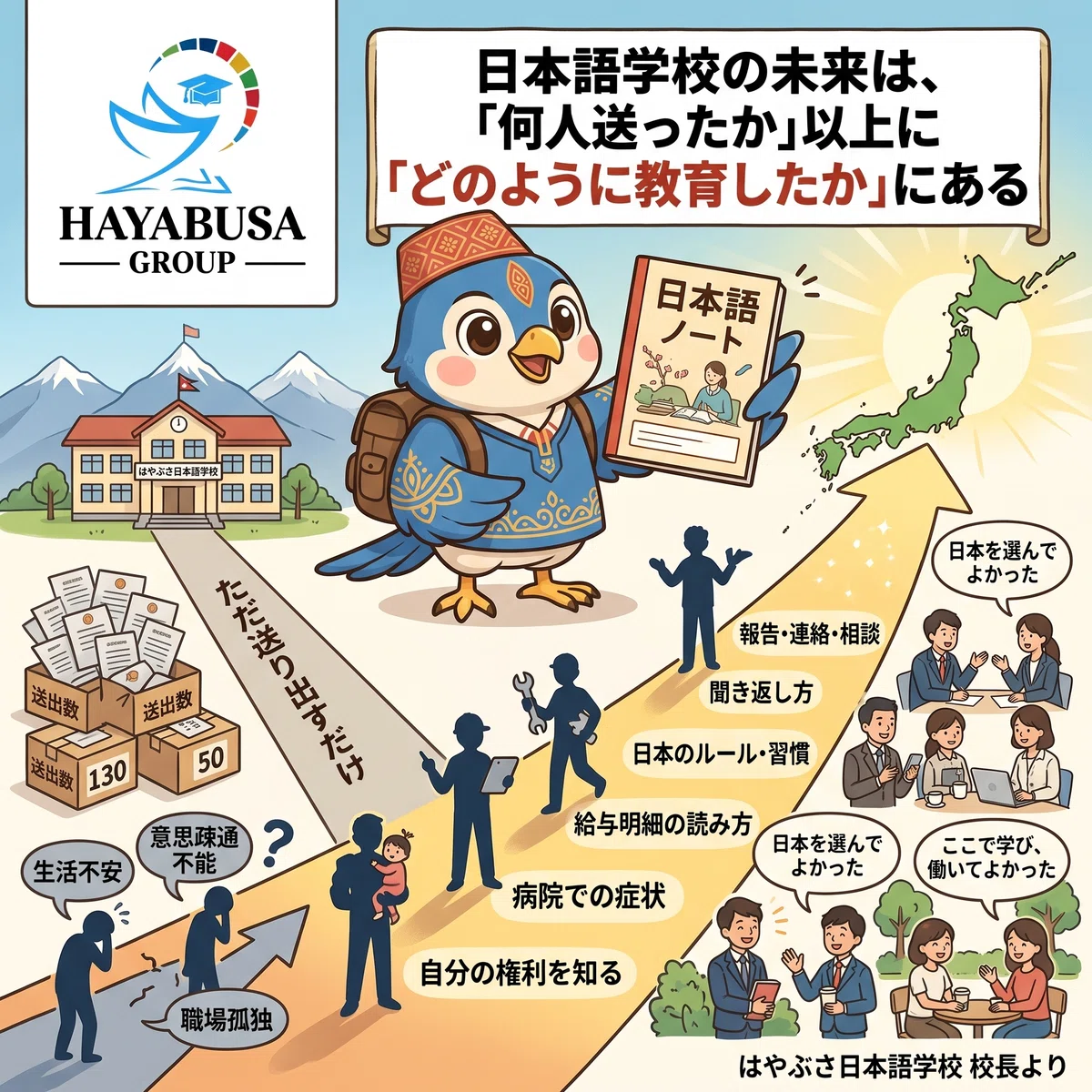
However, as a principal, what I value even more is the kind of education we provide before they leave Japan, and how that learning is utilized in their lives and work here . Passing a Japanese language exam. Securing a place to study or a job. Obtaining a residence permit and departing for Japan. Each of these is an important milestone for the individual and their family. However, whether our education has truly been useful will only become apparent in their lives going forward. Can they keep up with school lessons? Can they ask questions when they don't understand something at work? Can they talk to someone instead of keeping their problems to themselves? Can they build relationships with people in their community and find their place? And the question is whether, a few years later, the person themselves will be able to think, "I'm glad I chose Japan. I'm glad I studied and worked here." I believe that the role of a Japanese language school is to nurture students with that level of foresight in mind. To achieve that, vocabulary, grammar, and test preparation alone are not enough. Essential skills for work include reporting, communicating, and consulting; how to ask for clarification when you don't understand what someone is saying; developing the habit of keeping to schedules and promises; reading contracts and pay stubs; describing symptoms at the hospital; and knowing your rights and having the ability to ask for help when needed. You need to practice these things in concrete situations while you're in Nepal. I believe that integrating into Japanese society doesn't mean abandoning one's own culture or individuality. It means understanding Japanese rules and customs, while also communicating one's own thoughts to others and living in mutual respect. I want to cultivate the language and attitude necessary for that. Furthermore, the definition of "success" differs for each individual. People who want to acquire specialized knowledge and skills. People who want to support their families. People who want to work in Japan for a long time. People who want to use what they have learned in Nepal in the future. Instead of guiding students down the same path due to school convenience, we need to understand what each individual desires and work together to consider the necessary preparations to achieve those goals. We also collaborate with Japanese schools and companies to hear about the difficulties they face after arriving in Japan and incorporate that information into the education of future students. I believe that maintaining a supportive relationship before and after students leave Japan will be more important than ever. The number of Hayabusa students hoping to study in Japan has decreased from 130 to around 20. I do not take this number lightly. At the same time, I also take seriously the fact that more than 900 people are continuing to study Japanese. Each of these individuals has a life separate from the school's recruitment plan. They have their family's wishes, their own dreams, and their own anxieties. That's why we want to be able to talk about the achievements of our school, which we can be proud of, not only in terms of the number of students we've sent out, but also in terms of how our students have grown and are living in Japan. My goal isn't just to go to Japan, but to consider how I will learn, work, and live a happy life in Japan. I'm starting to prepare for that today, while I'm still in Nepal. And I want as many students as possible to look back on the path they've taken and say, "I'm glad I chose Japan." As the principal of Hayabusa, I want to build upon the education that embodies those words, one step at a time. In the second part, we will compare the costs of studying abroad in Japan, South Korea, and other countries, as well as the conditions under which one can work. We will consider whether it's possible to continue studying while paying tuition and living expenses, and to move towards one's ultimate goals, by examining the choices made from the perspective of the student's and family's lifestyle.







 EN
EN
 JA
JA