
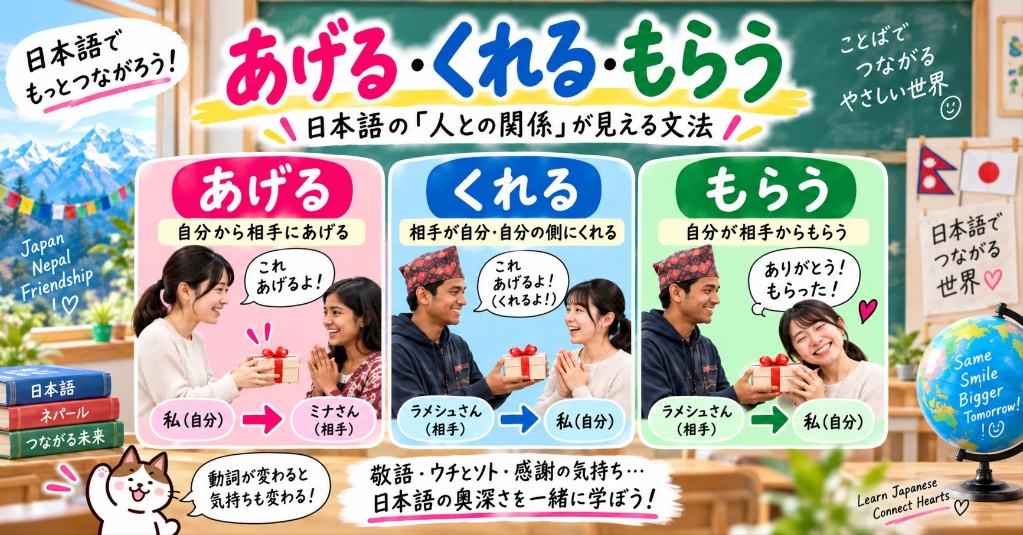
Thinking about "giving, receiving, and giving" in a Nepalese classroom, and the grammar of "thank you" "Teacher, your luggage looks heavy. Let me carry it for you!" At Hayabusa Japanese Language School in Nepal, a student named Ramesh approaches me as I'm holding my textbooks. I'm so happy. As a teacher, it's truly wonderful to see students grow up to be so considerate. However, there's one thing I'd like to convey here regarding Japanese language lessons. "Thank you. I really appreciate that. But when you say it to the teacher, it would sound more natural if you said, 'Shall I bring it for you?'" Then Ramesh made a puzzled face. "Teacher, why? Yesterday, I learned that 'doing something for someone else' is expressed as 'I'll do it for you.' When I used it today, I was corrected." ...You're absolutely right. The teacher is having trouble today because some students remember yesterday's lesson perfectly. "Do you have to take a grammar test just to be kind?" I completely understand why you would ask that question. The phrase "~te ageru" (to do something for someone) can sometimes sound like you're overemphasizing your kindness and being condescending, depending on the person and the situation. This difficulty in teaching is also a topic of research in Japanese language education. However, I believe that the joy of teaching Japanese lies precisely in this difficulty. The words "ageru," "morau," and "kureru" are not only used for handing over objects. The distance between people, one's own position, and respect for others. And how one perceives someone's actions. Because it carries even those invisible things along with it.
There's only one piece of chocolate. Yet there are three verbs.
First, let's put aside the complicated stuff and get a piece of chocolate. Ramesh hands it to Mina, who is standing next to him. Ramesh can say this:
I gave Mina some chocolate .
Upon receiving it, Mina could say this:
Ramesh gave me some chocolate .
There's another way to say it to Mina.
I received chocolate from Ramesh .
There was only one piece of chocolate. And it was moved only once. Despite that, I was able to create three Japanese sentences. Both "ageru" and "kureru" use the giver as the subject. However, "kureru" is used when the speaker or someone on the speaker's side receives something. On the other hand, "morau" uses the receiver as the subject. Even for the same event, the subject changes depending on which side you are on and who you use as the subject of the narration. I think of this as the "camera position of language." It's not just about what happened, but from whose perspective were those events being viewed? "Teacher, I'm busier operating the camera than making chocolate." Ramesh's opinion is quite valid. Therefore, in class, before we choose a verb, I would like to ask this question: "Who is talking now?" "Who handed it over?" "Who received it?" Before rushing to find the correct word, first confirm the positions of the characters. Lessons on giving and receiving can also be turned into small-scale theatrical performances. If you use real chocolate, the teaching materials might disappear before you finish explaining the grammar. That's where the teacher's ability to manage things will be put to the test.
But can we really say with certainty that it doesn't exist in Nepali?
Now, let me take a short, important detour. When explaining this grammar, you might be tempted to say, "So it's a special expression that only exists in Japanese, right?" However, "not using the same classification system as Japanese" and "not having similar expressions" are two different things. In Nepali, there is a system where verbs meaning "to give" are combined with other verbs to express actions for someone else or polite requests. For example, consider the following expression in Nepali:
Please teach me Nepali .
This "सिकाइदिनुहोस्" combines elements derived from "to teach" and "to give." Research has shown this form to be an example of making a request polite. "गरिदिनु" also has a usage that overlaps with the Japanese "shite ageru" or "shite kureru," meaning to do something for someone. In other words, it's a waste for teachers to simply say, "It doesn't exist in Nepali. Just learn the Japanese way of thinking about it." "There are similarities, but in Japanese, you choose your words even more carefully depending on whose side you're speaking from." Explaining it that way allows us to use the students' native language as a foundation for their learning. Learning a foreign language isn't about abandoning your own language. I think it's about building a bridge between your own language and the new language. To convey the appeal of the Japanese language, there's no need to portray other languages as "languages that are lacking something."
"Giving" doesn't mean it will only come to me.
Next, let's consider the following sentence.
Ms. Tanaka gave my sister a book .
I didn't receive the book; my sister did. And yet, you can say, "They gave it to me." This is where the concepts of "inside" and "outside" come into play. In expressions of giving and receiving, one considers one's own family members as "people on one's side," and can use "give" for actions directed towards them. Furthermore, this "one's side" is not determined solely by blood relations, but also depends on the relationship in the situation and who the speaker is siding with. "Teacher, even though my sister lives in a different house, does that still count as living with us?" "That's right. In this case, 'uchi' doesn't refer to the home address." So, what if you were to say this to a friend who is in trouble?
I'm sure that teacher would be happy to listen to your concerns .
I turn to my friends for advice. However, if you perceive that problem as something that concerns you as well and empathize with your friend, you can use "give." The Japan Foundation's explanation also includes examples of treating the other person's problem as if it were your own. I really like it here. "Your troubles are not unrelated to me." Because sometimes you can glean those feelings from the way you choose your verbs. However, simply remembering that "giving something = always from an outsider to an insider" is insufficient. My mother made me a bento box lunch . My mother and I are family. Yet we still use "kureru" (to give). The important thing is that the giver is not necessarily an external person, but rather the speaker is viewing the recipient of the action from their perspective. "Inside" and "outside" are not boxes that permanently categorize people. At least, that's how I want to teach it.
What lies between "I heard what they said" and "They listened to me"?
Let's take this lesson a step further. Write two sentences on the blackboard.
My friend listened to my story.
My friend listened to me.
Although the events are similar, the second instance conveys a sense that the speaker was grateful for the event and found it helpful.
The phrases "~te kureru" and "~te morau" can express not only the exchange of goods or actions, but also gratitude for being understood by the other person, or a feeling of respect for the other person. For example, imagine a student who has just arrived in Japan. I can't seem to express what I want to say in Japanese. They correct themselves mid-sentence. They search for the right words. They fall silent. Even so, the other person is waiting. That night, the student might say this to a friend:
Today, a senior colleague at work listened to me until the very end.
From this sentence, I can imagine not only the content of the conversation, but also the relief the student felt. I feel that the sense of relief that I couldn't find even by looking it up in the dictionary is placed in the word "given." However, this doesn't mean that "if someone says they gave something to you, they are necessarily truly grateful." Words are a means of expressing feelings, but they don't automatically prove the other person's true feelings. Nevertheless, I want to offer my students this perspective. You don't have to count "what was done for you" solely by the number of things you received. They waited for me. They noticed. They explained it to me again. It's okay to put those kinds of events into words, as they were things that supported you.
To avoid kindly including an invoice
Now, let's go back to Ramesh from the beginning. "Teacher, let me hold it for you!" Why does this act of kindness sometimes sound a little condescending? The phrase "~te ageru" (to do something for someone) implies that your action is a benefit to the other person. Therefore, when you offer this directly to someone of higher status, it can come across as too much like, "I'm doing something nice for you." Research has pointed out that in some situations, the purpose of the offer can be conveyed with "~mashō ka" (shall I do it?). I would like to explain this using the following analogy. "Kindness itself is appreciated. But sometimes, I can see a bill attached to the end of the words, saying, 'Don't forget my kindness.'" "Teacher, even though it's free, will I still get an invoice?" "That's why words are so difficult." The important point here is not that "ageru" (to give) is a rude word and should never be used . "I gave my sister a present" is a perfectly normal expression. In close relationships, "I'll help you with that" can also be a natural response. The key is knowing who you're talking to, your relationship with them, and what you're trying to communicate. As a teacher, I believe I shouldn't correct students' good intentions. What needs fixing isn't kindness, but how it's delivered. And this isn't just true for students learning Japanese. "I've done so much for you." Even when I feel like using such words, I want to pause and think for a moment. Is it something the other person needed? Is it something that makes them happy? Or am I just wanting them to be grateful? What starts as a grammar lesson can easily turn into a time for the teacher to examine their own attitude.
It becomes even more interesting when you use polite language. The teacher's name changes depending on whether you use "ga" or "ni".
Expressions of giving and receiving also include honorific forms. "Kureru" becomes "kudasaru". "Moura" becomes "itadaku". "Ageru" becomes "sashiageru". "Kudasaru" is an honorific expression that elevates the other person's actions, while "itadaku" and "sashiageru" are humble expressions that show respect to the other person through one's own actions. Now, let's compare the following two things.
My teacher taught me Japanese.
I was taught Japanese by my teacher.
In both cases, the teacher was the one who taught, and I was the one who learned. However,
My teacher taught me Japanese.
In that case, it would mean that the teacher was taught by someone. This is because "itadaku" is an action performed by the recipient. "Teacher, just because you made one particle mistake, you've become a student!" That's right.
Moreover, teachers do indeed learn things from their students, so the sentence itself isn't always wrong. Being able to construct a sentence grammatically and accurately conveying the event you want to express are two different things. Understanding this distinction transforms the learning of honorific language from rote memorization into a study that involves considering its meaning. There's one more thing I don't want to forget. Honorific language is not simply a technique for making oneself appear inferior to superiors. "Guidelines for Honorific Language" places the foundation of modern honorific language on mutual respect. Therefore, when I teach students honorific language, "Could you explain that again?" I want them to be able to ask for things without being too hesitant. Expressing gratitude and enduring not understanding something are two different things.
However, "kureru" can also be used when someone is angry.
After reading this far, "kureru" (to give) seems like a very kind word. So, here's a slightly tricky question.
You really shouldn't have done that.
Is this a sign of gratitude? ...Probably not.
The expression "~te kureru" can be used to express criticism or sarcasm, depending on the context. Studies analyzing actual conversations have also highlighted this usage. "Teacher, it was 'given' to me, so why not say thank you?" "That's right. If you respond with 'You're welcome!' here, the situation might escalate." The classroom is filled with laughter. However, while laughing, the students learn something important. Don't judge based on individual words alone. Listen to the surrounding words. Also, check the tone of voice and the context of the situation. The three verbs you learn at the beginner level contain a deeper challenge for understanding conversations.
The last thing I want to teach you is how to say, "I am someone who has been supported by others."
Fill-in-the-blank questions aren't the only thing I want to give at the end of class. It's a small problem like this.
Please write down one thing someone did for you today that made you happy.
Also, please write a message you'd like to say to that person.
It doesn't have to be a major event. "A friend taught me the kanji I didn't know." "My sister helped me practice for my interview." "My teacher remembered my name."
From there, "Thank you for letting me know." "Thank you for helping me, I really appreciate it." I want to connect this to words that are necessary for my own life. I believe that teaching Japanese is not just about getting students to use correct verbs. I want to be kind, but I get misunderstood. I'm grateful, but I can't express it properly. I need help, but I don't know how to ask. It's also a job that gradually lowers the language barrier that lies between people. And I, as a teacher, want to make sure I don't forget it myself. "I teach students." That's certainly true. but, "Students give me opportunities to think." "Students teach me different perspectives." You can talk about this job in that way too. I want to create a classroom where students can learn from others, rather than just a classroom where they teach others. Teachers are not the only ones who give, and students are not the only ones who receive. Perhaps that's what I myself want to learn most in the class on giving and receiving expressions. At the end of the lesson, Ramesh says: "Thank you again for teaching me today, teacher." "The pleasure was all mine. Thank you for asking so many questions." Then, after thinking for a moment, he added: "So, could you reduce the amount of homework?" ...You did an excellent job using polite language. We'll discuss the outcome of the negotiations in another class.
Learning about "giving, receiving, and being given" means remembering who gave what, and sometimes realizing who is supporting you. Thank you for reading this far. If you find the Japanese language interesting, I would be happy if you could let me know by clicking "Like."







 EN
EN
 JA
JA