
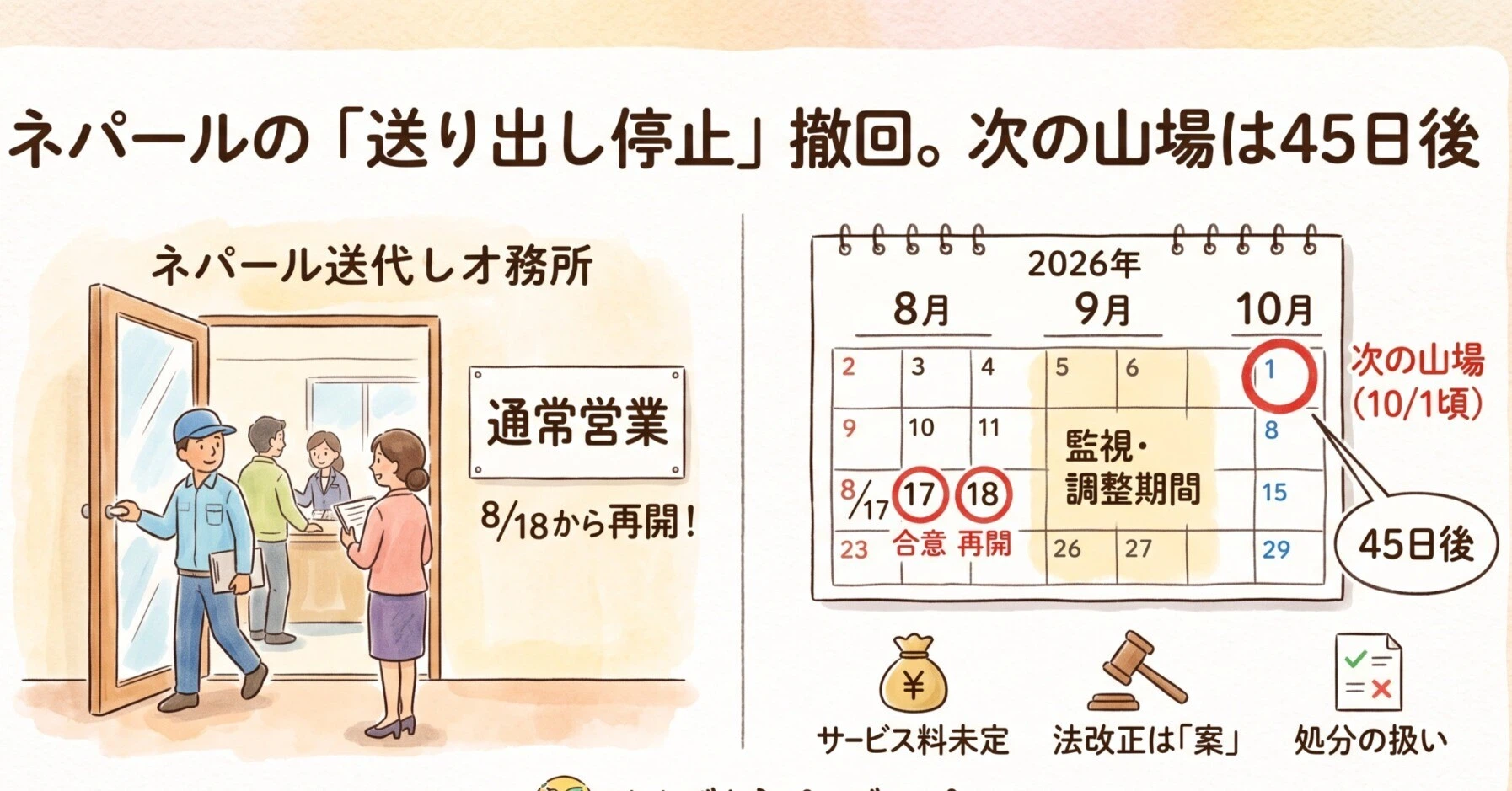
On August 17, the Nepalese sending agency did not close its office.
That day, three hours of negotiations took place at the Ministry of Labor, and the government and industry groups reached an agreement. The previously announced "sending suspension" was withdrawn, and the organization returned to normal operations from the following day, the 18th. However, this isn't the end. All the government has promised is that it will respond within 45 days.
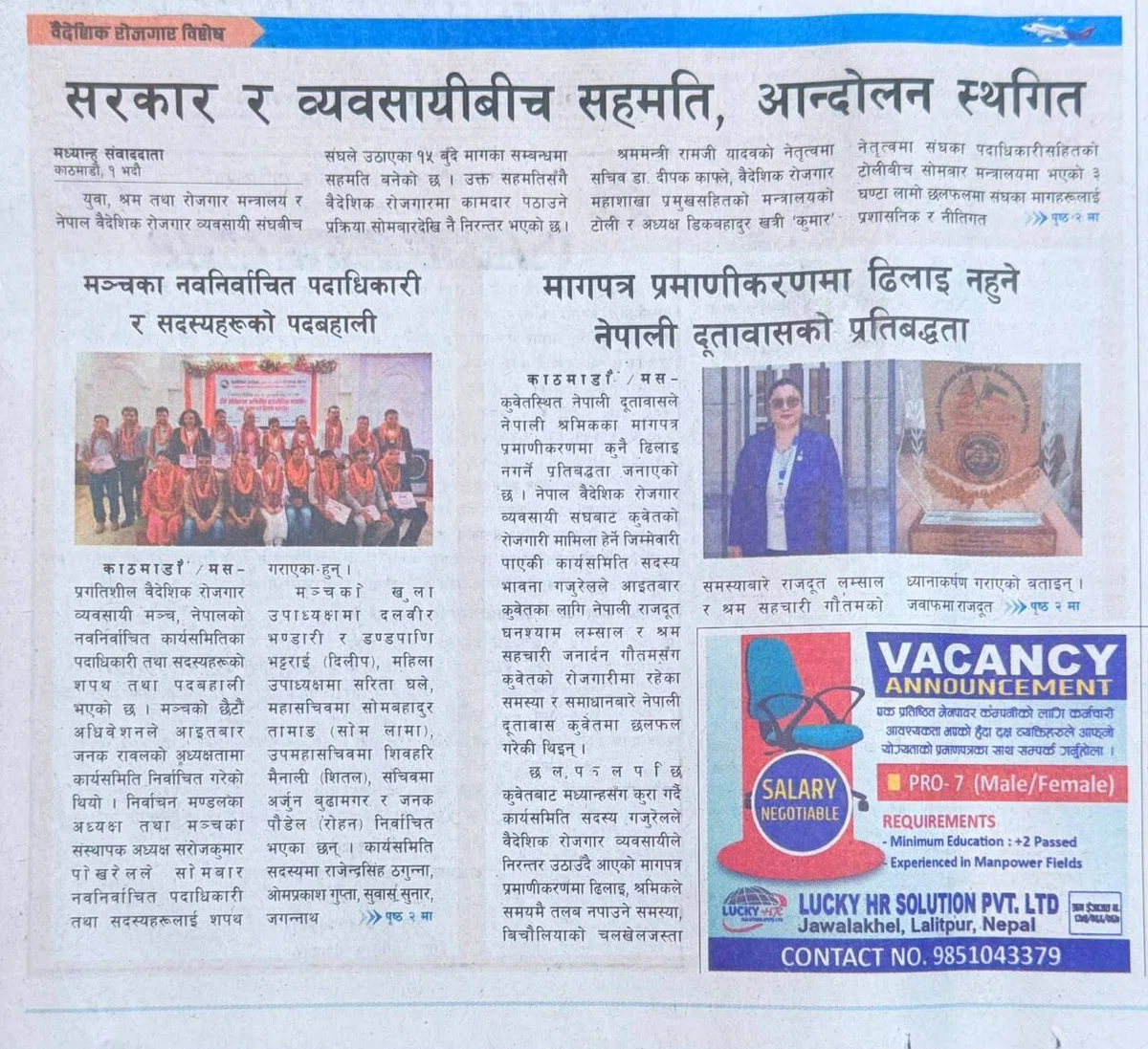
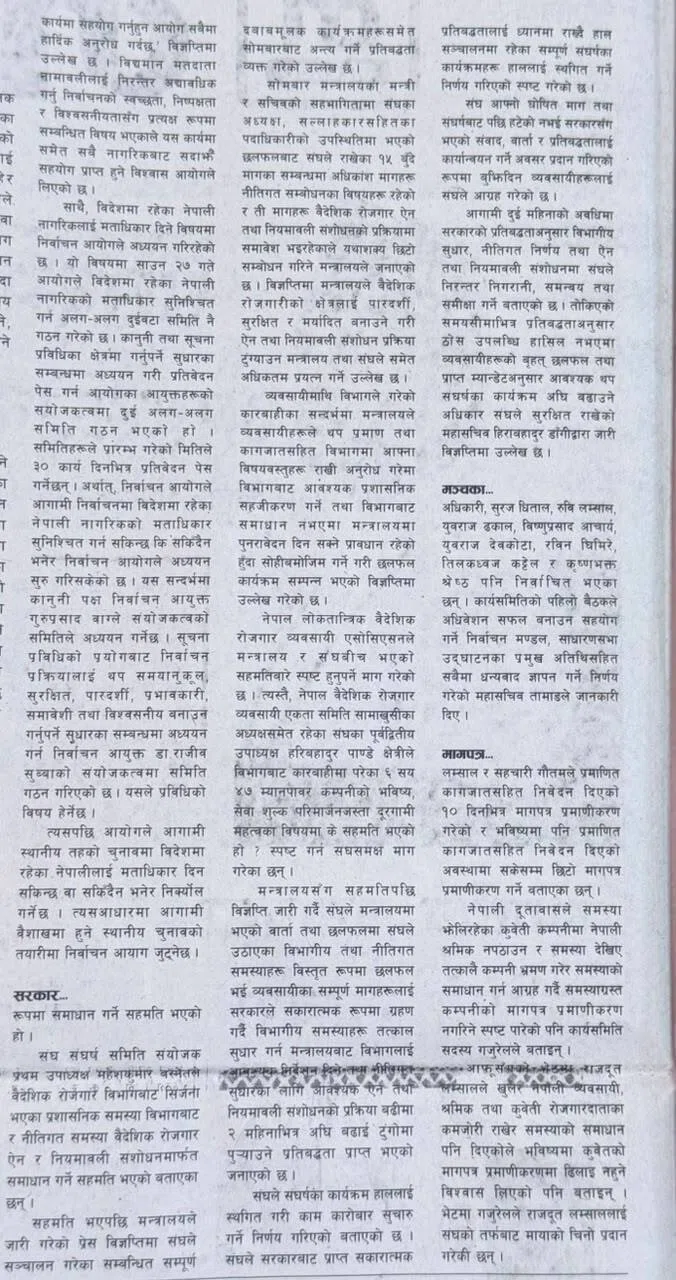
What happened at the Ministry of Labor on August 17th
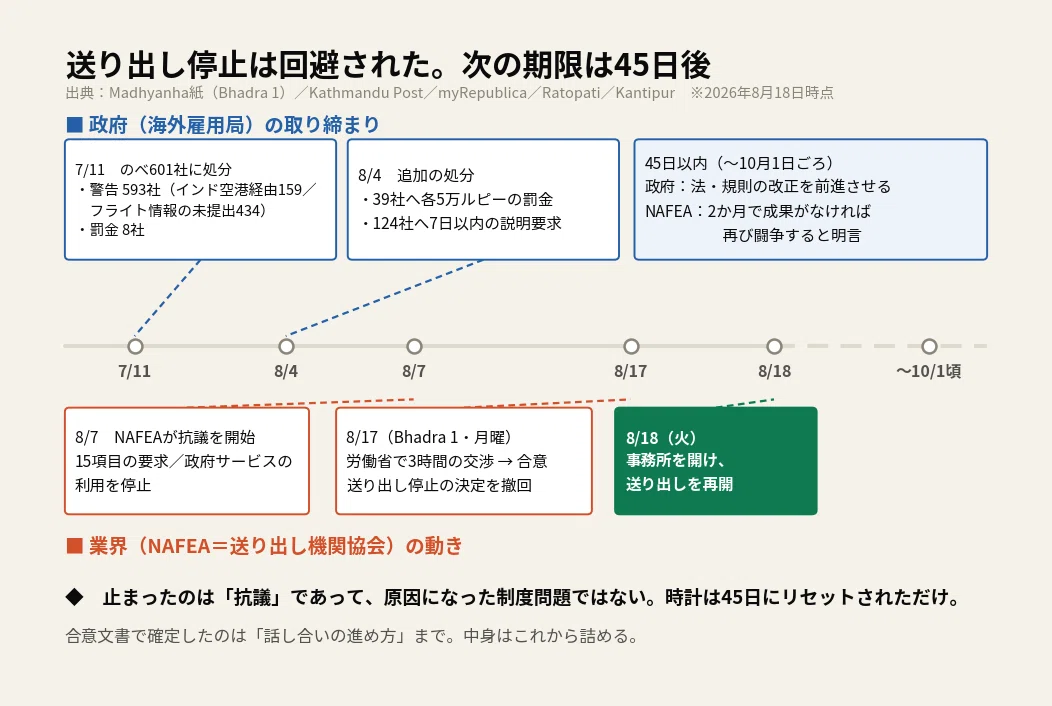
Bhadra 1, Monday, 2083 in the Nepalese calendar. From this day forward, the sending agency will close its office and stop sending workers. It was the morning of the day that was predicted. Labor Minister Ramzi Yadav personally stepped forward, and a team from the ministry included Undersecretary Dr. Deepak Kafre and the head of the relevant department at the Overseas Employment Bureau. In contrast are the officers of NAFEA (Nepal Association of Sending Agencies), including Chairman Dikbahadur Khatri "Kumar". After three hours of discussion, we reached an agreement. And within the same day, the industry announced that it would withdraw all pressure actions. Secretary-General Hirabahadur Dangi stated, "We will open our office and resume sending out goods starting Tuesday." In other words, the Nepalese repatriation has been underway since August 18th (Tuesday). If you heard the Japanese side that "Nepal stopped," please check this date first. The fact is, before it stopped, there was a resolution that didn't stop.
"598 companies," "643 companies," "771 companies" - Why the numbers were different
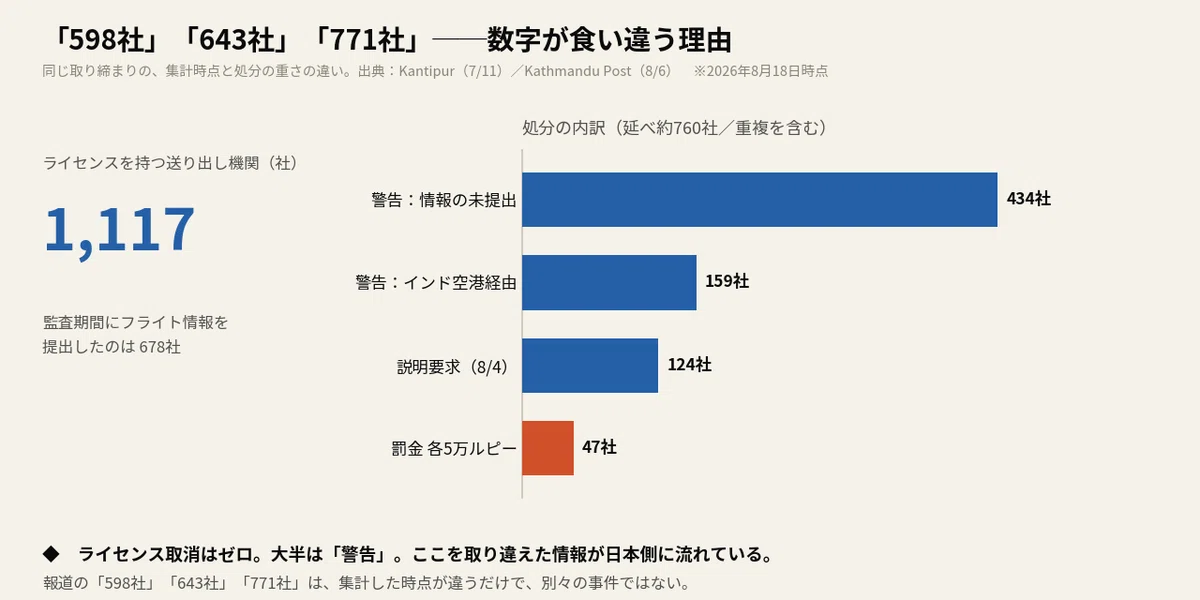
In my previous article, I wrote that "the number of institutions subject to disposition varies widely, from 598 to 771, according to reports." Subsequently, industry insiders also stated that the number was 643 companies. All three are correct. And all three are the same story of one crackdown. If you arrange them in order, they will look like this. July 11th. The Overseas Employment Bureau reviewed the departure records of work permits issued in 2082 Chaitra 〜 2083 Jesta (roughly March 〜 June 2026) and issued a disciplinary action. The breakdown is as follows: 159 companies received warnings for using Indian airports without permission, 434 companies received warnings for failing to submit flight information, and 8 companies received fines for repeated violations. There are a total of 601 companies. August 4th. Furthermore, 39 companies were fined 50,000 Nepalese rupees each, and 124 companies were asked to provide explanations within seven days. In other words, "598 companies" was the total as of July, "643 companies" was the total number of companies that received fines or warnings, and "771 companies" was the total number including requests for explanation. The only difference is the range of the amount of waste to be disposed of compared to when the data was compiled. And this is the most important place, 💡 No licenses have been revoked. Most of them are "warnings." There are 1,117 licensing organizations in Nepal. 678 companies submitted flight information during the audit period. The rest of the group received a warning at once. The information that the Japanese side reported as "598 companies have ceased operations" is a mix-up.
What is agreed upon and what is not
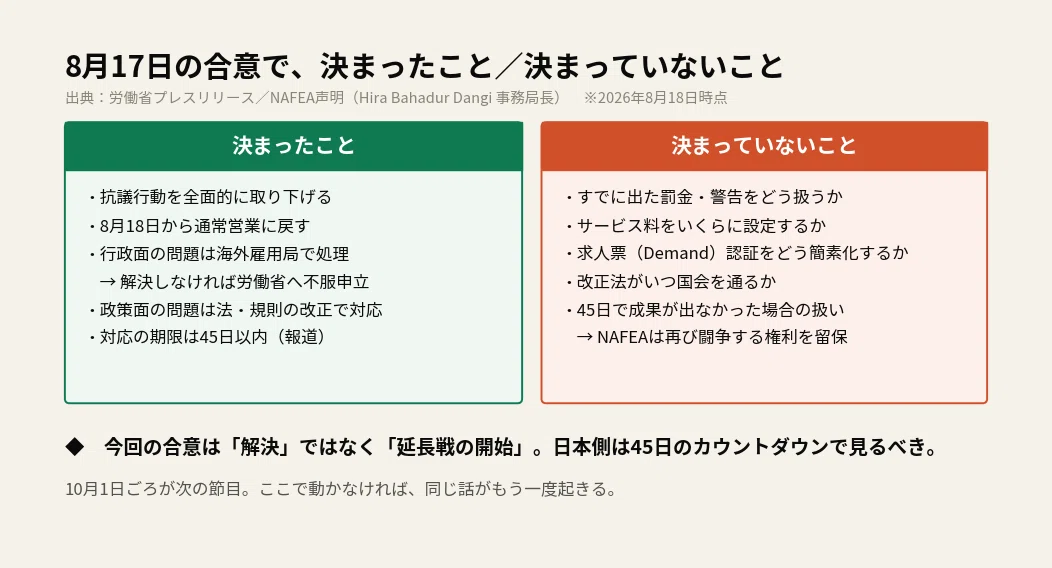
When you combine the Labor Department's press release with NAFEA's statement, the contents of the agreement are quite clear. What's decided is how to proceed. Problems arising from administrative operations are reported by the agency to the Overseas Employment Bureau, along with additional evidence and documents. If the issue is not resolved there, an appeal can be filed with the Ministry of Labor. The procedure for this two-tiered structure has been confirmed. Most of the policy issues, namely the 15 demands, will be addressed through amendments to the Overseas Employment Act and Regulations. The ministry promised to move the process "as quickly as possible." On the other hand, it is also clear that nothing has been decided yet. How to handle the fines and warnings that have already been issued How much to set the service fee How to simplify job posting (Demand Letter) authentication When the revised law will pass through the Diet None of them have numbers or dates. 💡 This agreement is not a "resolution" but a "start of overtime."
45 days or 2 months
There is a wide range of media coverage regarding the deadline. myRepublica and dcnepal reported that Secretary-General Dangi's remarks were "within 45 days (1.5 months)." Meanwhile, a statement issued by NAFEA itself said it would "monitor, coordinate and review the government's response over the next two months." If it's the 45th, it'll be around October 1st. For two months, around October 17th. Either way, the next milestone is October. And NAFEA wrote in its statement:If concrete results as promised are not achieved within the specified timeframe, we reserve the right to proceed with any necessary additional struggle programs based on extensive consultations with the contractors and the agreed-upon terms.
The struggle is not over. It just stopped. The Nepali headline also reads "आन्दोलन स्थगित" (Stop the struggle), without saying "End." I think this is the place to read accurately.
My favorite is legal reform. The names of Japanese companies appear there
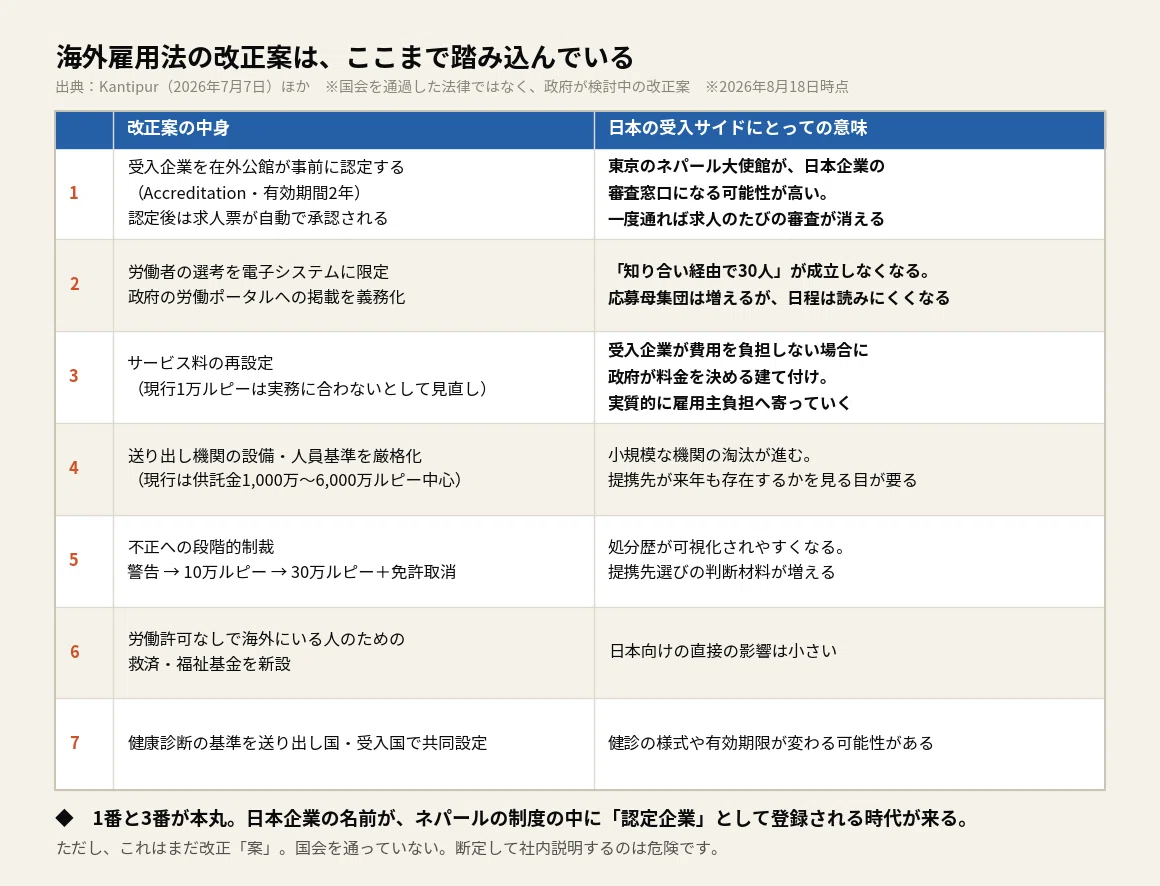
So, what will happen in those 45 days. The contents of the proposed amendments to the Overseas Employment Act were reported in July. Reading this honestly sent chills down my spine. Among them, numbers 1 and 3 are the main round. The host company will be certified in advance by the overseas diplomatic mission. The employment contract will be reviewed based on the performance of the contract, and if approved, the validity period will be two years. Job postings from accredited companies are automatically approved without any review. What this means. For Japanese companies, the Nepalese Embassy in Tokyo is likely to be the point of contact for the review process. Job postings for specific skills (Demand Letter) are still certified at the Nepalese Embassy in Tokyo. Company registration, two years' worth of financial statements, company seal registration certificate, and record submission documents for Nepalese workers hired in the past have already been finalized. If the amendment is approved, the review process will change from "one job posting per year" to "company certification every two years." If you go through, it will be incredibly easy. If you don't go through, your paperwork will remain increasing. And number 3. Resetting service fees. The current limit is 10,000 rupees, which will be reviewed as "not practical." It is structured so that the government decides the fees if the host company does not bear the costs. In short, it's slowly becoming a burden on employers (Employer Pays Principle). However, I will repeat it. This is still a proposed amendment. I haven't attended the Diet. Once we have made a definitive internal explanation, we will correct it later.
What the Japanese reception side will do in the next 45 days
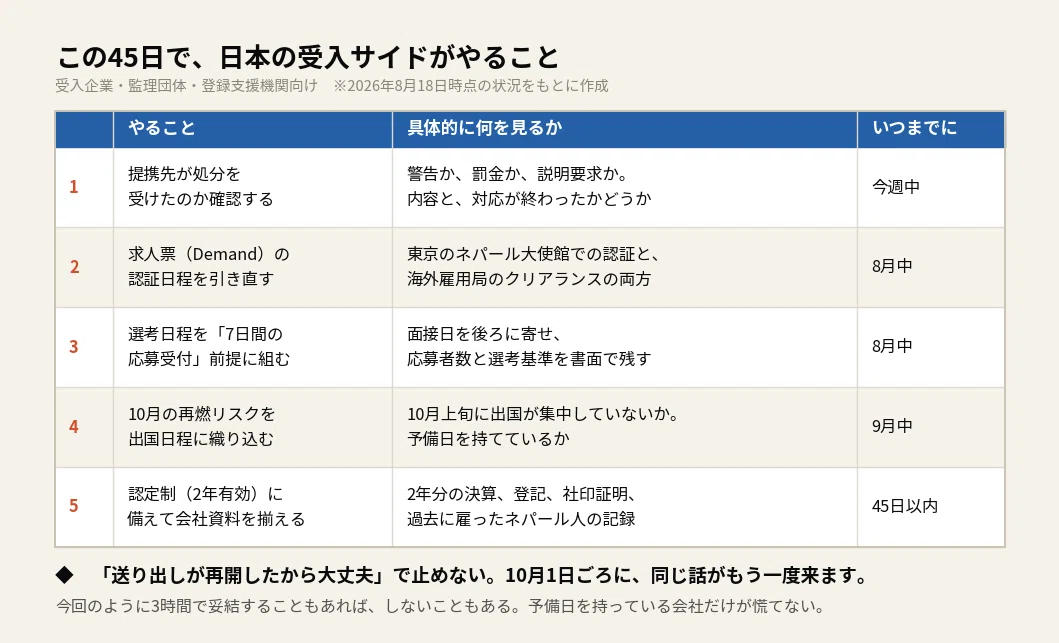
Don't stop with "It's OK now that it's back on." The same story may come again around October 1st. This time we reached an agreement in three hours, but there is no guarantee that this will happen again. So what we need to schedule now is a date with a backup day. If there are any projects that are concentrated in leaving the country in early October, we will consider bringing them forward. The interview date will be moved to the back, incorporating a 7-day application period. We will then ask our partner organizations frankly whether they have received any disciplinary action, and if so, what they have done and how they have responded. The most dangerous institutions are those that cannot listen and answer questions. 【Insert real-life experience here: What kind of contact actually came from partner Japanese companies and supervisory organizations during the 10th of August 7th 〜 17th, and how Hayabusa responded We have a case that has already been approved in advance ◯there was a case, so we told them this way, etc.】 This article is stronger than any other explanation







 EN
EN
 JA
JA