
![Is studying in Japan no longer a viable option? Considering the true role of education based on the costs of studying in Japan, Canada, Australia, and South Korea [Part 2]](https://hayabusanepal.com/storage/articles/images/sw91rK3spqHmSEzN1BTLNw4wx4IY9sg7vsY4lrJF.jpg)
"I'm glad I went to Japan."
Will the students be able to look back on their journey and say the same thing a few years from now? This is a question that I, who run the Hayabusa Japanese Language School in Nepal, want to cherish right now. In the first part of this report, we mentioned that the number of students at our school wishing to study in Japan has decreased from 130 in April of last year to around 20 this year, while more than 900 students are currently studying Japanese. These figures are based on our school's on-the-ground report and do not represent statistics indicating that the number of students wishing to study in Nepal as a whole has decreased by the same rate. There are still people learning Japanese. However, fewer and fewer people are choosing to study at Japanese language schools in Japan. I don't think this change can be explained simply by saying, "They've lost interest in Japan." Perhaps the combination of things they want to learn, their desire to support their families, the money they have available, and the options of other countries and employment systems has shifted. This time, we will examine the costs and working conditions in four countries: Japan, Canada, Australia, and South Korea. Our main focus is comparing whether students can continue their studies and build their future lives in these countries. *Information was verified on September 20, 2026. Foreign currency amounts were converted to Japanese yen using the Nepalese Central Bank's published selling rate on the same day and are shown as approximate figures. Actual exchange and remittance will incur exchange rate differences and fees. Below, published values and the author's estimates are distinguished. Published exchange rates used for conversion .
Before concluding that Japan is no longer chosen
First, let's separate the changes at our school from the overall trends in Japan. According to a JASSO survey, as of May 1, 2025, there were 408,069 international students in Japan. Of these, 140,174 were studying at Japanese language institutions, a 30.7% increase from the previous year. There were also 100,239 international students from Nepal, including those studying at universities and vocational schools. (JASSO 2025 Survey on the Status of International Students) At this point, the number of international students studying in Japan is increasing. However, there is a time lag between the number of students already enrolled and the movement of students who will apply in the future. We cannot be optimistic about future recruitment based solely on past increases, nor can we speak of the end of studying in Japan based on the decrease of one school. That's why I want to understand what the students in front of me are comparing and where they are feeling lost. The preparations needed for "I want to learn Japanese and go to a vocational school" are different from those needed for "I want to get a university degree in English." Similarly, the desire to "get a job quickly and support my family" cannot be accommodated in the same study abroad plan. Before deciding on a country's name, it's crucial to clarify its purpose. I feel that this order is becoming more important than ever.
Tuition fees are not determined solely by the country of origin.
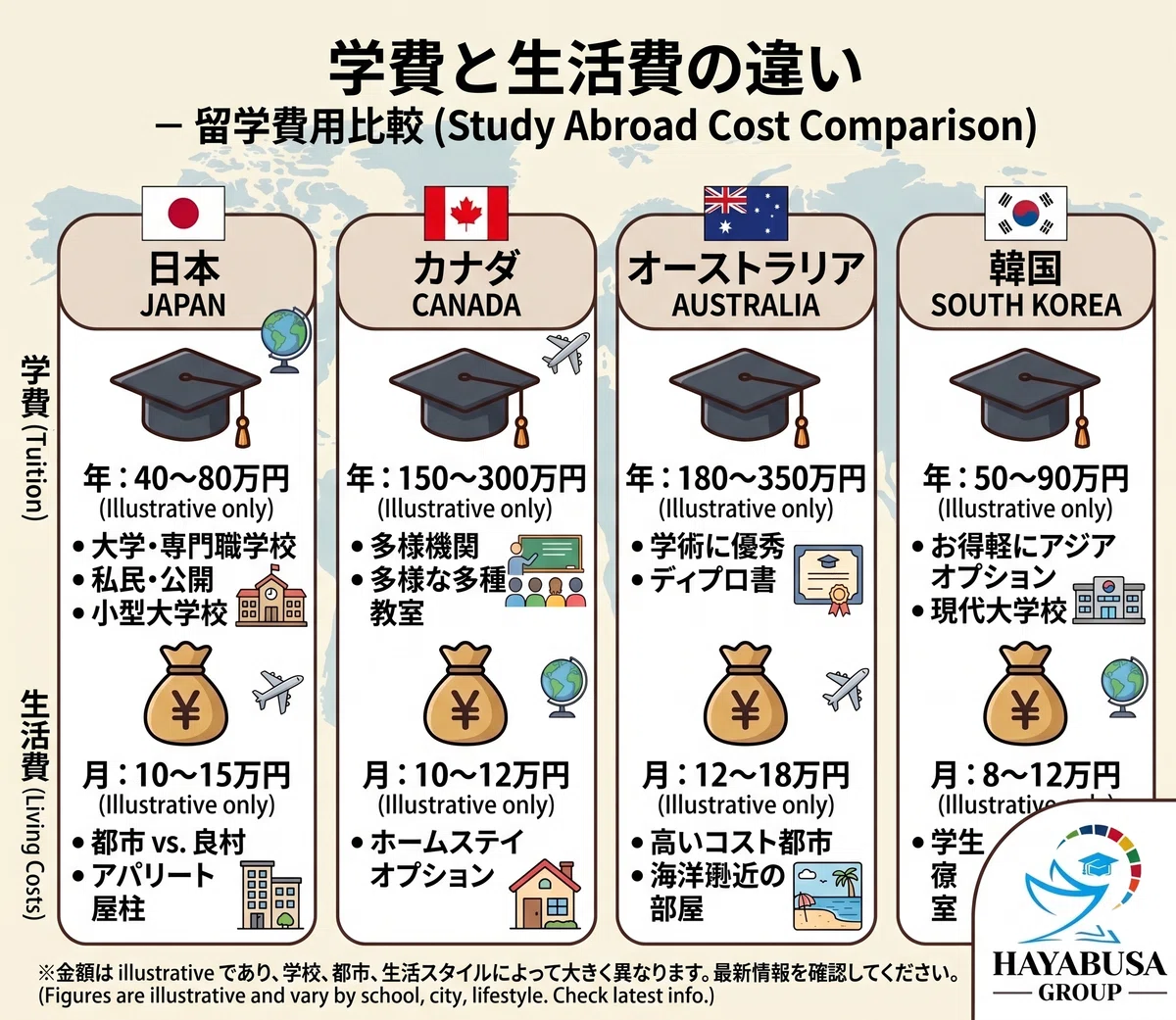
Here are the figures for tuition fees that can be confirmed from actual publicly available documents. All amounts are in Japanese Yen. The figures include tuition fees from individual schools and national averages, and do not represent a price comparison for the same qualifications and educational content. The following are the publicly available tuition and fee figures for courses and materials confirmed by the government, converted to yen: Japan JASSO Tokyo Japanese Language Education Center - Tuition for a one-year course starting in April 2027: approximately 823,000 yen. Selection fee of 20,000 yen is separate. Canada 2026/27 - Undergraduate tuition for international students: national average annually approximately 4,747,000 yen. Australia TAFE NSW - Diploma of Business, one-year course tuition in 2026: approximately 2,503,000 yen. South Korea Seoul National University Institute of Language Education - Regular course, morning classes, one semester: approximately 205,000 yen. If it were four semesters at the current rate, it would be approximately 821,000 yen. Japanese tuition fees include entrance fees and textbook costs. The Korean figure for four semesters is simply calculated by multiplying the current tuition by four, excluding application fees, etc. The Canadian figure is a national average for undergraduate programs and does not apply to all college courses. The Australian example is also for a specific one-year program. (Sources: Japanese admissions information , Statistics Canada - Table 37-10-0045-01 , TAFE NSW 2026 Tuition Fee Table , Seoul National University Tuition Fees) This difference is not something that can be dismissed with a small note. If you plan to attend university or another institution after completing a Japanese language school or a Korean language course, you will incur additional tuition and living expenses. Even if the first year is inexpensive, the total cost to obtain your desired qualification may not be low. Conversely, even in countries where the average undergraduate tuition is high, the burden varies depending on the school, field of study, and scholarships. What schools should explain is not just a single figure like "this is how much it costs in this country," but rather a plan outlining the student's chosen curriculum, including how many years it will take, what they will study, and what qualifications they will obtain.
The average cost of living and the proof of funds required for a visa are different.
There are different types of figures when it comes to living expenses. According to a survey by JASSO (Japan Association of Student Services Organizations), the average monthly living expenses for international students, excluding study and research expenses, is 105,000 yen. This amounts to 1.26 million yen per year. This is based on a 2023 survey and does not guarantee living expenses in 2026. Living expenses vary depending on the region and accommodation. JASSO Living Expenses Guide The South Korean government's study abroad guidelines estimate monthly living expenses at approximately 85,000 to 114,000 yen. This translates to approximately 1,030,000 to 1,370,000 yen annually. This figure does not represent the actual expenses of individual families. ( Study in Korea - Living Expenses) Meanwhile, in Canada, for applications submitted on or after September 1, 2026, there is a standard of approximately 2.646 million yen per year in living expenses for students studying alone outside of Quebec. Tuition and transportation costs are separate. This is not the average student expenditure, but rather a financial requirement for obtaining study permits. ( Canadian Government - Financial Proof) Australia, in its revised legislation for 2024, sets the standard for single primary applicants at approximately 3.344 million yen (in Japanese currency) for 12 months of living expenses. Travel expenses and tuition fees are considered separately. The Australian government's study abroad guide explains that actual living expenses may significantly exceed the visa standard. (See: Australia - Proof of Funds Law , Study Australia - Living Expenses) Reference values for annual living expenses/living expenses by country Meaning of the figures Japan 1.26 million yen 12 times the monthly average from the 2023 survey Canada approx. 2.646 million yen Single person, based on proof of funds outside Quebec Australia approx. 3.344 million yen 12 months' living expenses for the main applicant as stipulated by law South Korea approx. 1.03 million to 1.37 million yen 12 times the monthly guideline from the government study abroad guide This table cannot be directly interpreted as a "ranking of countries with low cost of living." This is because the average figures from the survey, the general guidelines, and the institutional standards are all different. Nevertheless, it can be useful in considering the size of a household budget. For example, the average tuition fee for undergraduate students in Canada plus the cost of living for a single person comes to approximately 7.39 million yen. This is a reference calculation before adding travel expenses and other costs, and is not a uniform expense required for all students, but it can serve as a starting point for considering the amount of money a family should prepare.
Even in countries where people can work, the start date for employment can vary.
Next, let's talk about part-time jobs for international students. Even if they are legally permitted to work, not everyone can work the same hours from the day they arrive in the country. Main working conditions for international students in Japan: With permission for activities outside of their visa status, they can work up to 28 hours per week in principle. If they have multiple jobs, the hours are added together. During long school holidays, it is up to 8 hours per day. Canada: Students who meet the conditions can work off-campus up to 24 hours per week during the semester. There are no time limits during designated holidays, subject to conditions. Courses that are only in English or French are not subject to the regular off-campus work system. Australia: With a regular student visa, they can work up to 48 hours in two weeks during the semester. There are no time limits during designated holidays. There are exceptions for research, master's, and doctoral programs. Korea: With language training qualifications such as D-4-1, they can work after 6 months with permission in principle. The hours allowed vary depending on language proficiency and the course of study. Sources: Japan (JASSO ), Canadian government , Australian government , and South Korean government . In all cases, it is assumed that the applicant meets the requirements regarding their residence status, course of study, and necessary permits. Of particular importance are the waiting period for language study in South Korea and the treatment of language-only courses in Canada. If you plan to include part-time job earnings in your household budget from the very beginning of your language studies, the system itself may make your plan unfeasible. In addition to national regulations, schools also have their own rules. The Tokyo Japanese Language Education Center, which I mentioned earlier as an example of tuition fees, generally prohibits part-time work, although it may be permitted after three months of enrollment under certain conditions. You must always check the school's rules regarding tuition fees and employment conditions together. (See the center 's application guidelines.)
Is it true that you can earn twice as much in South Korea as in Japan?
South Korea's minimum wage in 2026 is approximately 1,176 yen per hour. Assuming a Japanese minimum wage of 1,200 yen per hour for comparison, the levels are roughly the same. Under these conditions, it cannot be said that "South Korea's minimum wage is twice as high." ( South Korean Ministry of Employment and Labor, 2026 Minimum Wage) Of course, 1,200 yen in Japan is neither the nationwide minimum wage nor the average hourly wage for international students. In reality, it varies depending on the region and the type of work. In South Korea, too, depending on the contract, salaries and allowances may exceed the minimum wage. The important thing is not to compare the monthly salary of a full-time worker in South Korea with the part-time wages of a Japanese international student. Explaining the wage difference between people with different residency statuses and working hours as simply a difference between countries will mislead students. In Australia, the national minimum wage from July 2026 will be approximately 2,976 yen per hour. The general minimum wage in Ontario, Canada, is approximately 1,986 yen as of the date of this check. In Ontario, it will increase to approximately 2,026 yen from October 1st. Minimum wages in Canada vary by province, and this amount is not uniform nationwide. ( Source: Fair Work Ombudsman , Australia ; Government of Ontario) The following calculation assumes you find a job at that hourly wage and can work the set number of hours each week. Simple monthly estimate based on hourly wage, weekly working hours, and country calculations: Japan: 1,200 yen (assumed) 28 hours: approx. 146,000 yen Canada, Ontario: approx. 1,986 yen 24 hours: approx. 207,000 yen Australia: approx. 2,976 yen 24 hours: approx. 309,000 yen South Korea: approx. 1,176 yen 20 hours: approx. 102,000 yen *Monthly income is calculated as "hourly wage x hours per week x 52 weeks ÷ 12 months". This is a calculation before taxes and other deductions, and does not represent an average monthly income or income guarantee. The legal limit in Australia is 48 hours in two weeks. The 20 hours in South Korea is an example for language students who meet certain conditions and does not represent income immediately after arrival. Each country has exceptions to wages based on age, employment type, etc. A higher hourly wage means more income for the same amount of work. However, tuition and rent are paid at the local rates. You can't simply convert your salary to Japanese yen and think, "I'll have this much left over," based on the cost of living in Japan.
Even in Japan, there is a difference between calculations for working up to the limit and reality.
The Japanese estimate is based on working 28 hours per week. However, according to JASSO's 2023 survey, the average monthly income for part-time workers is approximately 81,000 yen. Multiplying this by 12 months gives us 972,000 yen. ( JASSO Part-time Work Information) Here, we'll use the household budget example from the previous part. If we add 200,000 yen for travel and accommodation expenses to the annual tuition of 800,000 yen and living expenses of 1,260,000 yen, the total for the first year would be 2,260,000 yen. The tuition and travel/accommodation expenses are just examples for illustrative purposes and are not the estimates from the school mentioned earlier. Subtracting the average monthly income of 972,000 yen from 2,260,000 yen leaves a difference of 1,288,000 yen . On the other hand, if you work 28 hours a week for 52 weeks at an hourly wage of 1,200 yen, your annual income would be 1,747,200 yen. The difference is approximately 510,000 yen. Even with the same expenses, the way you allocate your income can make a difference of about 770,000 yen. Neither of these figures represents the actual income and expenses of any particular student. Nevertheless, the impression parents receive can vary greatly depending on which figures are used in the recruitment explanation. There are times in student life when you can't find work, when you reduce your workload before exams, or when you're feeling unwell. I want to start by planning how to continue my studies even when I have less work to do.
Money for departure and money for graduation
When asked about initial costs, if the school only states the "first payment amount," the subsequent burdens become unclear. Before departure, there are expenses such as tuition upfront, visa, airfare, insurance, and accommodation contract fees. After arriving in the country, there are monthly rent and food expenses, and tuition payment due dates come at the start of the next semester. Families using loans will also have to pay repayments and interest. The Canadian government requires applicants to demonstrate that they have sufficient funds to cover tuition, living expenses, and transportation costs without relying on employment in Canada. For programs exceeding one year, they must also explain how they will cover subsequent expenses. (Canadian Government Financial Planning Requirements) I believe it's necessary for students and their guardians to review the same paper document to confirm monthly income and payments. Even if the annual income and expenses balance out, it will be problematic if there isn't enough money on tuition payment day. What if I don't get a scholarship? What if I can't find a job in the first three months? Who do I talk to when my family's support decreases? Being able to have that kind of conversation is also part of the education you receive before studying abroad.
How should we interpret the change from 130 people to 20 people?
Even after comparing all of these factors, we cannot pinpoint a single reason why the number of students at our school wishing to study in Japan has decreased. Did some change their minds and decide to go to South Korea? Did they decide to aim for employment in Japan? Did they postpone their plans due to financial reasons? Did their desired field of study or family circumstances change? We need to find out the reasons for each change and what their subsequent paths were. However, given that over 900 students continue to study Japanese at our school, I believe that the demand for learning Japanese and the demand for studying at Japanese language schools in Japan may not necessarily move in the same direction in the future. For those aiming to pursue higher education, we outline the necessary academic and language skills, the costs involved until graduation, and future career paths. For those seeking employment, we provide learning opportunities to understand job content and conditions. We must carefully listen to both their desire to support their families and their aspirations to acquire specialized skills. I believe that behind the question, "Which country can I make money in?" lies the question, "How will I and my family be able to live from now on?"
The future of Japanese language schools depends on how they educate and send students out into the world.
The number of students sent out is crucial for school management. To keep the school running, hire teachers, and maintain a good educational environment, the number of students cannot be taken lightly. Even more important is whether each of the individuals we send abroad can learn in Japan, participate in society, and build their own kind of success. If you don't understand the explanation in class, ask questions. If you don't hear the instructions at work, ask for clarification. If you have any doubts about your contract or payslip, consult with someone. Greet your neighbors and ask for their help when you're in trouble. I want to cultivate those everyday skills while I'm in Nepal. Integrating into Japanese society doesn't mean abandoning your own culture. I believe it's about understanding each other's differences, communicating your own thoughts, and building trusting relationships with those around you. We would also like to know from schools and companies in Japan what difficulties students are facing after arriving in the country. By incorporating the experiences after students leave into the lessons before they depart, we can improve education. Comparing costs and researching working conditions are all done to ensure that the person can continue learning without undue burden. I don't just want to explain the numbers and leave it at that; I want to work with them to consider how those numbers will impact their life. How many people were sent out? And, more importantly, how were they educated and sent out? Can each of those individuals say, "I'm glad I chose Japan"? As the principal of Hayabusa, I want to cherish education that looks ahead to that point.







 EN
EN
 JA
JA