
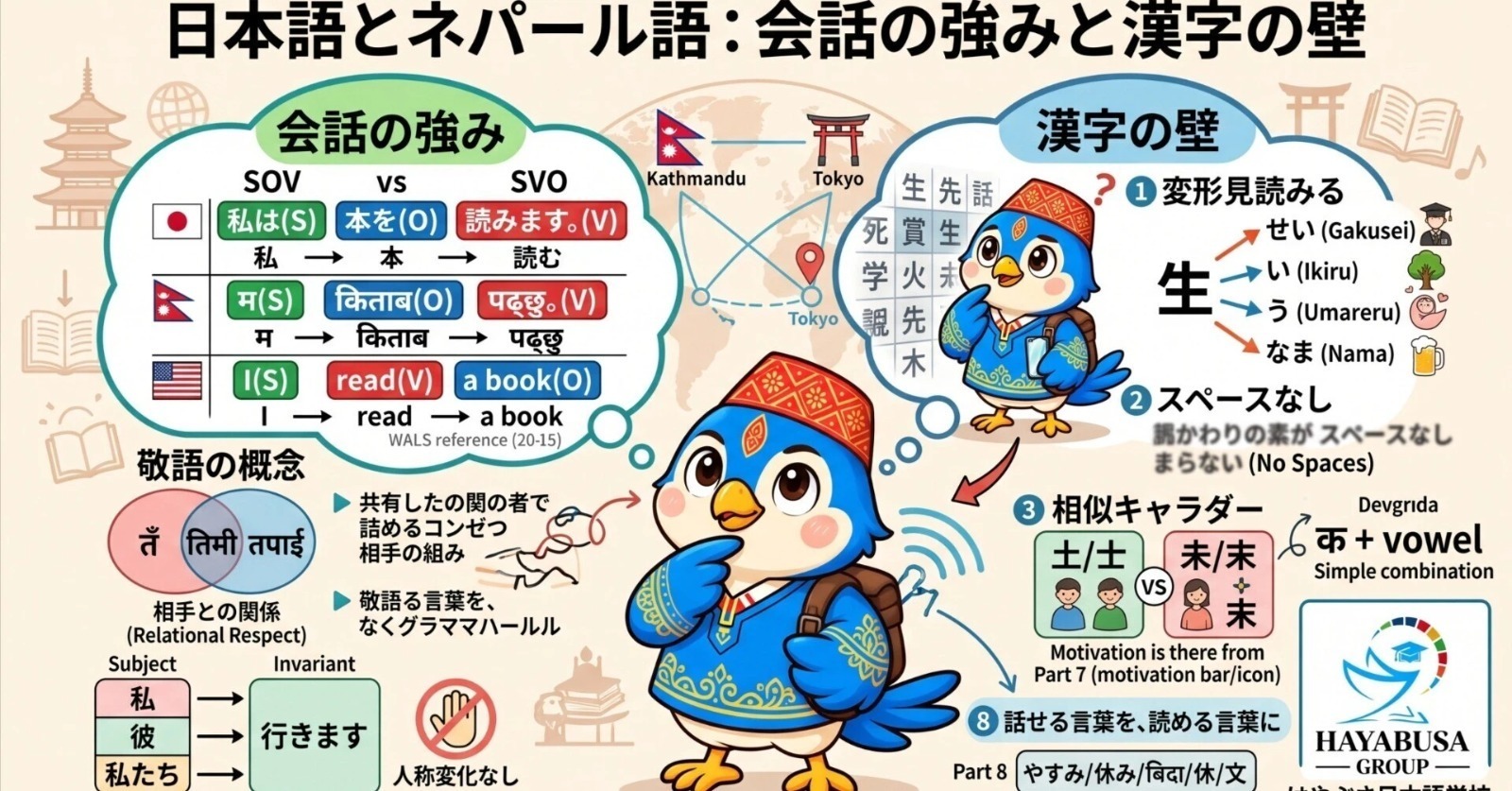
A comparison with English reveals the strengths of conversation and the barriers of kanji. If I were to express, perhaps a little dramatically, the feelings of Nepalese people learning Japanese, it might be something like this: "Teacher, I understand the word order in Japanese sentences pretty well. But this kanji...its pronunciation is different from yesterday's!"
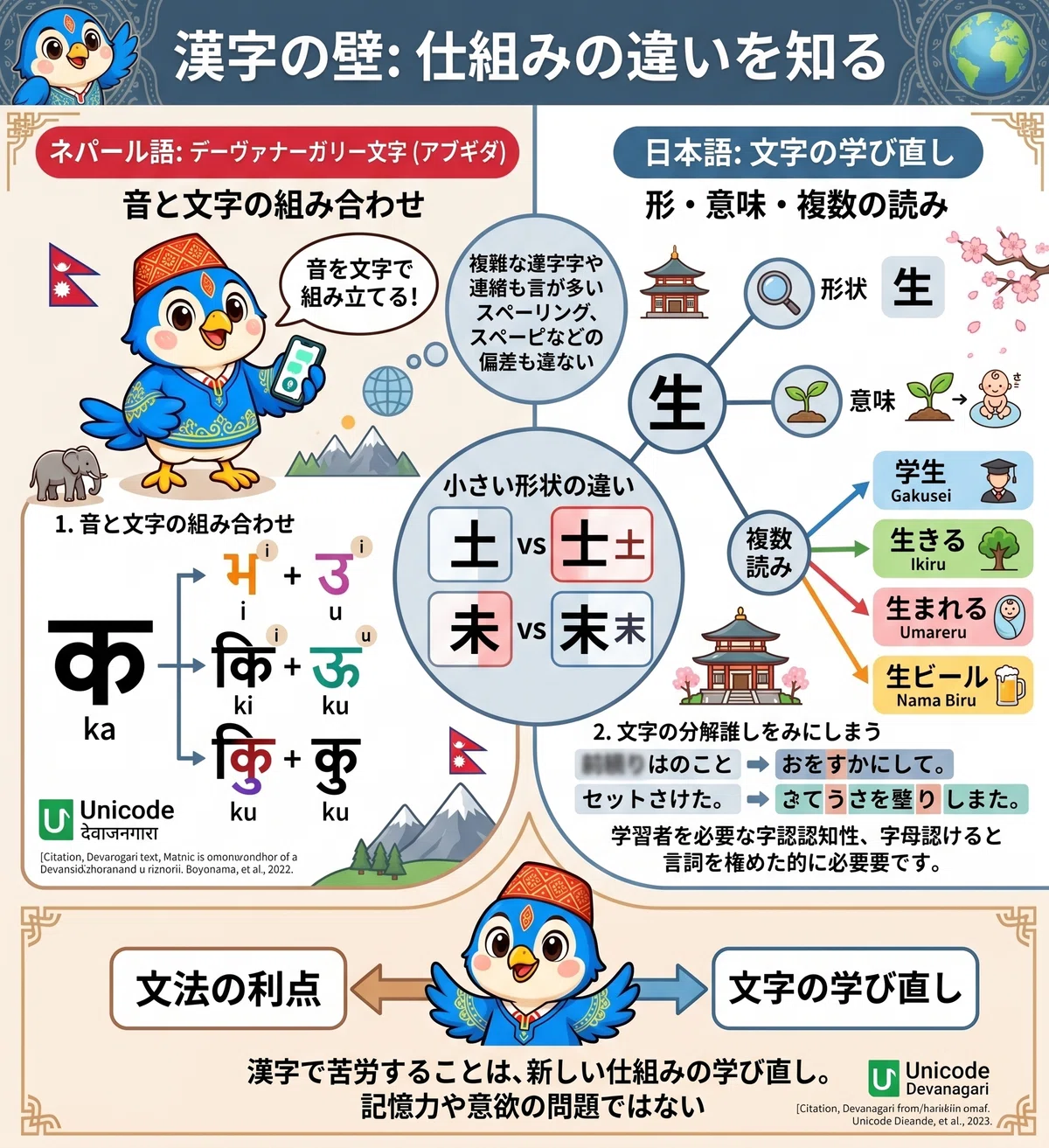
That's right. The character "生" (sei) is pronounced "sei" when referring to a student, "i" when referring to living, "u" when referring to being born, and "nama" when referring to draft beer. The same face, but the way you introduce yourself changes depending on the context. It's no wonder that learners might wish the person would introduce themselves first. For me, running the Hayabusa Japanese Language School in Nepal, a crucial educational challenge is how to simultaneously cultivate the ability to speak Japanese, read Japanese, and write kanji. The clues can be found in the Nepali language that the students already possess. Japanese and Nepali share some commonalities in sentence structure and the way they express human relationships, which can be helpful for learning. On the other hand, reading and writing kanji requires separate skills that must be developed. However, this discussion primarily focuses on "learners whose native language is Nepali or a language they use daily." In Nepal, a multilingual society, even people of the same nationality may have diverse native languages and educational backgrounds. Furthermore, none of the studies reviewed here provide a ranking of Japanese as the easiest language for Nepalis in the world. This article will consider what specific advantages Japanese has compared to English. 1. Even if the grammar is similar, the linguistic family trees are different. Let me start with something a little surprising. In terms of linguistic lineage, Nepali belongs to the Indo-Aryan branch of the Indo-European language family. English is also, broadly speaking, a member of the same Indo-European language family. On the other hand, Japanese, along with the Ryukyuan languages, constitutes the Sino-Ryukyuan language family. It has not been proven that Japanese and Nepali share a common ancestor. ( WALS classification of Nepali , explanation of Japanese language lineage by the National Institute for Japanese Language and Linguistics) "In terms of family tree structure, it's distantly related to English, but in terms of sentence structure, it gets along well with Japanese." "Genealogy," which investigates historical kinship, and "typology," which compares current grammatical structures, are two different things. Just because two words have the same word order doesn't mean they shared a common ancestor. English, too, hasn't always had the same structure as it does today. In Old English, word endings largely indicated relationships within a sentence, but much of this was lost during the Middle English period, and word order became more important. Even within the same language family, sentence structure changes over a long history. ( Explanation of English history by Open University) So, what paths have these two languages taken? Nepali has inherited vocabulary from Old Indo-Aryan languages and has also incorporated many words from Sanskrit. It is a blend of "what was inherited from our ancestors" and "what was borrowed later." ( Explanation of Nepali by Lancaster University) The history of the Nepali language is deeply intertwined with the linguistic traditions of the Kas people of western Nepal. The description of the Tentative List of World Heritage Sites submitted by the Nepalese Department of Antiquities highlights the Sinja Valley in Jumla as a place linked to the origins of the Nepali language. This area holds the history of the Kas kingdom from the 12th to 14th centuries, and 13th-century written records remain in the surrounding area. This does not mean that the language suddenly appeared in that year, but rather that it is important evidence for tracing its history. ( Description of the Sinja Valley submitted by the Nepalese Department of Antiquities)
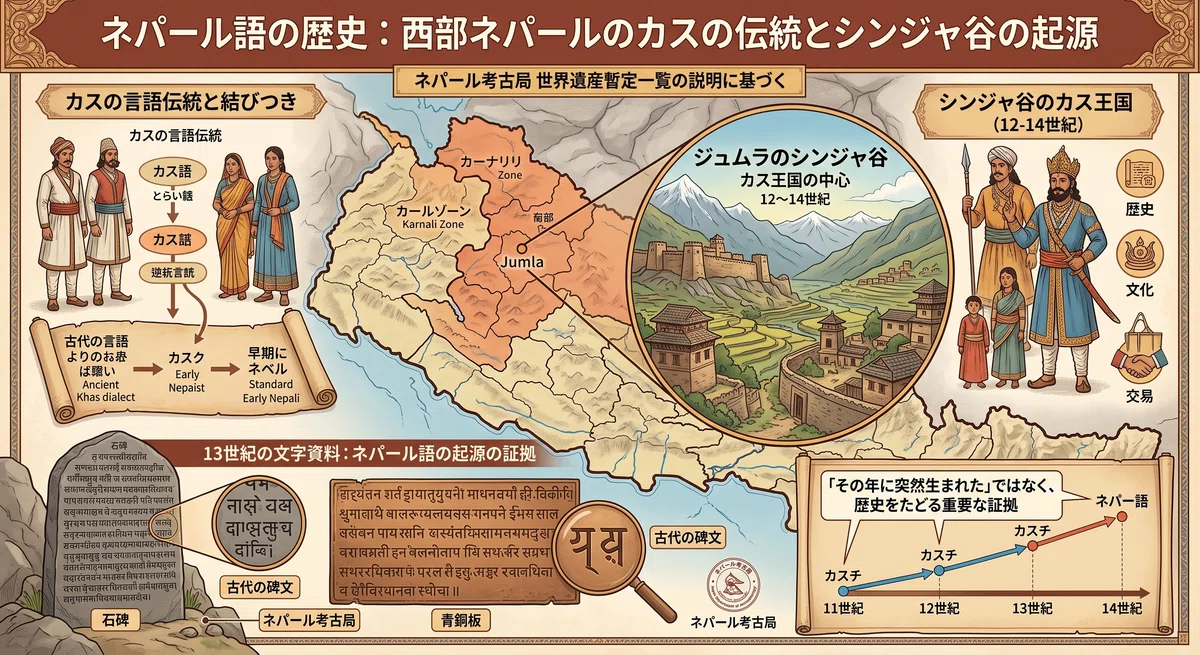
Description of the Sinja Valley submitted by the Nepal Archaeological Department
In literature, the 19th-century Nepali-language Ramayana by Bhanubhakta Acharya holds a significant place. It is a work that presented the Sanskrit narrative tradition to people as a Nepali poem. Literary endeavors existed before him, so it's not a case of "he created the Nepali language itself." ( Explanation from the Indira Gandhi National Centre for the Arts)
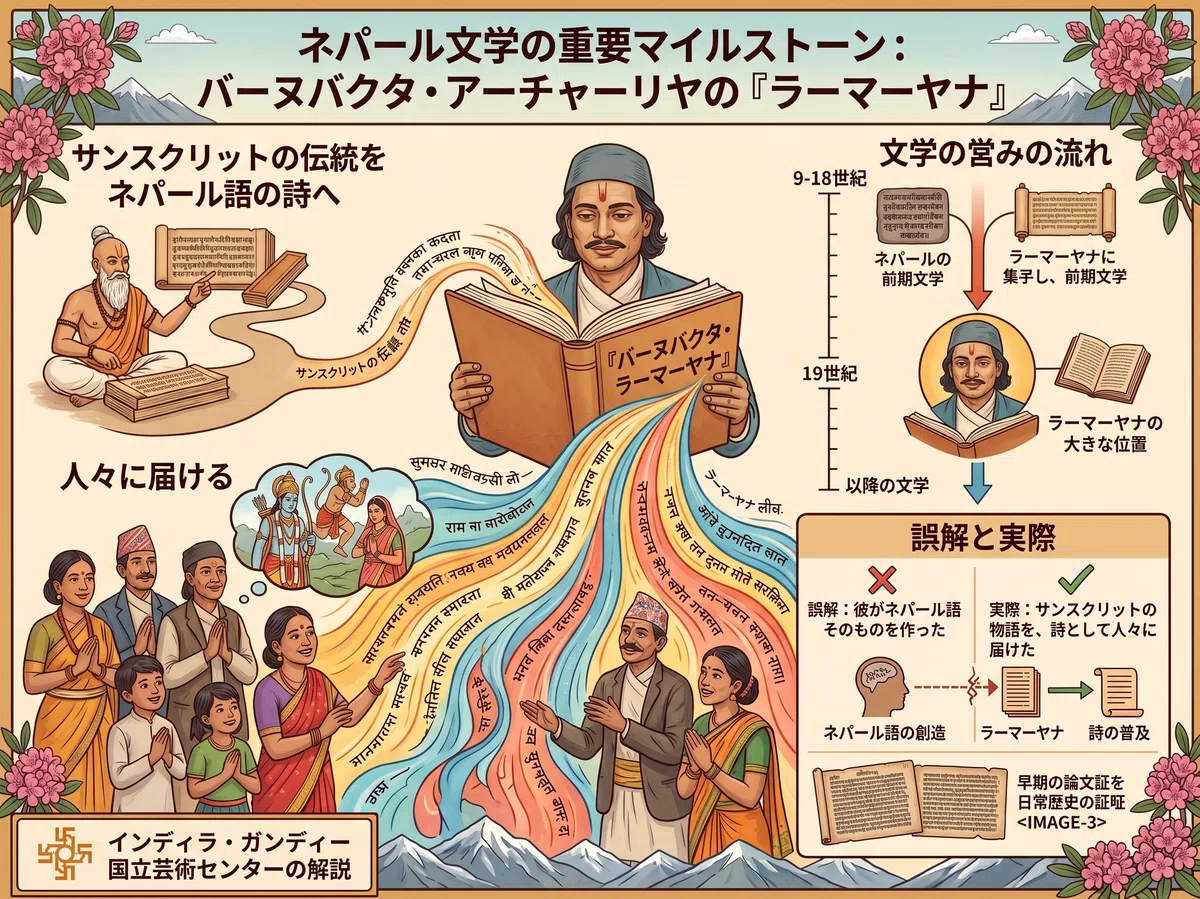
Explanation from the Indira Gandhi National Centre for the Arts
In Japanese, documents from the Nara period provide important clues to understanding the form of the language in its early stages. In the history of writing, the use of kana developed during the Heian period, progressing from the adoption of Chinese characters to Man'yōgana (a system of writing Japanese sounds using Chinese characters). The "Sanuki Kokushi Kai" (a document from 867) uses cursive kana. ( From the Tokyo National Museum Archives' guide to the history of kana) Hiragana and katakana are also characters that originated from kanji, with their forms altered and simplified. Japanese developed its own writing system while incorporating Chinese characters. ( Explanation of the Japanese writing system using Unicode) When comparing the histories of both languages, I am struck by their "ability to re-express inherited culture in their own words." However, this is a common theme found in the history of literature and expression, and not evidence that the languages are related.
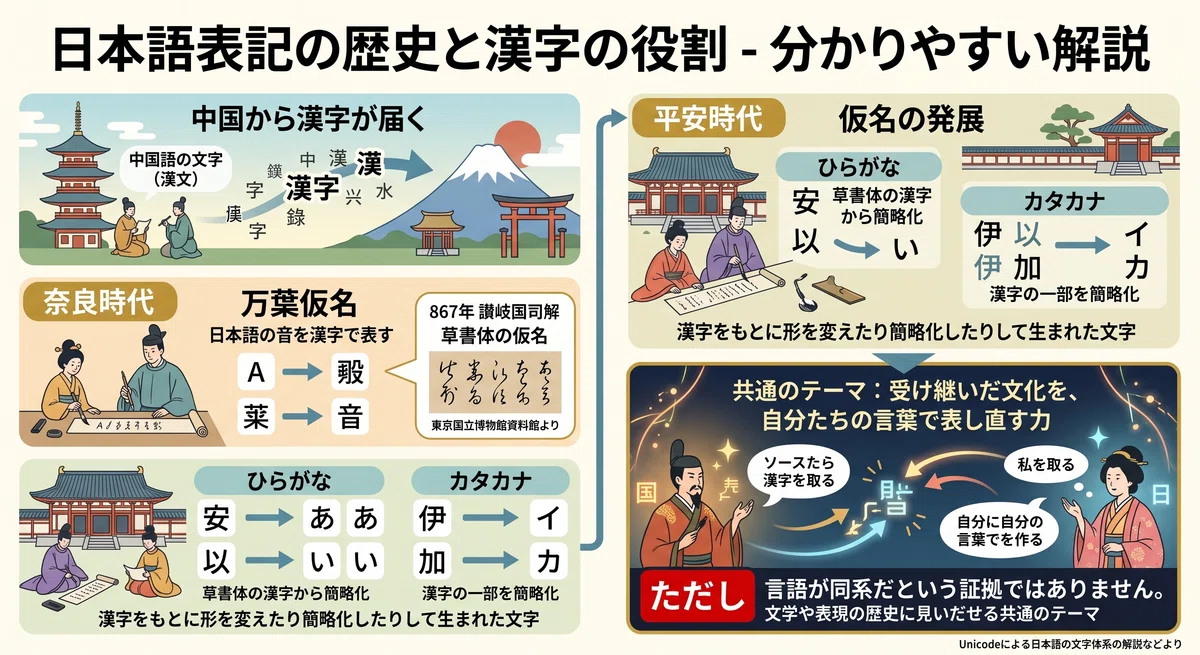
Here is an explanation of Japanese in Nepali ↓
https://www.youtube.com/watch?v=nhPnSZ3SGKshttps://www.youtube.com/watch?v=nhPnSZ3SGKs
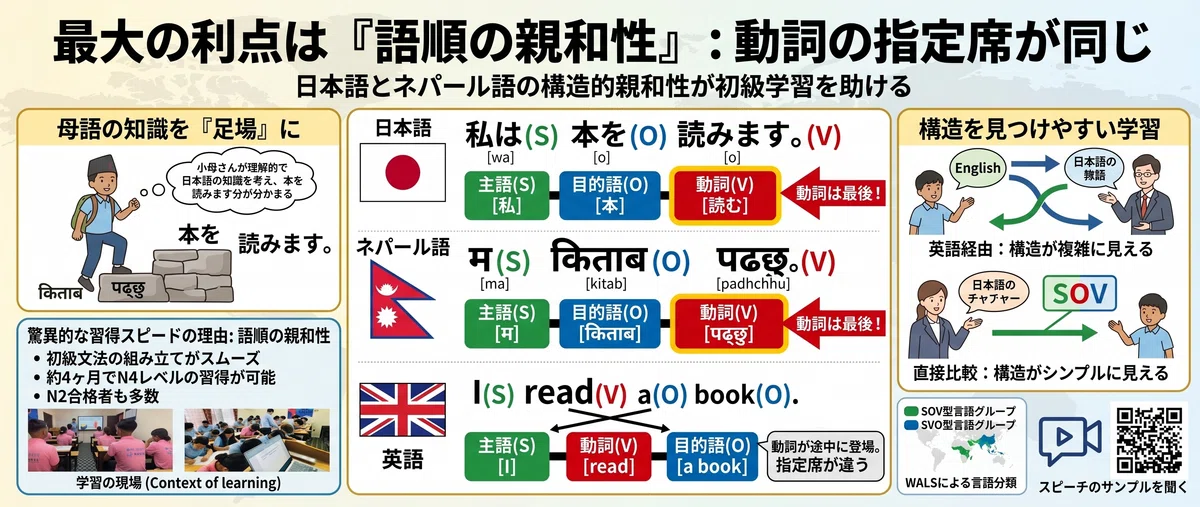
2. The biggest advantage is that the placement of verbs is familiar. First, compare the following sentences. The Romanized spelling of the Nepali words is a guide to how to pronounce them. Language example sentences General order Japanese I read a book. I → book → read Nepali म किताब पढ्छु।〈ma kitab padhchhu〉 I → book → read English I read a book. I → read → book Japanese and Nepali are basically SOV (Subject-Object-Verb) sentence structures. English is SVO (Subject-Verb-Object) sentence structure. This can also be confirmed in WALS, a classification of world language structures. [ Images of Japanese word order , Nepali word order , and English word order are shown.] When a Nepali speaker constructs this sentence in English, the verb must be placed before the object. In Japanese, they can use the order they are accustomed to in their native language as a starting point. In English, the verb appears in the middle of the sentence, but in Japanese and Nepali, it appears at the end. The verb "reserved seat" is similar in both languages. Of course, this alone doesn't prove a difference in conversational ability. Nevertheless, it does provide a reason to utilize knowledge of one's native language when constructing basic sentences. Those teaching Japanese don't need to explain everything through English. There are times when comparing directly with Nepali makes it easier to understand the structure.
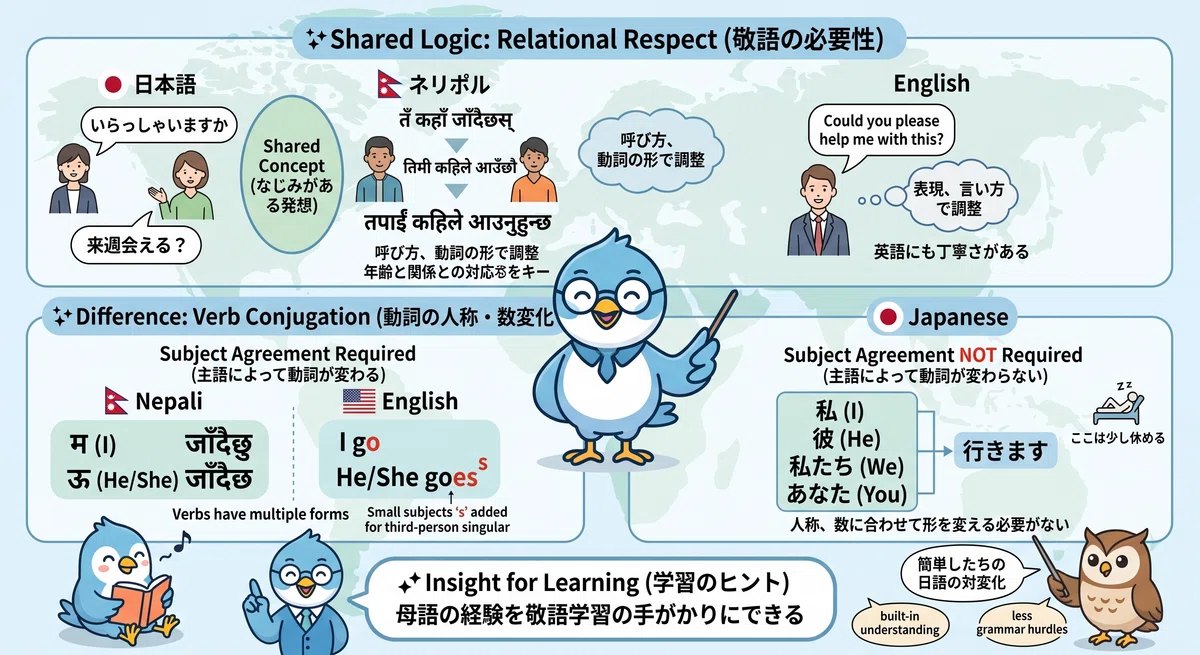
3. It's similar to the idea of placing a semantic marker after a noun. In Japanese, particles are placed after nouns, such as " in Japan ," " at school," and " with friends ." Nepali also has a system where postpositions are added after nouns to indicate their role or relationship. For example, "जापानमा" is a place expression equivalent to "in Japan/in Japan." Compared to the English "in Japan," the position of the relationship-indicating element is reversed. ( Lancaster University's study of Nepali postpositions) Japanese Nepali English In Japan / in Japan जापानमा〈Japan-ma〉 in Japan Ram's book / the book of Ram a good book राम्रो किताब〈ramro kitab〉 a good book This table also has similarities with English. In all three examples of "good book," the descriptive word comes first, and in English, "Ram's book" also puts the owner first. When making comparisons, we need to look at which aspects are similar, rather than conveniently equating Japanese and Nepali with similarities. Furthermore, it is dangerous to memorize the Nepali "मा" as having a one-to-one correspondence with the Japanese "ni". In Japanese, the particles used differ depending on whether you say " I am at school " or " I study at school ." Even if you understand the Nepali expressions for location, you need to learn this distinction separately. The idea of placing a marker on the back is familiar. However, the area covered by that marker is not the same. If you explain this carefully, you can learn to recognize the commonalities while also noticing the mistakes that can occur with direct translation. 4. Understanding the necessity of honorific language based on one's experience with one's native language. In learning Japanese, it's often said that "honorific language is difficult." Even for Nepali speakers, learning Japanese honorifics is necessary. However, the idea of "changing how you address someone or the form of verbs depending on your relationship with the person you're speaking to" is already familiar to them. Nepali has various forms of address such as "तँ," "तिमी," and "तपाईं," which are used depending on the level of familiarity, respect, and situation, and differences are also reflected in the verb forms. Actual choice depends not only on age and social standing, but also on psychological distance and emotions. ( Research on honorifics by Pathak of Tribhuvan University) Therefore, when explaining, "Change the way you speak when you're talking to your teacher compared to a close friend," you can use your native language experience as a guide. This is a great help for teachers as well, because they don't have to explain from scratch how to express respect through language. However, it's not possible to directly transfer the Japanese expressions "irassharu" and "ukagau," or the nuances of how to address one's superior to an outsider. Both Nepali and Japanese have their own unique ways of doing things. English also has its own way of showing politeness. Expressions like "Could you...?", as well as the way you address someone and your tone of voice, all contribute to this. It's not that "English lacks respect," but rather that the mechanisms for expressing respect are different. In addition, there are aspects of Japanese that can be somewhat reassuring for Nepali speakers. In Nepali, the verb form changes depending on the subject, such as "म जान्छु (I go)" and "ऊ जान्छ (he/she goes)." The fact that Nepali verbs change according to person and number is explained in grammatical studies. (See Lancaster University's grammatical overview.)
English also has the distinction between "I go" and "He goes." In Japanese, "ikimasu" (to go) does not need to change its form depending on the person or number, whether it's "I," "he," or "we."
Opening the conjugation chart, this is a place where you can think, "I can take a little break here." However, beyond that, "go, went, or not go" awaits. Even Japanese teachers don't let you rest all the time.
5. Don't explain conversational strengths solely by nationality. From these comparisons, it can be inferred that Nepali speakers possess knowledge that can be useful when constructing Japanese sentences and understanding how to speak appropriately depending on the person they are speaking to. However, we cannot conclude that "therefore, Nepalese people are better at conversation than people from other countries." Conversational ability is influenced by factors such as the length of study, the content of the lessons, opportunities to use Japanese, and the individual's interests. The rate of improvement will differ between someone who uses the same expressions daily in customer service and someone who focuses on reading comprehension. It's important to distinguish between impressions based on nationality and comparative studies conducted under controlled conditions. Furthermore, "being able to speak well" and "being able to accurately distinguish and pronounce sounds" are not the same thing. For example, "aunt/grandmother" and "come/cut." These are short differences, but their meanings change. Just because the word order is familiar doesn't mean you naturally acquire the correct length of sounds in Japanese. In education, we don't want to simply summarize someone as "good at conversation," but rather we want to assess their ability to maintain a conversation, accurately convey information, and listen. 6. The barrier of kanji becomes clear when you compare the structure of the characters. The Devanagari script used in Nepali has a system of representing sounds by combining consonants and vowels. For example, when a vowel symbol is added to "क", it becomes "कि" or "कु". This writing system is called "abugida". (Explanation of Devanagari by Unicode) Due to complex combined characters and discrepancies between spelling and actual pronunciation, it's not accurate to say that "Nepali is simply read as it's written." Nevertheless, the fundamentals lie in the combination of sounds and characters. In Japanese, when learning kanji characters, it's necessary to associate their shape with their meaning and how they are pronounced in each word. Looking at words like "student," "to live," "to be born," and "draft beer," you can see that there's a gap between learning a single letter and being able to read a word that contains that letter. Furthermore, small differences in shape, such as "土" and "士," or "未" and "末," create different characters. Since Japanese sentences are usually not separated by spaces between words, both the ability to distinguish characters and the ability to find groups of words are necessary. Even Nepali speakers who are already highly proficient in reading and writing will have to relearn a new system when learning Japanese. It's unreasonable to explain their struggles solely by a matter of memory or motivation. Native English speakers, coming from a writing system that doesn't use kanji, face similar challenges. On the other hand, learners familiar with kanji in languages like Chinese can utilize their knowledge of character shapes and some meanings. However, even they need to learn how to read and use Japanese kanji. In other words, gaining grammatical advantages and gaining writing advantages are separate things. 7. What the research revealed is that not everyone dislikes kanji. Now, let's move beyond impressions and look at actual research. A 2025 paper by Toyoji Kato analyzes a survey of 33 Nepalese students at Nagoya University of Arts, as well as the test results of 19 of them. The percentage of students who answered "I like kanji" was 93% among the 14 first-year Nepalese students and 74% among the 19 second-year students. On the other hand, the tests have reported challenges such as not being able to connect words known by sound with kanji characters, and being unable to write complex characters. Since this is a survey conducted at a single educational institution, it does not represent the proportion or causes of these issues among all Nepalese people. ( Toyoji Kato, "On Kanji Among Nepalese Learners of Japanese") This result raises an important question for teachers. Have you perhaps prematurely assumed that "the reason they can't read it is because they dislike kanji"? Even if you have a desire to learn something or think it will be useful, you might not be able to connect the dots effectively. If you know a word from conversation, that knowledge should be usable in reading and writing classes as well. What's needed, I think, is to identify what the student already knows and teach them the parts they haven't yet connected.
8. Connect words you know from conversation to kanji. From here on, I will present my educational suggestions based on the comparisons and research described above. First, in the introductory grammar section, we present Nepali and Japanese side-by-side. Our goal is to create a lesson where students realize they are not starting from scratch, but already possess usable knowledge. However, we will also place different examples immediately after similar explanations. We will include even those that cannot be directly translated from the native language, such as "I am at school/I study at school." In kanji, words used in conversation are combined with their characters, meanings, and context. Words heard in conversation, meanings in kanji and Nepali, sentences used together: yasemi-yasemi (holiday) बिदा / विश्राम Tomorrow is a holiday. kōjō (factory) कारखाना I work at the factory. zen-en-san (safety) सुरक्षा / सुरक्षित हुनु We ensure safety. In addition to repeatedly practicing writing just the two characters for "factory," we combine this with activities such as looking at pictures, saying the word aloud, reading it in sentences, and recalling it without looking at anything. We continue practicing not only reading but also writing the necessary words. As a memorization technique for learning, you can focus on the individual components, such as understanding "休" (kyū) as "a person resting beside a tree." However, it's important not to teach these memorization stories as the historical origins of the kanji characters. When evaluating students, we avoid scoring them based on a single impression of their ability to "speak," "read," and "write." Students who can converse fluently but cannot read notices need practice reading notices. Students who can read but cannot answer questions need practice interacting with others. Then, the words used in practice are those that the student wants to use. For example, a student aiming for a job might use "confirm," "prohibit," and "contact." For daily life, it might be "entrance," "exit," and "reception." The goal is for them to be able to use the kanji they've learned in their actions the next day. Kanji characters are quiet at first. But once you get to know them a little, they'll help you with anything, from signs to work documents. What I want to convey to my students is that they should cherish their native language while learning Japanese. The sentence structure and communication skills you've acquired in Nepali—these are valuable assets you can bring with you to your Japanese language class. Even on days when you feel that Japanese is difficult, I hope you'll try to find parts that are easy for you to understand. I hope you'll use that strength to gradually increase the number of words you can read. Today I was able to talk to my teacher. Tomorrow I'll be able to read one of the notices posted at work. These small steps will help me to verify things for myself and to communicate them in my own words. At Hayabusa, we want to consider Japanese language education while focusing on the abilities that each student already possesses.







 EN
EN
 JA
JA