
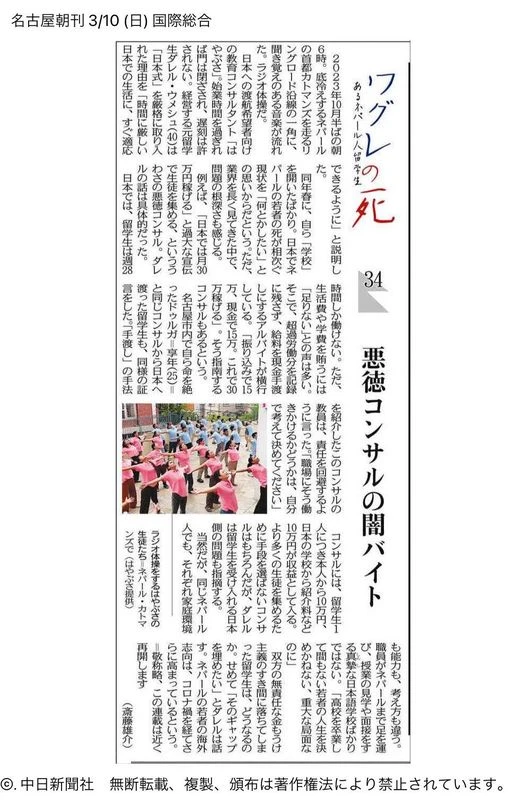
Overview The challenges and realities facing Nepalese international students in Japan have recently gained national media attention in Japan. Two major Japanese newspapers—Chunichi Shimbun and Nikkei Shimbun—featured the work of Dharel Umesh, Managing Director of Hayabusa Consultancy & Training Center in Kathmandu. The coverage highlights the dangers of predatory recruitment agencies promising unrealistic earnings in Japan, the illegal work arrangements some students fall into, and how Hayabusa is taking proactive steps to protect students. By instilling strict Japanese-style discipline (such as morning radio calisthenics) and incorporating pre-departure Career Education in partnership with the Japan International Cooperation Agency (JICA), Hayabusa ensures students travel with clear 10-year goals rather than focusing solely on short-term manual labor. Below is the full translated text content from both newspaper articles as featured in the media: Newspaper Content: Article 1 (Chunichi Shimbun — Nagoya Morning Edition, March 10) A Death in Whistle-Blowing: A Nepalese International Student (34) Shady Consultants and Dark Part-Time Jobs It is mid-October 2023, 6:00 AM. In the freezing cold morning of Kathmandu, Nepal, familiar music plays along Ring Road. It is radio calisthenics. At the educational consultancy "Hayabusa"—which caters to prospective students wishing to travel to Japan—the gates are locked tight the moment starting time arrives; no tardiness is permitted. Dharel Umesh (40), a former international student who runs the consultancy, explained that he introduced strict Japanese-style discipline into the curriculum "so that students can adapt quickly to the time-sensitive life in Japan." In the spring of the same year, Dharel had just opened a new "school." He says his motivation came from wanting to fix the current situation after seeing a succession of young Nepalese dying in Japan. Having observed the industry for a long time, he senses the deep roots of the issue. For example, there are shady consultants who lure students with false, exaggerated advertisements like: "You can earn 300,000 yen a month in Japan." Durga Prasad Bhattarai (25), who tragically took his own life in Nagoya City, went to Japan through the same consultancy as Dharel's former student. Nepalese students who went through the same agency gave similar testimony: the consultancy used cash-in-hand payment tricks to bypass regulations. In Japan, international students are only permitted to work up to 28 hours per week. However, many voice that this is not enough to cover living expenses and tuition fees. As a result, off-the-books part-time jobs—where excessive work goes unrecorded and wages are handed over in cash—are rampant. "You get 50,000 yen via bank transfer, and another 150,000 yen in cash. That’s how you end up earning 200,000 yen," points out Dharel, noting that some consultants actively advise students to work this way. Regarding the consultant who introduced this arrangement, a teacher shirked responsibility, saying: "Whether you work like that at your job is up to you to decide." Consultancies receive around 100,000 yen from the student and another 100,000 yen as an introduction fee from Japanese language schools for every student they send. To gather as many students as possible, unscrupulous consultants resort to any means necessary. However, Dharel also points out that the Japanese side—which accepts these students—shares the blame. Of course, even among students from the same country of Nepal, their family backgrounds, abilities, and mindsets vary. There are earnest Japanese language schools that travel to Nepal for interviews and class observations, but many do not. "These young people have just graduated high school and are at a crucial juncture in deciding their lives—why won't people care more?" What will become of international students caught in the cracks of this mutual irresponsibility and greed? "I want to at least bridge that gap," says Dharel. He notes that the desire among young Nepalese to go abroad has grown even stronger following the COVID-19 pandemic. (Honorifics omitted. This series will resume soon.) — Reported by Yusuke Saito Newspaper Content: Article 2 (Nikkei Shimbun — September 3, 2024)
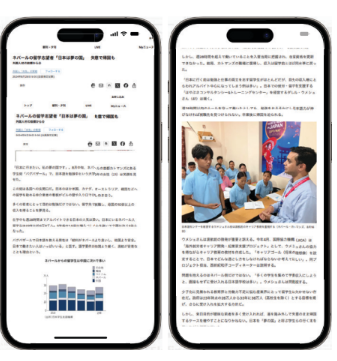 Nepalese Prospective Students: "Japan is a Land of Dreams" — But Some Fail and Return Home
Introduction:
An interview with a 20-year-old woman studying Japanese at a school in Kathmandu, the capital of Nepal. She expressed a strong desire to go to Japan, calling it her "dream country."
Background:
In Nepal, where domestic employment opportunities are limited, young people are increasingly looking overseas for education and work—to countries like Japan, South Korea, Canada, and Australia. For many families, sending a child abroad brings income that significantly exceeds average local earnings.
The Reality & Challenges:
Although Japan allows international students to work part-time up to 28 hours per week, some students end up prioritizing work over their studies due to debt or financial pressures. Consequently, some fail to renew their student visas and are forced to return to Nepal.
Dharel Umesh’s Role & JICA Project:
Dharel Umesh, head of "Hayabusa Consultancy & Training Center," points out that many students aim for Japan without a clear plan, leading to a focus solely on earning money through part-time work.
To address this, in April 2024, his center collaborated with the Japan International Cooperation Agency (JICA) under a pilot project to introduce Career Education into the curriculum. This helps students set long-term career goals and understand what skills they need to develop before going to Japan.
Issues with Unscrupulous Agencies and Schools:
Dharel Umesh also highlights systemic problems: predatory agencies in Nepal that send unprepared students for profit, and Japanese language schools that accept students without proper screening or interviews.
(Caption: Dharel Umesh providing career guidance to students at the Japanese language center in Kathmandu, Nepal.)
Nepalese Prospective Students: "Japan is a Land of Dreams" — But Some Fail and Return Home
Introduction:
An interview with a 20-year-old woman studying Japanese at a school in Kathmandu, the capital of Nepal. She expressed a strong desire to go to Japan, calling it her "dream country."
Background:
In Nepal, where domestic employment opportunities are limited, young people are increasingly looking overseas for education and work—to countries like Japan, South Korea, Canada, and Australia. For many families, sending a child abroad brings income that significantly exceeds average local earnings.
The Reality & Challenges:
Although Japan allows international students to work part-time up to 28 hours per week, some students end up prioritizing work over their studies due to debt or financial pressures. Consequently, some fail to renew their student visas and are forced to return to Nepal.
Dharel Umesh’s Role & JICA Project:
Dharel Umesh, head of "Hayabusa Consultancy & Training Center," points out that many students aim for Japan without a clear plan, leading to a focus solely on earning money through part-time work.
To address this, in April 2024, his center collaborated with the Japan International Cooperation Agency (JICA) under a pilot project to introduce Career Education into the curriculum. This helps students set long-term career goals and understand what skills they need to develop before going to Japan.
Issues with Unscrupulous Agencies and Schools:
Dharel Umesh also highlights systemic problems: predatory agencies in Nepal that send unprepared students for profit, and Japanese language schools that accept students without proper screening or interviews.
(Caption: Dharel Umesh providing career guidance to students at the Japanese language center in Kathmandu, Nepal.)







 EN
EN
 JA
JA