
"We can no longer gather Vietnamese people, so we came to Nepal to inspect the country we'll be visiting next."
I hear this phrase from presidents and executives of Japanese companies almost every week these days.
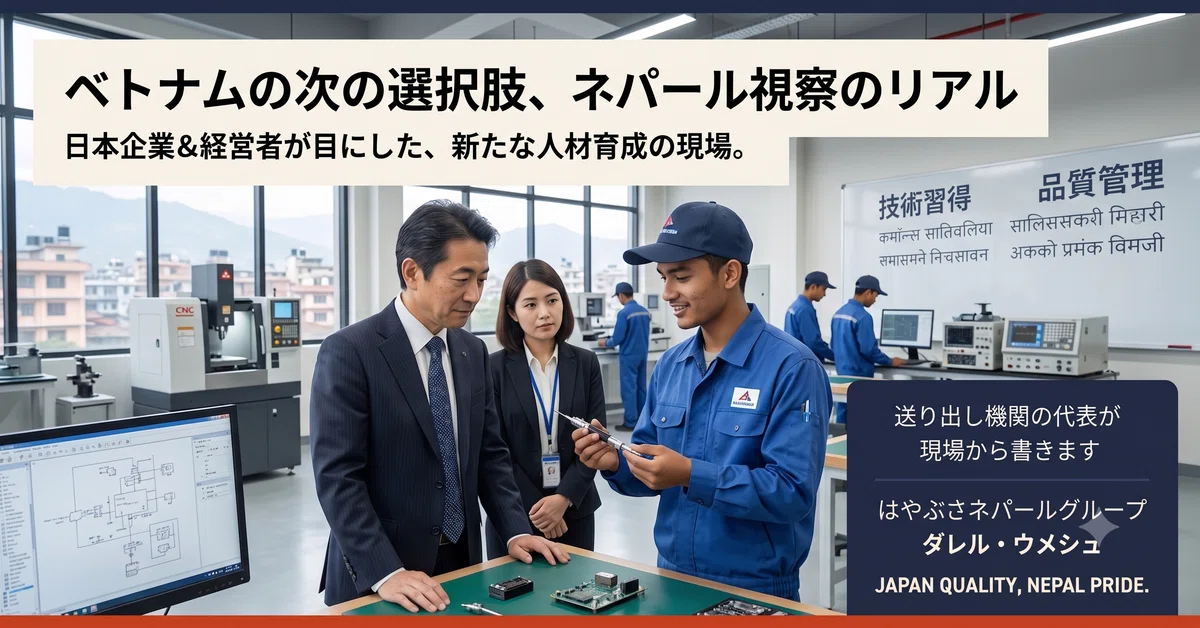
What are some of the most frequently asked questions during Nepal inspection tours?
"Which country will be next after Vietnam?"
This is the most frequently asked question I've received over the past year, from supervising organizations, HR personnel at receiving companies, and registered support organizations.
I'll write the answer first.
Over the next 10 years, Nepal has great potential as a country that "cultivates while harvesting for a long period."
However, I would like to add one more point.
"Just saying 'any Nepalese person will do' is absolutely unacceptable ." That's obvious, isn't it?
Hiring based solely on nationality will inevitably lead to mismatches. This is true whether you're from Vietnam, Indonesia, or Nepal.
I'm someone who wants companies to hire Nepalese people. Even so, I say this because I know what companies that fail due to sloppy hiring decisions will say next: "Nepalese people didn't work." That one sentence narrows the path for those who have diligently prepared. That's what I fear most.
I came to Japan in 2004 and studied at a Japanese language school, university, and vocational school. I have worked at the Sheraton Grande Tokyo Bay, a Japanese language school, and in the human resources industry. Currently, I run seven Japanese language schools and a sending agency in Kathmandu. I wake up at 4 a.m. every morning to lead radio calisthenics at 5:50 a.m. and teach Japanese language classes starting at 6 a.m.
I will write about both the good stories and the unpleasant truths, drawing on my experiences living in Japan for 20 years and observing young people every day in classrooms in Nepal.
1. First, confirm your current location using numbers.
The number of foreign residents in Japan at the end of 2025 is projected to reach a record high of 4,125,395. Of these, 300,992 are Nepalese nationals , an increase of 67,949 from the previous year , placing Nepalese in fifth place by nationality/region (Immigration Services Agency, end of 2025).
According to reports from the Ministry of Health, Labour and Welfare, as of the end of October 2025, there will be 2,571,037 foreign workers and 371,215 businesses accepting them . Both figures are record highs.
Here's one thing I'd like to caution practitioners about.
"Number of foreign residents" and "number of foreign workers" are separate statistics.
The number of residents includes both international students and their families. Not all 300,000 Nepalese are "ready to work." If a business approaches you saying, "It's a market of 300,000 people," without making this distinction, you should be a little suspicious.
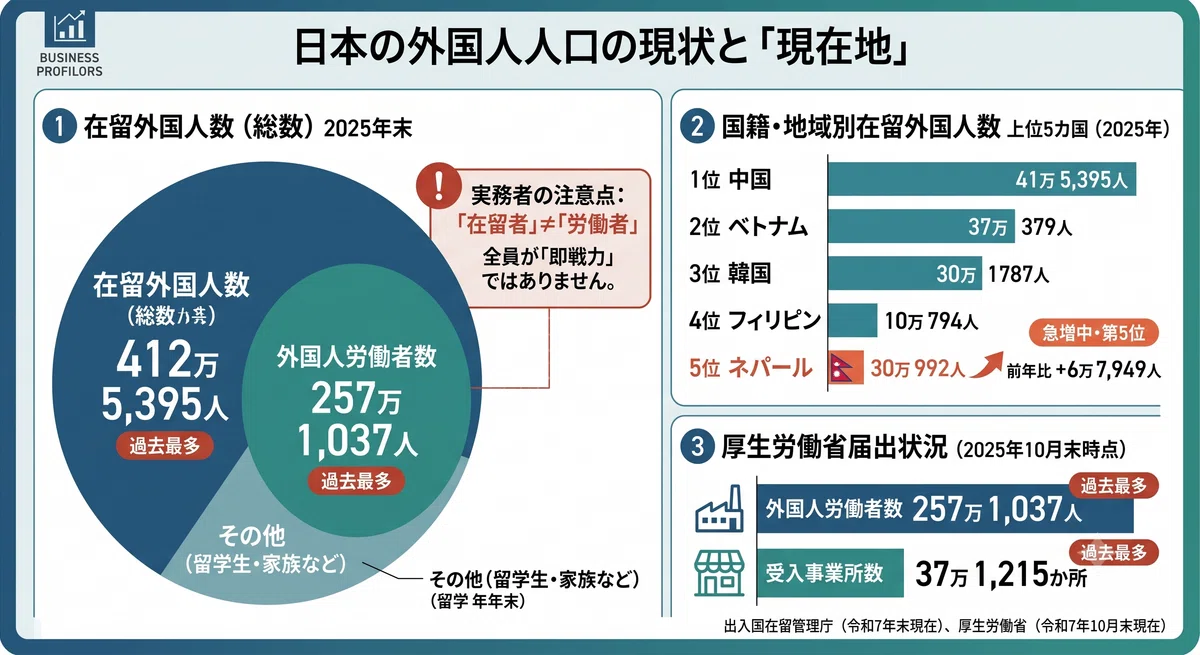
Current status of the foreign population in Japan
2 | It's not about "giving up Vietnam," but rather "giving up relying on only one leg."
Let me clarify to avoid any misunderstandings. It's not that Vietnamese talent has become incompetent.
Vietnam is a long-standing pioneer in supporting Japan's manufacturing, construction, nursing care, food, and restaurant industries. Their foundation in education for the Japanese market, as well as their experience in sending workers abroad, are far more extensive than ours.
What has changed is that young Vietnamese people are less likely to choose Japan.
The reasons are obvious to everyone. When viewed as a destination for migrant workers, Japan is no longer as attractive as it once was. Wages are rising in their home countries. Competition for workers is intensifying with South Korea, Taiwan, and Germany. Even within Japan, companies are competing with each other for the same candidates. The desired conditions of young people are changing.
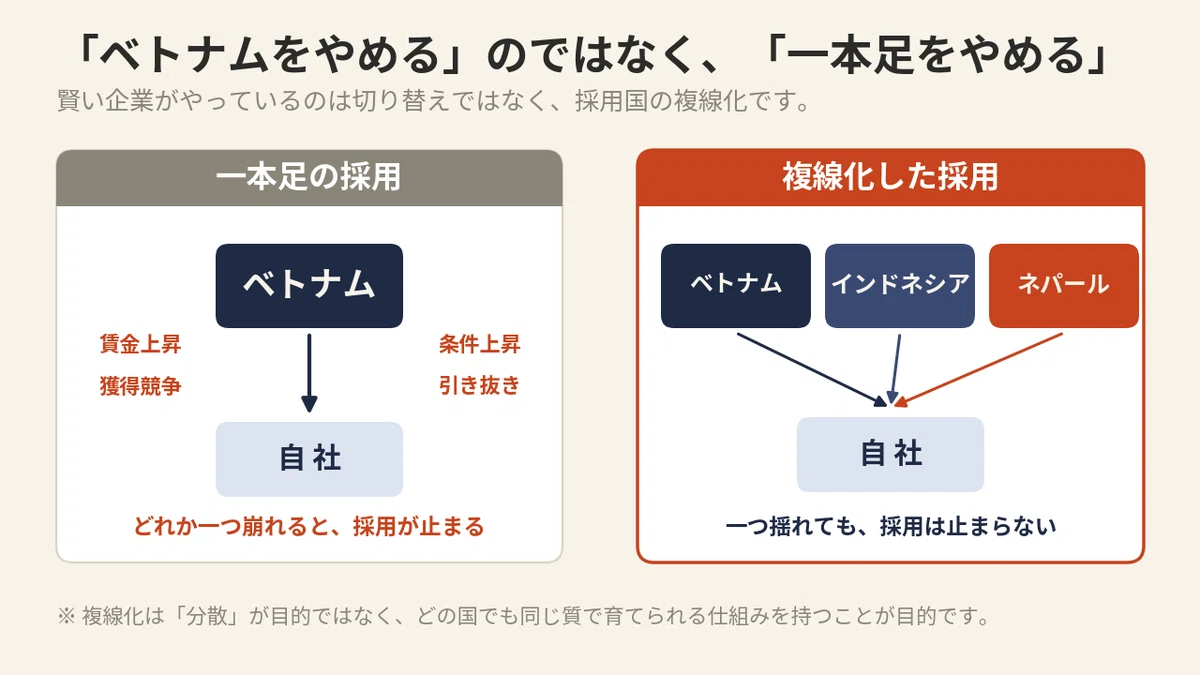
Let's consider country risk!
Therefore, successful companies today are not "giving up on Vietnam," but rather diversifying their hiring countries . They keep Vietnam as their core focus, while adding a second and third pillar.
Certainly, harvesting everything in the same country makes management easier and saves initial effort. However, this arrangement is limited by the relationship between the two countries and the circumstances of the other country. A stable supply cannot be maintained without establishing connections with at least two or three other countries.
💡The purpose of diversifying our production lines is not "decentralization." It's about having a system in place that allows us to cultivate crops of the same quality regardless of which country they're sourced from.
Companies that can do this will honestly succeed no matter which country they recruit from. Companies that can't do this will repeat the same mistakes no matter which country they go to.
3 | In a country with a population of 29 million, 800,000 work permits are processed annually.
Nepal's population was approximately 29.15 million according to the 2021 census. Compared to India and Indonesia, it is a small country.
However, the scale of overseas employment is on a completely different level.
According to the Nepalese government's "Nepal Labour Migration Report 2024," there were 741,297 overseas work permits issued in the 2023/24 fiscal year, including both new and renewal permits . The Foreign Employment Bureau's annual statistics show this number is projected to increase to 839,270 in the 2024/25 fiscal year . Remittances from overseas account for approximately one-quarter of GDP (World Bank).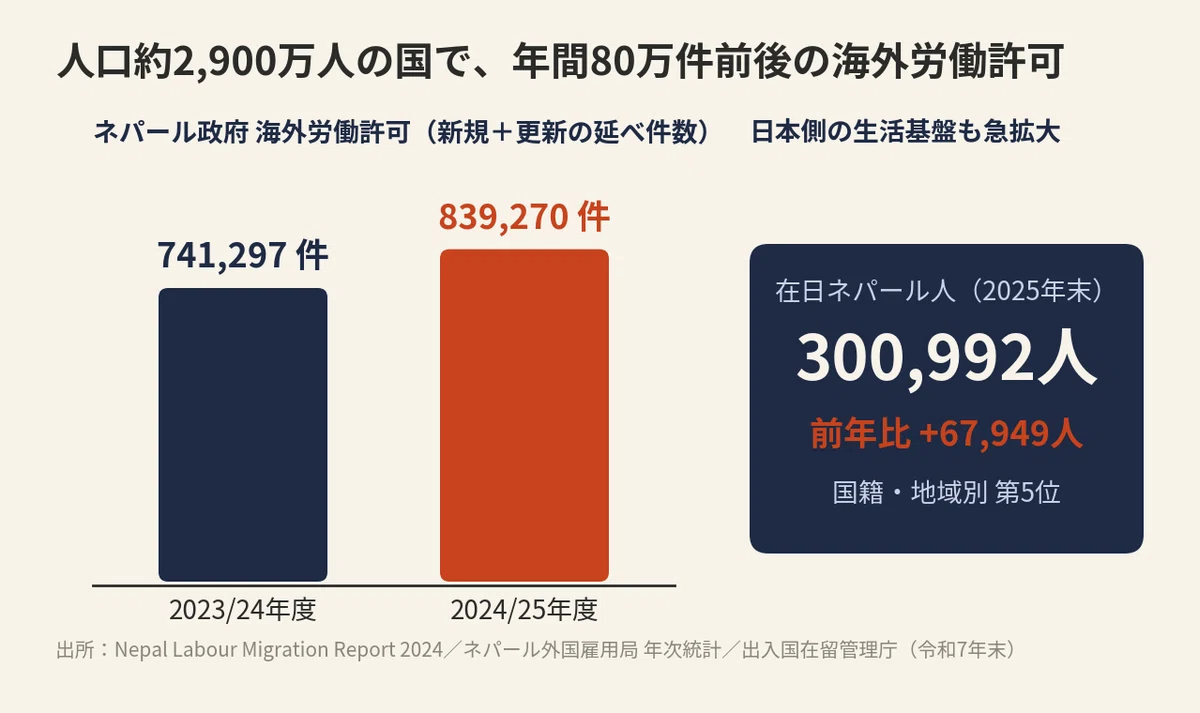
Approximately 800,000 Nepalese people obtain overseas work permits each year.
This figure does not mean that 800,000 people leave the country every year. It is the total number of entries, including renewals and re-entries. Travel to India, which can be done without a passport, and studying abroad are hardly included in this statistic.
Even so, in a country with a population of 29 million, around 800,000 people travel abroad annually. This is highly significant.
In Nepal, working abroad isn't a special adventure; it's a normal option. Someone in your family, a relative, or a neighbor is almost certainly working in one of the Gulf countries, Malaysia, South Korea, or Japan. Therefore, the psychological hurdle to deciding to "work abroad" is inherently low.
And in recent years, a clear change has occurred.
Parents who witnessed the harsh realities in the Gulf countries began telling their children to "go to Japan."
In our classroom, it's not uncommon to hear students say, "My father had a tough time in Qatar, so he told me to choose Japan." If you only compare salaries, there are countries where you can earn more than in Japan. Even so, the reasons for choosing Japan are safety, the opportunity to work long-term, and the chance to acquire skills .
💡Currently , Japan is the country that young Nepalese people are "chosen" by. Companies that create the right recruitment models while this trend is still favorable will not have any labor shortages in 10 years.
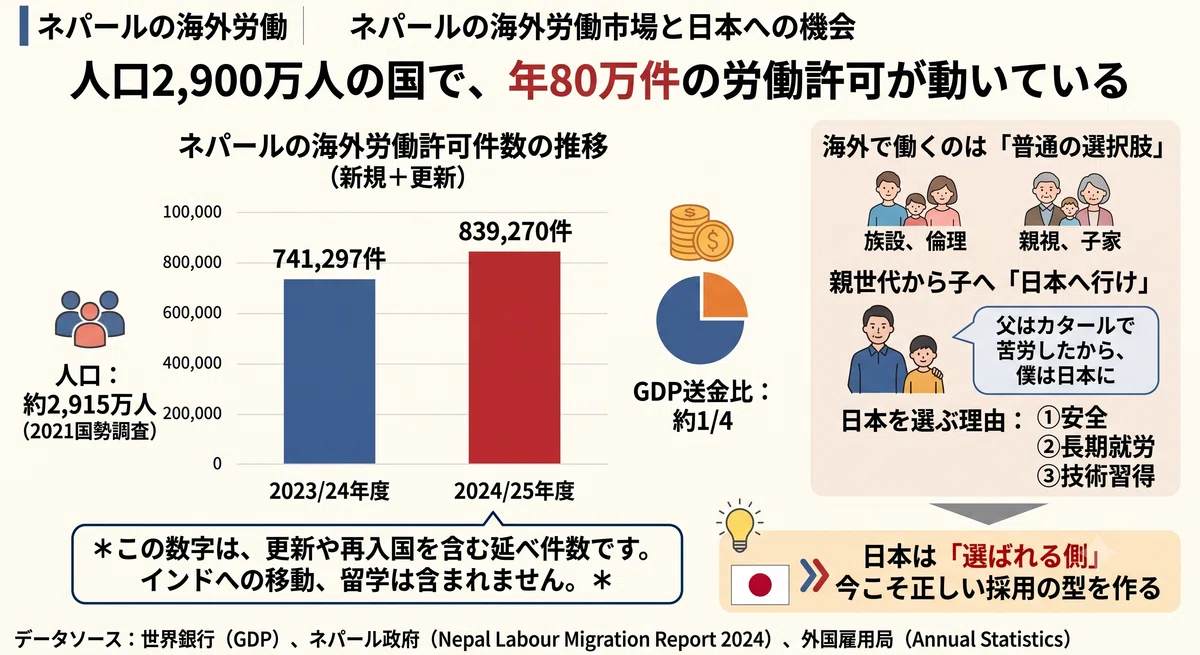
Pearl is a country that relies on overseas remittances (sending money abroad) for 30% of its GDP.
4 | What are the strengths of Nepalese talent? A perspective from the field.
Many articles list the advantages of hiring Nepalese people: they are family-oriented, hardworking, tolerant of multiculturalism, and quick to learn Japanese. All of these points are correct.
However, simply listing only the positive aspects won't earn you trust. We add "on-site annotations" to each point. Skipping these will lead to surprises after hiring.
"I won't quit because I care about my family" → That's half true.
They come here to support their families. That's why they're very serious about their work and won't quit easily. That's a fact.
But the opposite can also happen. If something happens to a family member, returning home will take priority over work. If family members object, even after receiving a job offer, one's resolve may waver.
That's why, before hiring, we explain the job details, contract period, salary and deductions, and return-to-home-country conditions not only to the applicant but also to their family . Students whose families are convinced are much more resilient once they arrive in Japan.
"They learn Japanese quickly" → The word order is the same. But it's not magic.
Japanese: I eat rice.
Nepali: म खाना खान्छु। (Ma Kana Kanchu)
Both follow the "subject → object → verb" structure. The word order hurdle that English speakers often encounter is absent in Nepalese. The vowel structure is also similar to Japanese, and it's true that many students speak easy-to-understand Japanese.
However, characters, kanji, and honorifics are all different things. Simply having the same word order won't improve conversational ability. A sufficient amount of class time, conversation practice, and the student's own determination to continue— only when these three things are present does "rapid learning" become a reality.
Being "cheerful and friendly" is not the same as being able to provide good customer service.
Young people in Nepal truly love to gather together, sing, dance, and celebrate. This cheerful spirit is certainly an asset in caregiving, food service, and hospitality settings.
But let me be clear: "Being cheerful" does not equal "Being good at customer service." Standard phrases, understanding customer boundaries, and reporting methods—these things only become valuable skills after training.
"They are accustomed to multiculturalism" → That's true. However, consideration is also required from the company side.
Nepal is a multi-ethnic country inhabited by approximately 130 ethnic groups, with about 80% being Hindu. Buddhism, Islam, and Christianity also coexist. Growing up surrounded by differences makes it easier to adapt to Japanese workplaces.
On the other hand, there are four things that companies should be aware of.
I don't eat beef. In Hinduism, cows are sacred animals. This will help avoid any awkward situations at barbecues during welcome parties. However, there are a certain number of people who start eating beef after coming to Japan.
There is a custom juto of avoiding food that others have taken a bite of. Sharing food from a hot pot or drinking from the same cup is easier for everyone if they are aware of this custom.
The left hand is considered unclean . The right hand is the standard for passing objects.
They are surprisingly proud. They strongly resist being reprimanded in front of others or being asked to apologize without explanation. If you're going to reprimand them, do it one-on-one and stick to the facts. This is probably true for young Japanese people as well, but for foreigners, it can lead to them quitting.
Don't overthink it. This is a problem that can be avoided 90% of the time if you simply ask about it once before hiring.
CONTINUE READING- https://note.com/umechyansensei/n/n871eef15a18f
I don't eat beef. In Hinduism, cows are sacred animals. This will help avoid any awkward situations at barbecues during welcome parties. However, there are a certain number of people who start eating beef after coming to Japan.
There is a custom juto of avoiding food that others have taken a bite of. Sharing food from a hot pot or drinking from the same cup is easier for everyone if they are aware of this custom.
The left hand is considered unclean . The right hand is the standard for passing objects.
They are surprisingly proud. They strongly resist being reprimanded in front of others or being asked to apologize without explanation. If you're going to reprimand them, do it one-on-one and stick to the facts. This is probably true for young Japanese people as well, but for foreigners, it can lead to them quitting.
Don't overthink it. This is a problem that can be avoided 90% of the time if you simply ask about it once before hiring.
CONTINUE READING- https://note.com/umechyansensei/n/n871eef15a18f







 EN
EN
 JA
JA