
"They quit," "They don't understand basic manners"...
To all HR managers, business owners, cooperatives, and registered support organizations in Japan.
Hello. My name is Darrell Umesh, and I am the representative of HAYABUSA Group Nepal, a specialized education and sending organization for Japanese people , located in Kathmandu, Nepal.
I came to Japan as an international student in 2004, and after graduating from a Japanese university, I spent about 20 years on the front lines, working at the Sheraton Grande Tokyo Bay Hotel, in sales at a Japanese language school, in the Japanese human resources industry (Outsourcing Co., Ltd.), and at the International Human Resources Exchange Support Organization (IHNO).
Today, I don't intend to just use nice words. I would like to speak frankly about the "real pain" that you all face every day in the field of hiring foreigners, and the "gritty daily student guidance" that we practice in Nepal.
Why did I leave Japan and build a school in Nepal?
To be honest, my life in Japan was comfortable. I had a 20-year career, I had passed the N1 level of the Japanese Language Proficiency Test, and I had no trouble with Japanese or my work. On my days off, I would drive my car on paved roads, breathing in clean air free of dust, and I was living a very comfortable and enjoyable life. I could have stayed in Japan.
However, while working in the human resources industry, I witnessed a certain reality every day.
Young Nepalese people who had worked hard dreaming of coming to Japan would enter the country without understanding the Japanese language, Japanese culture, or the "work mindset in Japan," and would fail to adapt to Japanese society, experiencing setbacks one after another. Company representatives would suffer from burnout on the ground, students would give up on their dreams, and no one would be happy.
"I'm the only one who can solve this problem, as I know both sides of the situation."
That's why I decided to return to Nepal, knowing the risks involved, and establish a school. In 2022, I opened Hayabusa Japanese Language School.
I will honestly talk about the "failures" we experienced in our first year of operation.
Shortly after starting the school, I experienced a major failure.
A student I sent to a company quit after only a few months. The reason wasn't the student's ability; it was my own lax teaching.
I had the misconception that "as long as they can speak Japanese, everything will be fine." What the actual Japanese workplace demands is not just language skills, but the accumulation of "basic" things like punctuality, reporting, greeting others, and practicing 5S.
This failure became the catalyst for creating Hayabusa's current boarding school system, which is sometimes described as "too strict."
The true nature of the "invisible costs" that trouble HR managers
When I was working in the Japanese human resources industry, I heard many heartbreaking stories from HR managers.
The biggest challenge in hiring foreign nationals is not the referral fee. It's the enormous, invisible cost of having to re-teach them manners from scratch after they've been assigned to their positions—in other words, the exhaustion of the staff on the ground.
Woke up at 5:30 AM. Nepal's most "gritty and tough" boarding school.
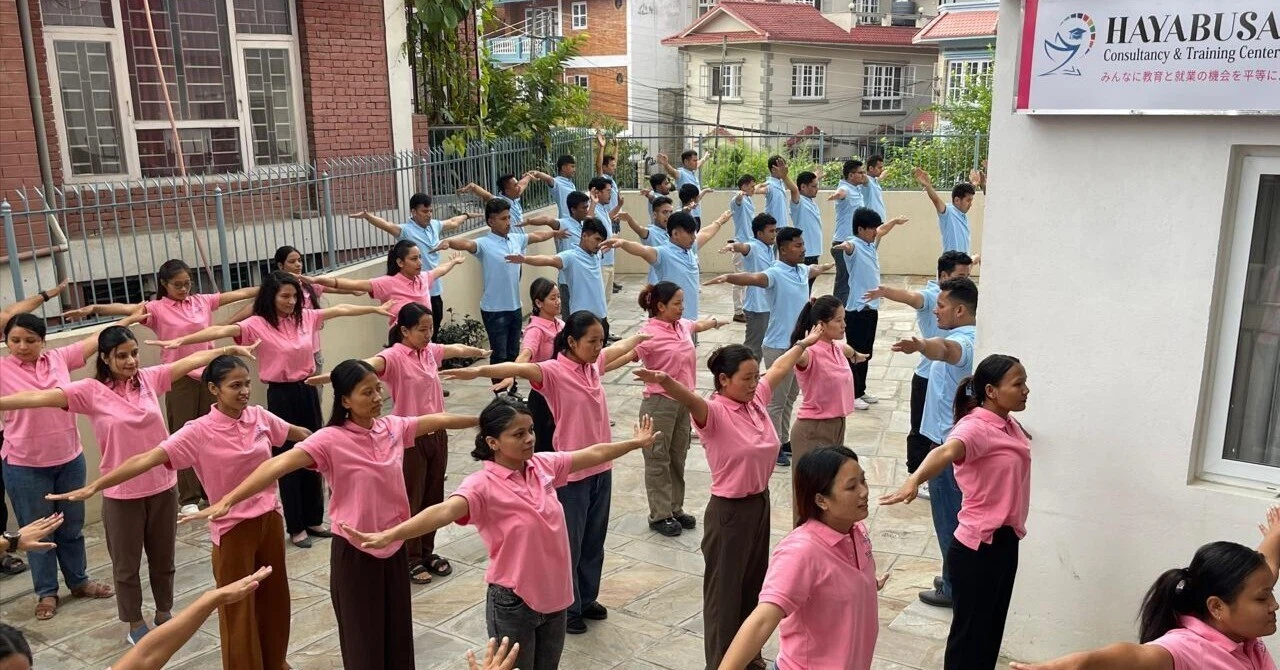
Hayabusa Japanese Language School is said to be the school with the strictest discipline in Nepal.
We are not a smart school that only teaches language. We are a 24-hour boarding school where daily life itself is considered "training."
This is by no means a glamorous education. It's a gritty process of repeating the same things day after day, ingraining Japanese lifestyle habits into their "unconscious level."
However, I am convinced that this repetitive practice is the only way to earn the praise of employers in Japan who say, "We're glad we hired them."
Before focusing on "not quitting," ensure "accurate" hiring practices. Thorough screening of admissions is also essential!
The biggest reason for early resignation is not a lack of ability, but the discrepancy between the "expectations" before coming abroad and the "reality" of the workplace.
We never hide the harsh realities of the Japanese workplace. For caregiving positions, we make sure to clearly communicate the difficulties of night shifts and the realities of assisting with toileting beforehand.
• Only students who meet the requirements for class participation and academic performance over two weeks can enroll in Hayabusa!
• Counseling in the student's native language (Nepali) is provided – continuing mental care.
• A career development program in collaboration with JICA (Japan International Cooperation Agency) is implemented.
• Students are encouraged to thoroughly consider "why they want to go to Japan" and "what they want to be in 5 years" before departure.
By encouraging young people to view their work in Japan not merely as "migrant work," but as part of their own "career," we cultivate a strong mindset that prevents illegal absconding and early resignation.
Don't run away from the responsibility of raising children and the responsibility of sending them off.
Typically, Japanese language schools and sending organizations are separate legal entities, which can lead to ambiguity regarding responsibility when problems arise.
The Hayabusa Group is a comprehensive, end-to-end organization specializing in Japan, combining the functions of both an "educational institution" and a "sending organization" within its own group. We monitor students' true personalities and learning attitudes from the moment they enroll, creating a system that ensures continuous information flow (no information gap). This allows us to carefully
select and recommend only those candidates who truly match your company culture, and to provide unwavering support from arrival in Japan to their eventual settlement, without abandoning our responsibilities.
Track record and trust
• Number of enrolled students: Over 936 at all times
• Group schools: 5 in Kathmandu city and 2 in other regions (7 schools in total)
• Partner Japanese language schools: Over 95
• Partner Japanese companies: Over 80
• Media coverage: Featured in the Nikkei Shimbun (September 2024) and the Chunichi Shimbun (March 2024)
"We received reports from the field that their greetings were more thorough than those of our Japanese staff during the first week."
— A testimonial from a company that has adopted our product.
To all cooperatives and registered support organizations
We are actively collaborating with cooperatives and registered support organizations. Let us work together to build a system that ensures "settling in" the workplace, including follow-up after dispatch. We are not an organization that "sends people out and then forgets."
lastly
We are not merely a "sending agency," but rather an "education outsourcing partner" that completes the education that your company would otherwise have to bear, before departure, at a low cost.
Let us help support your company's future alongside young people who understand JAPAN QUALITY, hold NEPAL PRIDE in their hearts, and continue to take on challenges with grit and determination.







 EN
EN
 JA
JA